Netflix’s Monster series is one of the streamer’s most popular shows. It began with a dramatisation depicting the life and disturbing acts of serial killer Jeffrey Dahmer, and continued with a season about Lyle and Erik Menendez. The latest entry focuses on Ed Gein, one of the most notable killers in American history.
If you hadn’t heard of Ed Gein before watching the new season of Netflix’s Monster series, you will most likely have unknowingly stumbled across works inspired by his life and despicable acts. Gein’s bloody and immensely disturbing legacy, which includes murder and body snatching, has inspired some of the most famous works of fiction, such as Jonathan Demme’s The Silence of the Lambs, Alfred Hitchcock’s Psycho, and Tobe Hooper’s The Texas Chainsaw Massacre.
In this post, we give you an overview of the real story behind Gein’s life, comparing it to how key moments are portrayed in the series.
Who was the real Ed Gein?
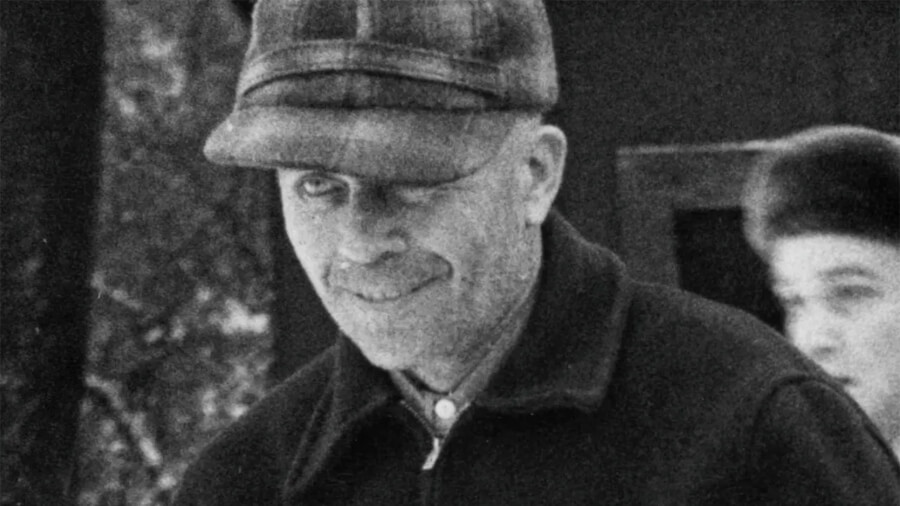
Ed Gein Photo – Picture: Getty Images
Born in Wisconsin in 1906, Edward Theodore Gein was the second child of George Gein and Augusta Gein. His father, George Gein, died at 66 due to heart issues, prompting Ed and his brother Henry to take on greater duties to keep the household afloat. He grew up in a fanatically religious household, being preached bible verses, largely Old Testament verses about murder and sexuality, regularly by his mother. Augusta would impart on him the belief that women were inherently promiscuous.
Augusta isolated Ed from the outside world, and he would ultimately become obsessed and infatuated with her, a trait that resonated throughout his life.
One of the key moments in Ed’s life came with the death of his brother Henry. The death occurred in 1944 when a fire on their property got out of control. Henry was found dead in the rubble, but there was a significant bruise on his head that suggested possible violence inflicted by Ed Gein. However, while the show portrays that Gein did kill his brother, the historical facts are conflicted and it was never proven.
The major turning point in Gein’s life arrived when his mother passed away in 1945, not too long after the death of Henry, which broke her. Augusta died of a stroke while under the care of Ed. Her death ultimately saw Ed spiral out of control; the home fell into disrepair, and he found himself incredibly lonely. As his mental decline accelerated, Gein began robbing graves and committing murders. In this period, he also internalised and personified his mother’s personality, a trait similar to Norman Bates in Psycho.
His awful crimes ranged from murder to body snatching. He confessed to the murders of two victims, Mary Hogan and Bernice Worden, and was also suspected of other killings, such as his brother’s death. Gein would frequently visit graveyards, where he would dig up and skin corpses, wearing their faces as masks. He also mutilated cadavers and crafted furniture from their skin. His necrophilia extended to creating ‘suits’ and masks from the skins of female bodies, reflecting his desire to embody women — especially those who resembled his mother.
When the police raided his home, they found many corpses and instruments for mutilation. They also found numerous books on anatomy and books containing Nazi references and wartime atrocities. He had a morbid obsession and fascination with the macabre and the human body.
Once his acts became known, Gein earned the titles Butcher of Plainfield and the Plainfield Ghoul.
What was the real relationship between Ed Gein and Adeline Watkins?

Picture Credit: Netflix / Alamy
Played in the series by Suzanna Son, Adeline Watkins was a real-life woman and one of the few people who knew Ed Gein intimately. The show largely portrays her as an accomplice to Gein’s heinous crimes, which has sparked some backlash over real historical facts.
Back when Gein was arrested in 1957, Watkins spoke to the Minneapolis Tribune about her and Gein’s relationship. “Eddie and I discussed books,” she claimed. “We never read the same ones, but we liked to talk about them anyway. I guess we discussed every murder we ever heard about. Eddie told [me] how the murderer did wrong, what mistakes he had made. I thought it was interesting.”
A marriage proposal was made, but not heeded. “I turned him down, but not because there was anything wrong with him,” she added. “It was something wrong with me. I guess I was afraid I wouldn’t be able to live up to what he expected of me. I loved him and I still do.”
As for the claims of a long-standing romance, she said: “There was no 20-year romance.”
The show’s portrayal of Watkins encouraging Gein is not wholly supported by historical evidence. Watkins also claimed to have never entered Gein’s home, where he kept mutilated human bodies and a shrine to his mother.
You can read an archived version of the interview with Watkins here.
Ed Gein’s influence on Hollywood: Did he inspire some of horror’s best-known villains?
While Gein himself is the central figure of the series, it also explores how his horrific deeds inspired some of the bleakest and most brutal films in Hollywood history. Alfred Hitchcock’s seminal work, Psycho, and Tobe Hooper’s slasher, The Texas Chainsaw Massacre, are the two prime examples.
The character of Norman Bates in Psycho seems absolutely inspired by Ed Gein. There are numerous strong connections. Perhaps most notable are their split identities, hallucinations, delusions, and respective obsessions with their mothers, as well as their social isolation and conflict over love and sexuality.
In terms of character, the similarities are remarkably striking. However, when it comes to specific plot elements, both Hitchcock and screenwriter Joseph Stefano added major scenes that didn’t happen in Gein’s life. The movie is fictional, after all. For instance, the Netflix show contains a scene reflecting the iconic ‘shower scene’ in Psycho, but the scene itself was not based on a specific murder that Gein committed. No doubt it was added in for dramatic licence.
As for the original Psycho novel by Robert Bloch, the author ardently denies any inspiration taken from Gein’s life.
The Texas Chainsaw Massacre, however, very much takes inspiration from Gein’s story, but it’s a myth intertwined with fact. Leatherface wears masks of his victims, much like Gein. However, there is no historical evidence that Gein killed with a chainsaw. This idea has become a myth popularised by The Texas Chainsaw Massacre.
“I definitely studied Gein,” Texas Chainsaw Massacre writer Henkel told Texas Monthly in an old interview. “But I also noticed a murder case in Houston at the time, a serial murderer you probably remember named Elmer Wayne Henley.”
Did Ed Gein really assist in the arrest of Ted Bundy?
One of the most surprising moments in the Netflix series comes when Gein, trapped in a psychiatric institution in his final moments, assists investigators in tracking down serial killer Ted Bundy. This moment particularly surprised viewers, causing widespread confusion.
Let’s put the debate to bed: no, Ed Gein did not assist in the arrest of Ted Bundy. This storyline was added to the series as fiction, possibly as a made-up scenario in Gein’s mind.
Is the Netflix series an accurate representation of Ed Gein’s death?
While there are elements of pure fiction — such as his assistance in the Ted Bundy arrest — the show’s portrayal of Gein’s death is mostly accurate. The beginning of his downfall began with his arrest in 1957. Gein ultimately admitted to the murder of Bernice Worden and Mary Hogan, as well as numerous counts of grave robbing. However, in 1958, he was deemed insane and found unfit to stand trial for his crimes.
He was sent to a hospital for the criminally insane, and by the late ’60s, he was seen as competent to stand trial for his crimes. While he was initially found guilty, the verdict was swiftly amended to not guilty due to insanity. Rather than face prison, Gein lived out the rest of his life in a mental institution.
He died of lung cancer (specifically of respiratory and heart failure) at Mendota Mental Health Institute, aged 77.
Additional Reading and More Fact vs Fiction
- Was Ed Gein really a babysitter? Yes, it’s reported that Ed Gein began babysitting not only to take up odd jobs around the town to earn money, but that Adeline suggested he should practice being around children.
- Did Ed Gein kill Evelyn Hartley? Unclear. While she is a real person who went missing in 1954, her case is still unsolved, with a 2004 tape suggesting some possible assailants did not include Ed Gein.
- Did Ed Gein exchange letters with Richard ‘Birdman’ Speck? This seems to be a work of fiction, given there’s no evidence that has been found to support it.
We’d recommend taking a look at this original Time article from 1957 in issue 23 (another article found here) plus we’d also recommend taking a look at Frank Scherschel’s photographs for Life Magazine, published back in 1957:
Finally, we’d also recommend the 1989 book by Hardol Schecter, titled Deviant: The Shocking and True Story of Ed Gein, the Original Psycho, which has been consistently used as a source over the decades.
You can read our review of Monster: The Ed Gein Story here.