
Pictures via Sony Pictures Animation / Netflix
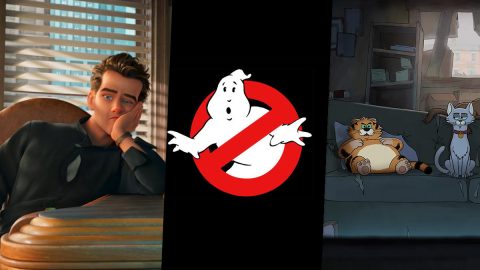
At Netflix’s headline Animation Annecy Showcase, we were treated to a massive deep-dive into the highly anticipated new animated series, officially titled Ghostbusters: Night Shift. Executive producers Jason Reitman and Gil Kenan (the creative stewards behind Afterlife and Frozen Empire) took to the stage alongside showrunners Ben Hibon and Elliott Kalan (who is infinitely entertaining) to peel back the curtain on this Sony Pictures Animation and Netflix collaboration.
As Reitman noted, Night Shift is “unlike any story we’ve ever told. It’s a story that can only be told with animation. It pushes the envelope in terms of comedy and, more importantly, scares.”
If you’ve been wondering what happened to New York’s premier paranormal exterminators between the classic 1980s films and the recent Afterlife era, you’re in luck. Here’s our deep dive into what we learned:
The Missing Decade: A “Smelly” 1994 New York
Night Shift is an official, in-canon chapter of the Ghostbusters saga set entirely in 1994. The original Spengler, Stantz, Venkman, and Zeddemore crew has disbanded, leaving New York City vulnerable to a brand new spectral cataclysm and the OG four’s legacy a distant memory.
The showrunners emphasized that they wanted to capture the “real” New York of the ’90s. As Kalan put it: “We will be experiencing their street-level view of a New York of 24-hour diners and corner store bodegas. To put it bluntly, this is a New York that smells. And somehow, Ben and his amazing team… have managed to make an animated New York that has that real New York smell.”
Our new heroes will be moving into the iconic Tribeca firehouse, though it’s seen better days. Hibon described wanting to infuse a “palpable sense of time passing by. History spilling all over the walls, as if the city poured right into the lobby of the firehouse.” (And yes, the sacred basement has apparently been condemned by the FDA!)
“Janky” Aesthetics: A Deep-Dive into the Show’s Textures
One of the most fascinating segments of the presentation was the deep-dive into the show’s unique textures and art direction. To accurately reflect 1990s NYC, the team utilized a tactile, grimy, “DIY punk” visual filter.
Hibon explained their meticulous approach to the animation’s surfacing: “We approached each prop design with a lack of broad, colorful, and vibrant palette. Our process goes through uneven base colors, kind of lifted with accents of primary tones. It’s almost like to try to cut through the more muted tones of the city and give our sets a more vibrant, in-world kind of noise.” The result is an environment made of “uneven surfaces, organic textures” that feels “more alive and lived-in rather than artificial and staged.”
Kalan elaborated on why this textured, rough-around-the-edges look was so vital to the era: “Back in the 1990s, the punk scene was all about the authenticity that came with things being homemade. It was a badge of honor when the stuff you had looked a little janky, a little not good, because you made it instead of just buying it somewhere. And that do-it-yourself philosophy is one of the guiding principles of the style of Night Shift.”
Meet the New Team (and the Terror Puppy!)
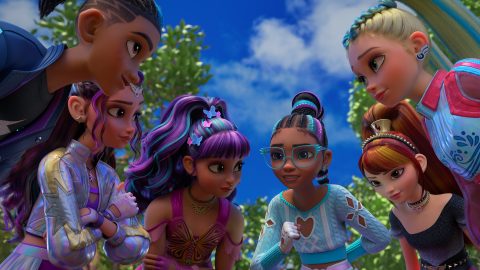
Because our original Ghostbusters are grown men who “had a certain confidence,” the showrunners wanted a team at “earlier, messier stages in their lives.” Kalan proudly introduced the 1994 lineup: Belladonna (the goth), Mitzi (the punk), Zoe (the kid), Travis (the con man), and Mike (the scientist). There was an extra character, which seemingly was quickly skipped over, which I think I caught was Zephr.
Despite their one-word labels, the showrunners stressed that these characters have deeply three-dimensional personalities, which heavily influenced their visual designs:
- Zoe: Described by Kalan as “our adorable kid who’s also a real wise-ass, really gets on my nerves.”
- Travis: “A charming, petty criminal who needs to be charismatic and cool, but also kind of a loser.”
- Jack Quaid is the voice artist here!
- Mike: “Our engineer and tech wizard, he needs to be a scientific genius who also exudes warmth and emotional inner strength.”
- Mitzi: “A badass riot girl who jumps headfirst into action, but is also extremely protective of her sister, Zephyr.”
To make these characters feel believable, the animation team focused heavily on their eyes. “Eyes are the connective tissue between performance and viewers,” Hibon noted, adding that deep, complex eyes give the cast a more natural presence on screen.
But the real scene-stealer? The Terror Puppy. Designed to look exactly like the classic, demonic Terror Dogs from the original film, this little guy is playful, rambunctious, and adorable. “When he pees on things, they burst into flame. A puppy, you know,” joked Kalan.
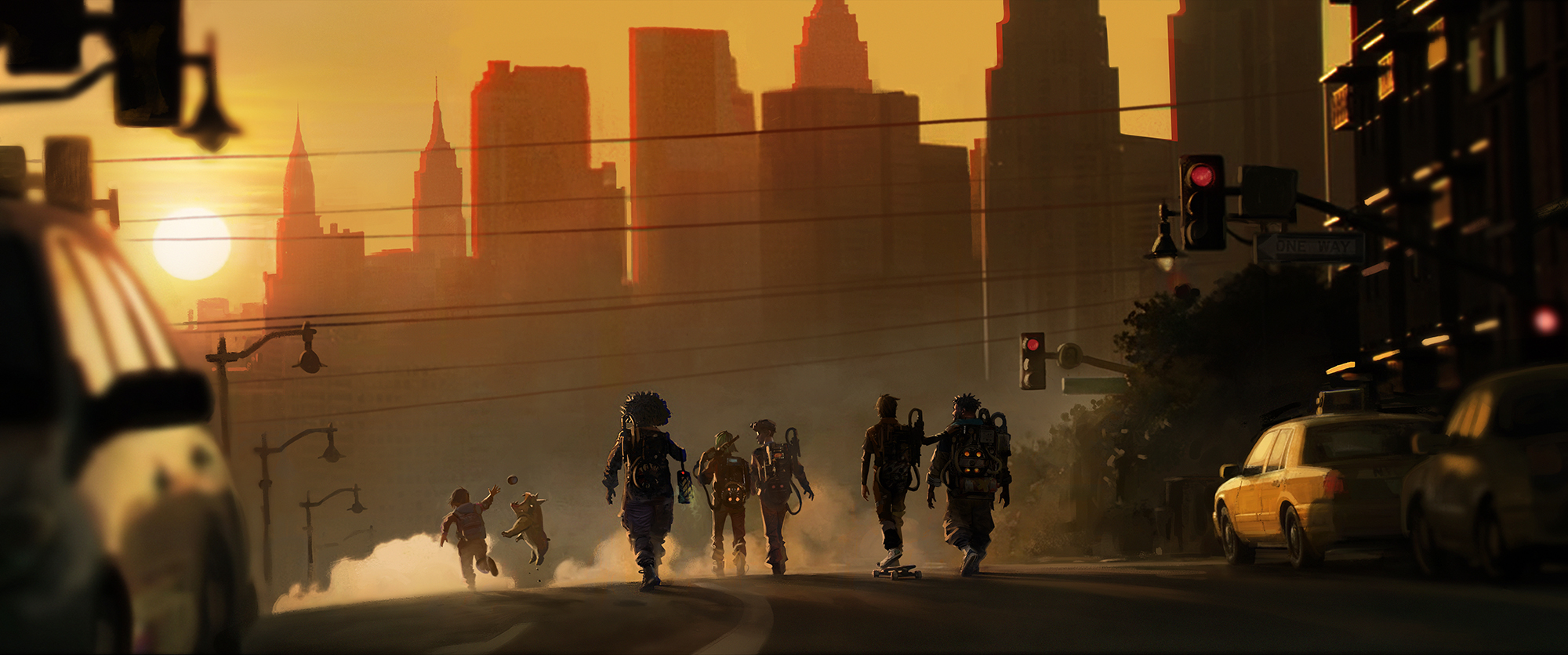
Ghostbusters: Night Shift – Visual Development Art. Cr: Sony Pictures Animation ©2026
Upgraded (and Downgraded) Gear
In 1994, our broken heroes are utilizing stripped-down, half-working prototypes left behind by the original crew. Hibon noted they “wholeheartedly embrace Ghostbusters’ more DIY, makeshift approach to technology. So think recycled, used parts, taped, glued together.”
Some incredible tech highlights include:
- Proton Packs: Featuring a low-tech energy beam that is “random and angular in shape, kind of unstable in its feet.”
- A DIY PKE Meter: Built using spare parts from a Sony PlayStation 1!
- The Ghost Drive: Modified with recycled skateboard wheels, a spinning mirror mechanism, and bass/guitar pedals.
- Ecto-94: Operating without permission to use Ecto-1, the team drives a gently pre-used van customized with spray paint and a “spinning roof turret for some precarious Ghostbusting on the go.”
A Terrifying Tone & Exclusive Clip
While the series will absolutely retain the signature humor of the 1984 classic, Kalan made a bold promise: “This show is legitimately scary. When you are not laughing at Ghostbusters Night Shift, you will be shitting your pants.”
The animation medium allows the team to push the boundaries of horror, keeping violence “more graphical and abstract, and infuse a sense of dread, tension, and fear right into the design of the world itself.” Some of the threats name-dropped included a “Poison Demon” residing in the Hopscotch Hellhole, a Class IV malicious sludge known as the “Rot Monster,” and a “Grabby Hands” Reflector Ghost.
To cap off the segment, the audience was treated to an exclusive work-in-progress clip from Episode 2, where Travis tracks down an entranced Zoe to Grand Central Station. Things quickly go sideways as they are attacked by a terrifying Class III semi-corporeal anchored spirit—a demonic “Ticket-Taker” Ghost who tries to kidnap Zoe for a mysterious entity known as the “Nightwalker.”
First Impressions
The attention to detail on show through concept art, early animation tests, and shown footage was second to none. This is clearly a team that loves the world of Ghostbusters, but they’re also giving it their own spin. We didn’t get to spend too much time with the main cast of characters, but they easily fulfill a role and point to the series being aimed at a much younger audience than I first anticipated, but the tone certainly suggests it might be leaning much older, somewhere close to Arcane and Scott Pilgrim Takes Off.
The sequence we got to see was huge in scale, spanning the full stretch of Central Station, and the signature quippy comedic comments and character design were superb.
As it stands, this is the second (or third) best thing Netflix showcased at Annecy all week for the streamer, only behind Ray Gunn.
Ghostbusters: Night Shift looks to be a loving, wildly creative extension of the franchise that leans heavily into a gritty, ’90s punk-rock vibe. Ultimately, as Kalan summarized the show’s guiding philosophy: “Busting makes you feel good. Even when you’re working the night shift.”
Keep your eyes peeled to What’s on Netflix as we wait for an official release date!