Picture Credit: Netflix / Corey Baker
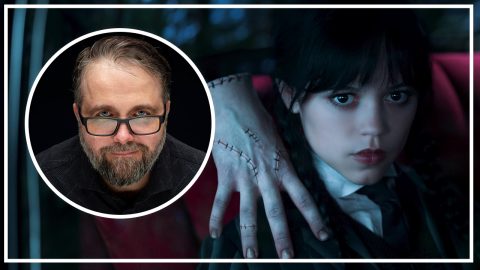
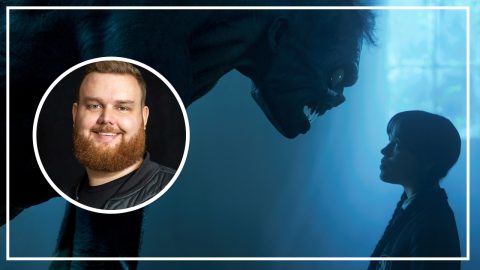
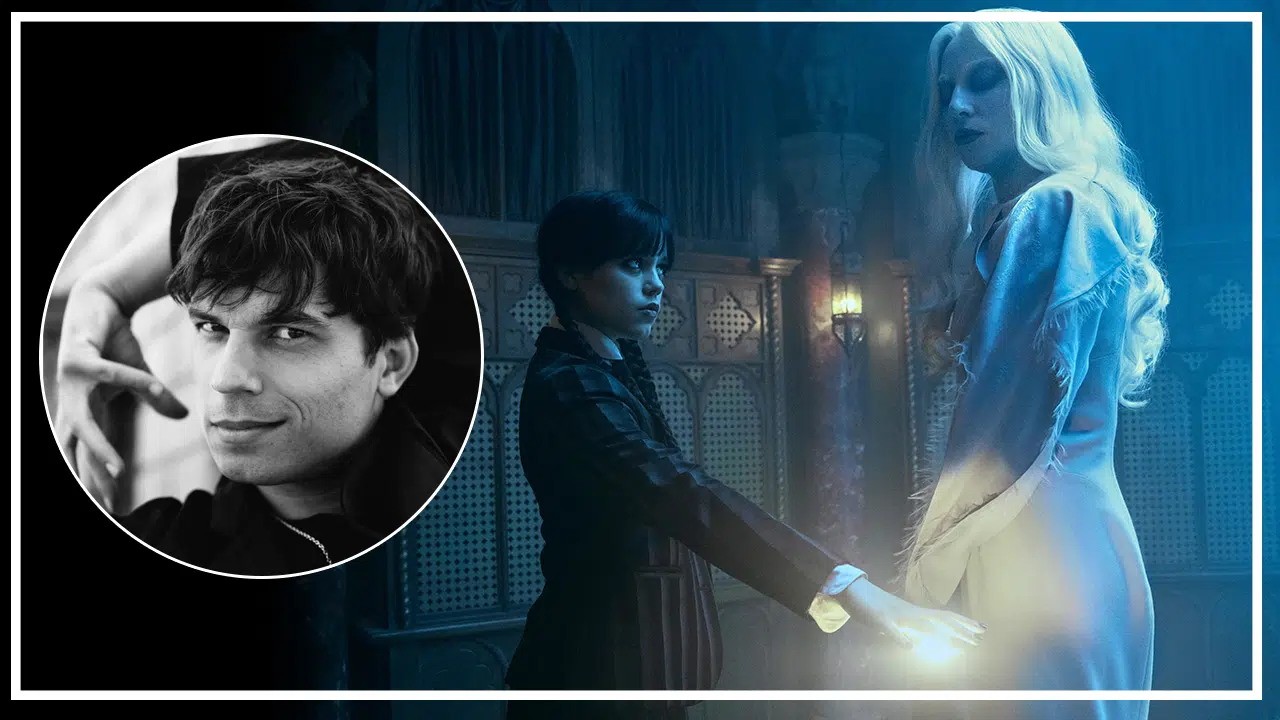
Corey Baker is the lively choreographer behind the Dead Dance. For the penultimate episode of Wednesday season two, Baker had Agnes (Evie Templeton) and Eni (Emma Myers) tear up the gala floor in true Tim Burton fashion. The end result earned the choreographer an Emmy nomination for Outstanding Choreography in a scripted program.
Baker previously worked with the filmmaker on Beetlejuice Beetlejuice. This time around they brought together a plethora of influences, from Bob Fosse to monsters, for their dance number. Recently, the Emmy nominee spoke with What’s On Netflix about crafting the number to Lady Gaga’s original track, how Burton inspires him, and living his dream.
For the first week or so working on the “Dead Dance” sequence, you and three or four dancers got together and discussed what was possible. Is the sky the limit during that process?
In a way, yeah. I would say Wednesday was particularly different because when you work on TV and film, it’s different to, let’s say, “I’m just going to create dance,” because then you go, “Yeah, I’ll do whatever the frick I want.” But in this you’ve got a script, you’ve got a very established world, you’ve got established characters, you’ve got a very established director who comes with his own physicality. You can quickly see what would work for Tim Burton and what wouldn’t.
To top all of that off, we had a very specific song that was, at the time, brand new, had never been out, no one had ever heard it. I was given it on a link that I was allowed to listen to five times. And that’s the starting point. It’s going, okay, let’s listen to this piece of music. What is it? How do you bring it to life? What’s the tone of it? And then when you establish that, you filter that with, how do we make it feel Tim Burton-y? Does it honor the characters? Does it service the script?
And so, there are all these layers that you go through. In a way, it is the sky’s the limit, but there are some real foundational roots that you have to build from. I like to not tell anyone about them first. I know them all here so I can filter them, but I don’t like to stifle my collaborators’ creativity. I came up with that in the shower on day one.
Really?
I was like, “Oh, that’s it.” And then from there, all the rest of the stuff, it was getting dancers in the studio playing and being like, “Let’s think of something like Thriller. Let’s think of hunchbacks and monsters.” It would give little tonal things, but not all the information. And then from there, filter it and edit it and put it together like a Tetris game, in a way.
Where do you go after establishing the dance?
Once we established the dance, I film it, I send it to Tim, our showrunners, Al [Gough] and Miles [Millar], and I get any notes back. I adapt and then finish it. And then the final layer that I don’t think I’ve actually ever really talked about is that I bring non-dancers into the studio, a bunch of my friends who don’t dance, and I give them a beer or whatever. I ask them to learn the dance. I teach it to them and see, is it too hard? Is it too easy? Do you want to learn it? If that’s there, then I’m like, “Cool, this is going to work.”
You have your own test audience.
Exactly. It was a bit too hard, so I had to make it a little bit easier. I still think it’s really hard. The whole “Dead Dance” is quick, man.
A VFX-heavy dance, too, which is its own challenge. How much collaboration did you have with the VFX supervisor when it came to the digital effects in the dance?
The VFX team on Wednesday is insane. They have to be, right? The VFX and stunts, actually, we collaborated on how we make Emma disappear. We would have meetings and talk through it. I thought we would do it all first with a green suit. We had a dancer in a green suit who would switch in and spin Emma around. We did do that for a couple of the shots, but then it became clear that her dress became the problem.
Why’s that?
VFX would have to rebuild all of her dress that was getting smudged by the person’s shoulders she was on in every frame. It was like, “That’s never going to look real, and it’s going to take forever.” It’s actually easier and cheaper to build a special spinning device that Emma can lay on that’s all green, doesn’t mess up the costume, and she can spin around. That’s what we did.
It came together very well.
Thank you.
Did you and Tim Burton ever talk about specific famous monster poses and how they could be incorporated into dance? You think of Nosferatu raising his hands as he dies from the sun – it is kind of a musical pose.
No, not anything in specific. We’d done Beetlejuice Beetlejuice Beetlejuice before this. Working on that with him, there was a whole heap of references of stuff that I know he loves, and it’s a similar world. I possibly pulled from that subconsciously.
But obviously Emma, who plays Enid, is a werewolf character, so I did think of that a little bit. Specifically, she has some claw moments. Actually, in our original video, her claws were popping out on beats like boom, boom, boom. But that got too expensive.
Tim Burton has such a specific style. How does his sensibility inspire a dance sequence?
One thing that Tim does so well is mixing genres, which is also tricky for a lot of people because you’re like, “Wait, what do you do with that? What is it?” But he mixes genres fluidly. It’s a comedy, it’s a drama, it’s action, it’s gothic, it’s modern. It’s all of these things all at once that, on paper, probably shouldn’t work, but somehow they always do.
I find that inspiring, because as a choreographer,you shouldn’t have a style. I think that’s limiting. It’s really nice to go, “What does this need? What is the right version for telling the story, bringing this music to life, what these characters would do, and how do we engage the audience the most?”
There’s ballet, there’s jazz, there’s [Bob] Fosse, creatures, and weird shit. There’s a whole load of stuff in that dance, which is wild. I come from a ballet and contemporary background, and my TikTok has, I think, 27.5 million people who have watched and done the Dead Dance. So for me, it’s insane to see that so many people have done a bit of contemporary and ballet, and they don’t know it. They absolutely don’t know it. They just think they’re doing the Dead Dance. But inside that is a whole plethora of techniques, history, and ideas.
You want to serve the story first and foremost.
That’s totally my job. My job isn’t to have an ego and go, “I want to put my best choreography in.” No, it’s about how do we engage the audience in the right way that the story needs?
I’ve talked to Tim’s editor, Jay Prychidny, a few times.
I love Jay. Jay is an absolute icon.
He’s great. He cuts as Tim shoots, so are you seeing and responding to edits as the dance is shot?
We actually worked quite closely on it because he didn’t have the music. I was the only one that had the music on my phone. I would go to his editing office and press play on the music from my phone to the cut that he was doing. I mean, it’s an editor’s worst nightmare. He was cutting without the music. We had created a fake track, which was very similar, and he was using that. But I’d go in and be like, “Oh, so this is the verse, that’s the chorus.”
Also, Tim has this sort of free spirit in which we don’t know how long it’s ever going to be. We don’t know how much it’s going to be used because obviously we’re chopping away to other stuff, and that has to marry to the music.If we need to come back to the dance, it might not be the right point.
So, Jay’s incredible skill of being organic and adapting, but also really the technique of editing. He did a great job.
Tim Burton is one of those directors who does these really great wide shots that let you appreciate his worlds. How much do you two discuss his shot choices for a dance sequence?
What I will do is when I create it, I film it in a way that I think serves the choreography the best. I’ll actually edit it together and make quite a detailed music video version of the choreography. I think that helps. If I’m doing something and someone’s upside down, then it’s made for a top shot, I’ll film it in a top shot so he can understand the way that I’m seeing it.
And then that goes through his filter. A lot of the time there’s a lot of crossover and similarities, but he’ll always ask me, “Is there anything else we need?” And I’ll go, “I think we don’t have this beat.” What’s great is he trusts me, and I really feel that on set, which is not always the way with directors.
Someone as established and as iconic as him, the fact that he’s still collaborative, but truly knows what he wants and truly can see anything can go, “No, that’s not right. It needs to be this.” It’s remarkable. I think he’s remarkable.
I was reading about the beginning of your career – studying Australia, dancing in Switzerland, and now you’re working in Barcelona. On paper, that’s a great life. What do you find most fulfilling about the path you chose?
What I find most fulfilling is that I get to do my job. For so many parts of my career, I say this all the time, I would pay to do my job. To me, it’s not a job. It’s a hobby and I absolutely love it. Literally, I would do it for free. Probably shouldn’t tell the producers that because you always want more money, don’t you?
But the reality is that I love it. I’m so grateful that I can do it. I’m grateful that I do love it. I’m grateful that every day I go to set, even if it’s at 4:00 AM, at 3:00 AM, if it’s an 18-hour day, I’m there going, “Okay, it might be tiring, it might be stressful, might be hard.” But I’m like, “Fucking love this. This is what I’ve always wanted to do. I’ve worked hard to get here and I’m doing it.”
So that’s what I’d say I’m grateful for. Collaborating and learning, too. Every job, it’s never the same. It doesn’t matter what gig you do. I’ve never got to a point where I feel like, oh, let’s whip that one out again. Because you’re always working with different people and different collaborators and different dancers, different sets, different stories. It always feels like it’s a new adventure, which is so fun.

Wednesday. (L to R) Evie Templeton as Agnes, Emma Myers as Enid in episode 207 of Wednesday. Cr. Courtesy of Netflix © 2025
Starting off dancing at a young age, does that just set you up with a certain discipline – an athlete’s mindset – that leads to sustaining a career in choreography?
I think it does. They say that if you learn how to dance, if you dance, you can kind of do anything, is the saying. Although I see that as being a little egotistical, I understand because the discipline in order to dance is quite extreme. It teaches you that you can’t do something unless you’re completely committed. You have to have full focus. In the world that we live in, it’s a great tool, and I apply it to my job and my life.
Congratulations on all your success, Corey. What’s next for you? What do you hope to accomplish going forward?
There’s a few directors and artists that I’m eager to collaborate with. I’m really chomping at the bit to do a movie or a TV show that is more dance-centric as opposed to the dance being a tag-on or a scene. A movie musical would be great, something like that.
But I’m more leaning in and shifting and developing my career to be a director at the same time, which is why I’m so grateful to be on set working with these amazing directors all the time and learning from them. Hopefully, one day I’ll get to create some magic like they have.