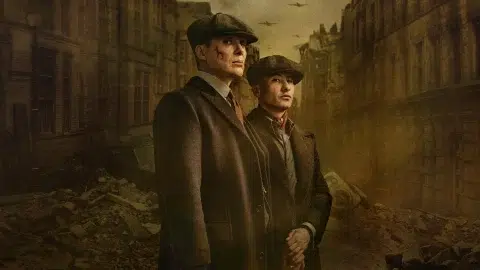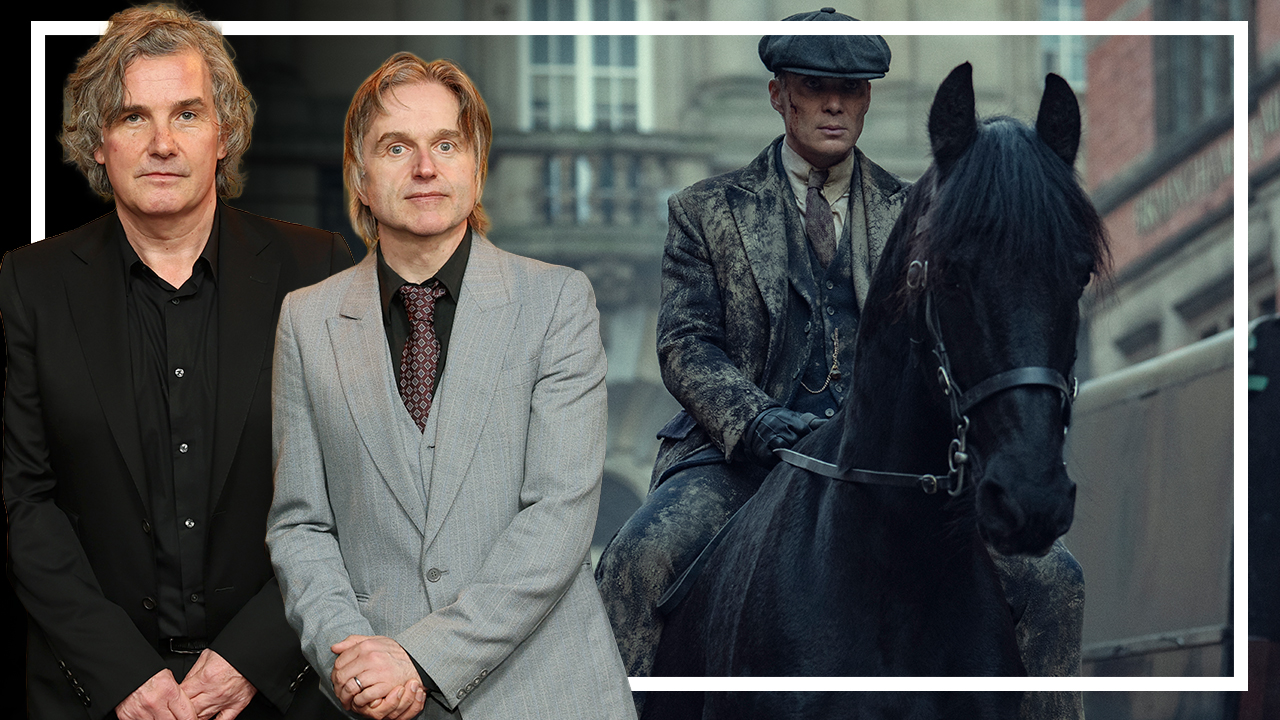
Peaky Blinders: The Immortal Man soundtrack is a dense piece of music that, simply put, rocks. Including an array of collaborators, instrumentals, and genres, it’s packed to the brim. Despite all the weight on it, it moves. Enjoyed on its own, the scope from composers Anthony Genn and Martin Slattery plays like a great concept rock album.
No surprise Genn and Slattery are basically all smiles talking about the creative process behind scoring Peaky Blinders: The Immortal Man. From their warm and inviting studio, the duo spoke with Netflix about scoring the gangster ghost story – a continuation and finale for the acclaimed series.
Let’s start with “Opening Scene, The Currency.” It has such a great ebb and flow, unpredictability to it. Where did that track start and evolve for you guys?
Read Next
Netflix Top 10: ‘Peaky Blinders’ Movie Dominates Week While ‘One Piece’ Season 2 Is 35% Behind
Martin Slattery: Well, the piano piece came from a neutral perspective because it was the very beginning, you’re not really quite sure what’s going on. We didn’t want to give anything away with the very opening part of it until you start to see what’s going on.
Anthony Genn: Start with something that’s cold, neither sad or happy or too mysterious. Gradually we add in a mysterious chord here and a low note there and a tremolo low guitar thing. As the scene unveils what is actually going on, you realize, oh, hold on a second, this ain’t such a good scene. What’s going on here? This is a bad vibe. And then, of course, we see the Nazis and at that point we come in.
Martin Slattery: Carlos jumps on the guitar.
Anthony Genn: Mr. Carlos O’Connell from Fontaines D.C., which came from a jam that we did one day in the studio. We ended up speeding it up and redoing you playing the drums. Often with these things, it’s a collage. You start in a place and then you follow the story and see what the picture tells you to do.
Whether it’s the Fontaines D.C. or with Lankum, how much of the score starts by jamming? I imagine you have plenty of ideas, but how much is found once you’re in the room and collaborating?
Anthony Genn: Most of the stuff we do comes from just jamming music. We’re not head scratchers. We don’t sit in front of computers all day piecing things together. Whoever it is that comes in to work with us comes into this place, it’s like a playground.
Martin Slattery: Apart from the Lankum track, obviously.
Anthony Genn: Well, the Lankum track obviously already existed, but we rerecorded it in this studio. That did start in an environment that’s organic and where you are recording instruments with our amazing engineer, Drew [Dungate Smith], who’s worked with us for a long time.
Anthony, you said while recording with Lankum, it was one of the most magical few days of your career. What made it special?
Anthony Genn: I’m fascinated by musicians. I’m fascinated by different characters that come together. With Lankum, that was the one track in the whole film where it was all these people, Lankum and their producer, [John] “Spud” Murphy.
It was a unique experience in the making of this film because the stuff that the songs we did with Grian [Chatten] were mostly me, you and Grian, weren’t they? Grian played guitar and he played bass on one. He played drums on that, played drums on “Angel,” “Medusa.”
Martin Slattery: And “Ellipsis.”
Anthony Genn: He’s a wicked multi-instrumentalist. But Lankum was, I guess, just being themselves. I’m such a fan of their music. When I saw them play in Hackney Empire and Barcelona as well, and I was like, oh man, we got to get in the studio and on this film somehow. What transpired was that Tom Harper, the director, chose that track and it stayed there for a long time. And then I said, “I want to rerecord it,” which had raised a few eyebrows, didn’t it?
Martin Slattery: Why would you?
Anthony Genn: Yeah, why would you? As Cillian said, to go deeper, to see where we can go in the scene. Add certain instruments that aren’t in the original and really weave it to the scenes of the film. Really, get the most out of every single little moment, every little frame.
Martin Slattery: There’s something interesting about our studio – it’s like a massive living room. It’s not like a cold studio where you’re waiting for a record to be hit and then everyone’s nervous. Imagine having that massive living room and then putting one of your favorite bands in there and then listening to them play music. I suppose that’s why you would feel like it was a great day because it would be a great day.
Amy Taylor, Girl in the Year Above, Mclusky – you guys really do great work with them here.
Anthony Genn: We’ve been incredibly lucky on this film that anyone we’ve collaborated with and brought in. It’s all been such a free flowing river of ideas and everyone’s so open-minded. I hope that the people that come in and work with us fundamentally know that our reason for them being there is for us to get what they’ve got rather than us saying, “Oh, you should do this or you should think like this. ” You have to let musicians be themselves. See what language they’re speaking, because we all speak a little bit of a different language with music.
Martin and I have worked together for 30 years and we have a pretty common language, but I do things that he doesn’t do. He certainly does things that I could never do. Somewhere in the middle we have this language, but it’s about giving people freedom to be themselves.
Martin Slattery: I think of it as holding space for people. There’s every instrument you could ever want here. Drew, our engineer, he’s got everything so hooked up that if you go over to an instrument, as soon as you touch it, you’re recording. For artists and musicians, that is like the holy grail really, because as soon as you start doing something, you’re on.
Anthony Genn: And we like to work fast and everyone we worked with likes to work fast.
Why the preference for working fast?
Martin Slattery: Don’t get us wrong. Once we’ve done the bit that goes fast, sometimes it goes really slow.
Anthony Genn: To be honest with you-
Martin Slattery: He’s a bit of a fiddler, this guy.
Anthony Genn: I can be guilty of… I’ll tell you who said it brilliantly, Tyler, The Creator, who said, “Play like a child, edit like a Scientist.” I think that is what we do. We come and play, so that’s the quick part. The slower part is considering things in real detail.
Peaky Blinders: Immortal Man is a ghost story, not just a gangster story. There are some very ethereal tracks. How’d Thomas Shelby’s ghosts influence your choices?
Anthony Genn: It’s one of the most interesting parts of the film for us, playing-wise. We have this old wonky piano, an old Kimball piano. It’s pretty knackered, pretty frail, fragile and haunted itself. I’m sure it’s got lots of old stories to tell. We found that that sound, the viola, and Grian’s work, as the ghost in Tommy’s head. Those organic sounds really lent themselves to that haunted, ghostly feeling.
Martin Slattery: It’s all subtle. I watched a movie again the other night and realized how much quiet dialogue there is, but you still have to score that and let that dialogue shine whilst presenting the emotion. Getting those tones right, like the dinner scene, took quite a while, didn’t it?
Anthony Genn: Because less information is often more powerful. There’s too much music in films these days. There used to be a lot less. If you watch Chinatown, there’s about 23 minutes of original music. It’s a masterpiece. My favorite ever film, Kes, made by Ken Loach in 1969, was scored by John Cameron, which he wrote when he was 25 years old. There is 18 minutes of music in that film, and some of it is reused.
Even with massive blockbusters, I think there’s less than an hour of music in Jaws. So it’s about using silence and being bold enough to also have space between music, between the notes and not feeling like you have to fill everything with drones and long legato pedal strings. All that has its place and can be used beautifully, but we wanted to have a lot of space in that first act of the film, so to speak.
When you listen to “The Immortal Man,” there’s a great contrast there. There’s fragility. What were some other broken, soft choices you wanted to make?
Anthony Genn: Well, we jammed a lot of stuff just with him on the piano and me on this old guitar we’ve got. It’s from 1916 that Gibson guitar. Did you buy that in New York?
Martin Slattery: Yeah, years ago.
Anthony Genn: I remember it was expensive. Bold, bold move. Also, it only had five strings on it and I can never be asked to change strings. I did some mad tuning, and that’s pretty much how we left it for the film. I probably returned it a few times, but it was never in a normal tuning, was it? I couldn’t even tell you what tuning it’s in, to be honest with you.
Martin Slattery: You would drop in the law string all the time, the electric as well, so you get that extra depth.
Anthony Genn: Yeah, to get that wonkiness. It gives you a sense of organic, human physicality. A lot of physicality in the music.
Martin Slattery: I wanted to make sure that we moved away from making sure that not everything was done to a click, because there’s something about that fragility that you talk about. When music’s moving in a more natural way, when you’re off that sort of rhythm, you’re letting the music flow. Obviously, some of it is done to a clip, but that was a sort of conscious decision early on.
Anthony Genn: For fragility, for you to take a breath, you don’t know when it’s coming back in. And because we play together and mess around jamming, and because we know each other so well, we ebb and flow and somehow seem to fall back in at the right time. We’ve been playing music together for so long that it’s natural.
It’s obvious by hearing how you continue and complete each other’s thoughts.
Martin Slattery: We’re lucky, man. People find it, don’t they? I’m not comparing, but band members that find each other, right? You could put another drummer in there playing the same parts, and it ain’t the same.
We’ve been working together for a long time, and I think there’s a sort of bravery that comes with that. Something as simple as going off click, some people might say, “Oh, we can’t go off clip, because how will anyone else know what they’re doing in the future?” It’s just like, who cares, man?
Anthony Genn: When you get into then recording a big orchestra session and what you’re doing is ebbing and flowing often, like with “Teardrop.” It comes and goes, and then you just end up going, “Well, you know what? I’ll conduct it myself.” I’m not a conductor, but I just got in there myself. We did have a brilliant conductor, two brilliant conductors, Richard [Jones] and Joe [Davies].
Sometimes I do go in and conduct or not. I could probably conduct super fragile and absolutely brutal, remove the skull from your shoulders – I could probably conduct that. I could communicate that pretty well.
When will you definitely get in the room to conduct?
Anthony Genn: There’s this brilliant violin player that led the orchestra, Tom Gold. We’ve worked with him for years. He says, “Richard is good at translating your Shefftalian.” I’m from Sheffield. Obviously, all musical notation is Italian. I don’t read music. Richard has been reading music since he was five. I don’t, but yeah, Tom says, “Richard is really good at translating your Shefftalian.
For example?
Anthony Genn: When you’re recording in Abbey Road, you have two buttons – one for the orchestra and one for the conductor. You can just press the conductor and can say, “Rich, it needs to be more gnarly, man. Get him up on that bridge, get off him really fucking going for it and fucking it up. It needs to be fucked up, man. Get bent. It’s too fucking polite, man.”
And then Richard goes, “Yeah, okay.” And then you hear him in the orchestra, and he goes, “I think at Bar 42, what we need to do is…” [Laughs] And it comes back like that. Sometimes I have to say it to the orchestra as well.
Martin Slattery: You have to get in the room. We’ve had great people across the board with this whole movie. We’ve been so lucky.
Any final words on Peaky Blinders: Immortal Man?
Anthony Genn: Such a great project. The heart and soul of that is Tom Harper, our brilliant director, and Cillian Murphy, who is a brilliant producer, also happens to be the leading star of the movie, Mr. Tommy Shelby. Myself and Cillian go back a long way.
Cillian is a serious musical mind himself. He is a musician himself. That’s how he started, but he’s been very involved with the landscape of the music of Peaky Blinders for six seasons. He’s the person who called me and said, “You might want to do season four.”
It wasn’t really his decision, but he came to us and said, “I’d love you to come on board with it.” And then in this film, it was the other way around. I called him. It’s a very collaborative process. The story, as ever, is the boss.
 Rating: TV-MA