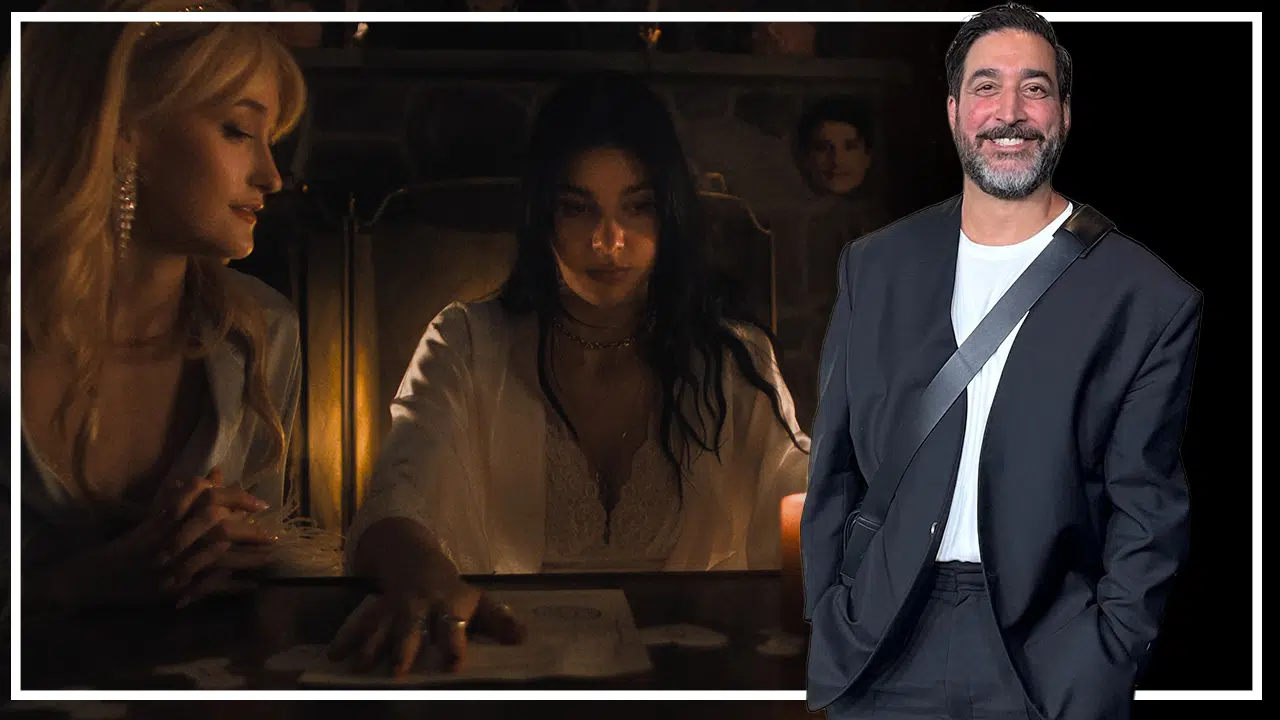
Pictures courtesy of Netflix and Dev Singh
Something Very Bad Is Going to Happen is a rare horror treat from Netflix. There aren’t enough horror shows, simple as that, but creator Haley Z. Boston’s show gives fans multiple styles of horror all in one season. For editor Dev Singh, he got to cut road trip horror — a couple isolated on the road, with strange and violent happenings. Then, in the penultimate episode, it’s a contained chamber piece in which claustrophobia and anxiety run rampant in long takes.
The project came to Singh at a funny time. The editor, who’s surrounded by beautiful stacks of books in his office, was reading a book about horror filmmakers Ari Aster (Heredity) and Robert Eggers (Nosferatu) when Something Very Bad Is Going to Happen entered his life. Both filmmakers are without a doubt an influence on the series, which homages horror classics while still shaping an identity of its own.
Recently, What’s On Netflix spoke with Dev Singh, who previously edited 40 Acres, Wayward, and Spiral, about crafting the gleeful horrors of Something Very Bad Is Going to Happen.
Is there something about the language of horror storytelling that you really appreciate?
Read Next
How Colin Stetson Crafted the Bone-Chilling Score for ‘Something Very Bad Is Going to Happen’
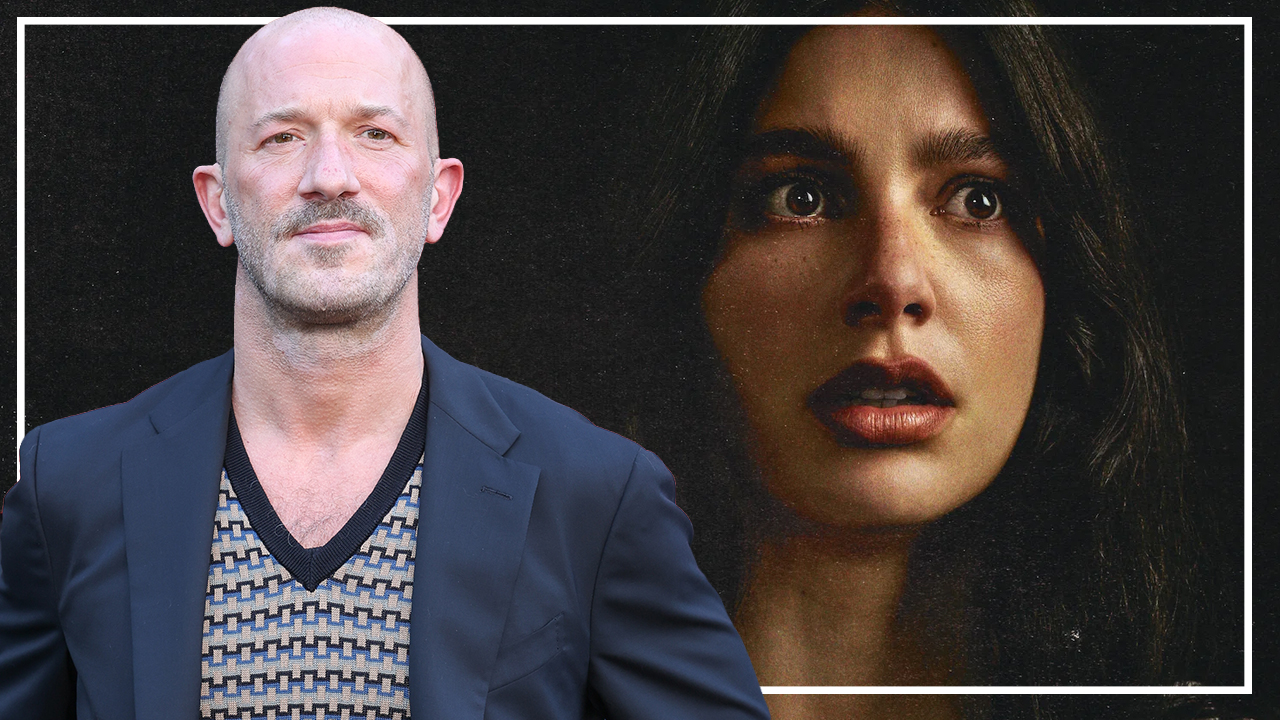
Absolutely. Well, it’s funny, I was recently watching The Killing of a Sacred Deer. It’s very restrained and psychological, and how they carry those shots. I started timing out each shot. I have the script, so I’m writing how many lines are actually used in a shot. Then what’s the ambient sound like? What music is being used? Why? When does it start? What is the length of the shot? What type of shot?
Recently I’ve been like, oh, I really want to have this approach of building more restraint, because horror has this real timing signature that you want to apply to things and how long that lasts. It can be so precise. And then you want to create different timing signatures that people don’t necessarily see coming.
Sometimes you want to do it so they see it coming, so you build a threat. Having control of that language with shot length, shot size, is fun. It’s a constant exercise and teaching to be able to do it.
In Something Very Bad is Going to Happen, you get slow dread in the beginning. Then, in episode seven, you get fast-paced horror. How’d you enjoy timing scares with completely different tempos throughout the show?
A lot of it is obviously Haley. It all starts on the page. We got the first two episodes when interviewing for it. You get the first two episodes and you’re like, okay, this is really interesting. I went back and I did some research and I found a short story, “This is Not For You.” Haley must’ve written it right out of school or something, but it was really exceptional. You feel everything. She’s got a reflexive quality in her writing.
To your point, it has this postmodern thing of someone who’s seen everything. She’s voracious in her language and what she’s seen. In her pitchdeck, it reads that it lands between Carrie and Rosemary’s Baby. All those things lined up in what we saw in it.
Then you meet her. I had done a movie with Pascal Laugier (Martyrs), Incident in a Ghostland. Not many people had seen it, quite frankly, but it got to her. You had to be kind of a deep horror person to have seen it.
I still got to see that, to be honest.
Yeah, I understand. Pascal Laugier taught me so much about timing. He was a master of tension and kineticism. It was vicious, just deep, hard horror. He actually said this to me when we were working: “This is actually my first horror movie because I haven’t felt that I was hiding behind art before. This is pure.”
What’s it like, in your mind, cutting pure horror?
In horror, you can have multiple things happening. You can have a rhythm that’s going this way, and then your visuals come in a different timing signature, so they’re playing into each other a little bit. And then when they connect, there’s a bit of a verticality on the cut.
You get to even cut a mini found-footage story in episode four. Each episode must’ve just presented a new experience, right?
Totally. It was Lynchian. Haley is so free about ideas. We were working through something and I was thinking, oh, we’re struggling a little bit with how this is connecting. The narrative was we had all these shots of going back and seeing where we were [outside of the found footage]. And then, we restructured it.
We shot a new opening, pulled scenes, and restructured the front end. Once we went into the video, we decided to stay there for 25 minutes. I was like, “I have this idea, maybe we get rid of those intercuts and we go like this.” Haley’s like, “Oh, I was kind of thinking that too. Let’s do it now.”
And so, two minutes later, we’re reworking the whole thing to try and build a 25-minute section where you’re in the found footage. We’ll figure out how to cut it. And that speaks to my assistant editor, Mary Juric, who was so integral to helping us design and build out our visual effects cuts. My assistant editor was a key co-collaborator in all of what we were doing, and that just made it so much fun. [Director] Axelle [Carolyn] fell in love with this VHS footage that they shot on a VHS camera.
You worked quite a bit with [the director] Weronika on the first two episodes, as well as the madness of seven. The pace of episode seven, with all these long one-takes, is furious. How’d you all accomplish such chaos and clarity?
Weronika called me a few days into the shoot of episode seven, saying, “I don’t know if this whole stitched-one strategy is going to work.” And I’m like, “No, I think it’s working.” You’re at that point, both of us are like, it has to work. We can’t do anything else. So, her and the team just committed fully to it.
And then we got into seven, starting the edit, and I started thinking about, oh, I think we need different music. Colin [Stetson] had built all these themes even based off the script, which was really incredible. And then it ends with a single, no-music, no-score love scene where they just talk to each other.
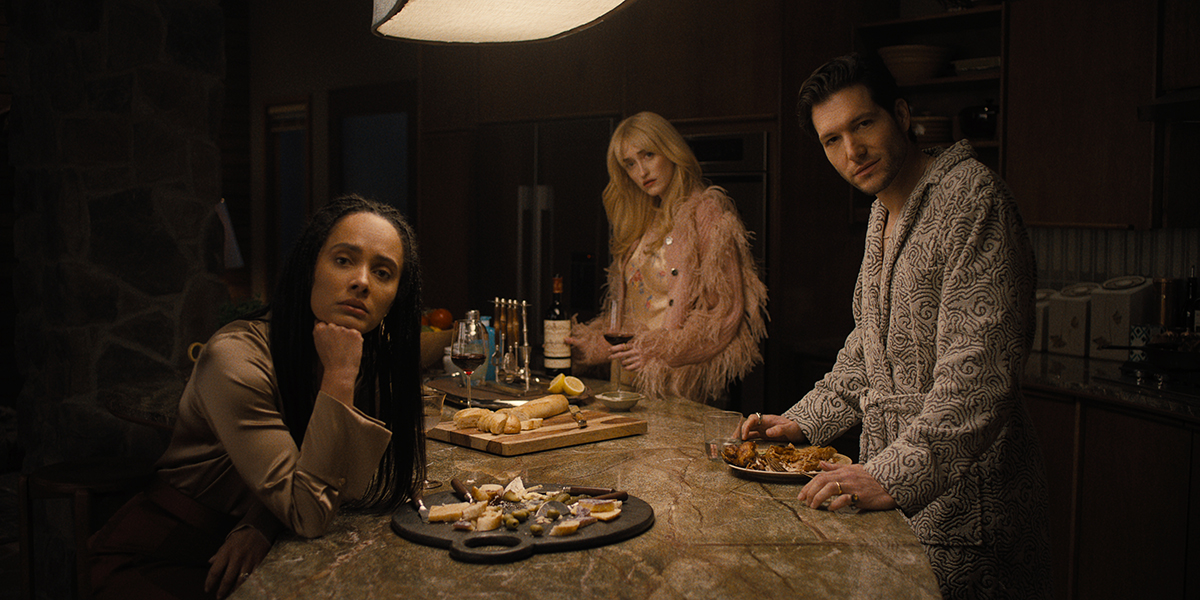
Something Very Bad Is Going to Happen. (L to R) Karla Crome as Nell, Gus Birney as Portia, Jeff Wilbusch as Jules in episode 101 of Something Very Bad Is Going to Happen. Cr. Courtesy of Netflix © 2026
Just the two of them, Rachel and Nicky, in a quiet room for an emotionally complex scene that really suits the shooting style.
You get to just go, “Oh, we’ve just spent 20 minutes, 26 minutes or something, on a hard run, relentless.” And then you stop. We stop in one single room, hold it there, and just let it go. I think maybe it’s eight or 12 minutes.
Haley would always say, “The most important scene in the whole series is you have to believe this moment when they’re on the bed.” We ended up really working that scene. She gets up and we click into another piece of music. I think I had nine tracks that I put to the end, and my weirdest one was “Happy Birthday.” Immediately, Haley, as soon as she heard that one, she’s like, “This one.”
We got the weirdo episode, this brand new voice, this thing that could be divisive that you’re pushing out. Nobody is expecting “Happy Birthday” to come through, but it’s going through this montage. And then it ends with Colin’s big wail, it cuts out, and you’re like, “Oh, here we go. We’re ready for eight.” That was our goal.
You have these very long takes. Often when you and Weronika cut, though, it doesn’t feel like cheating or cutting for convenience’s sake. You cut for drama. When Rachel and Nicky are together in the room for 12 minutes or so, you cut close to get close to them. What drove the cuts for you in episode seven?
Where that cut happens is we see their distance. She closes the door and sees him. She needs something from him. In her head, there’s a plan being formed about what she needs. But from his point of view, which we kind of stay away from, we use the mirror as a device to bring her close. You see her coming close, you get into the mirror, and we’re doing a mirror shot.
We cut into when it’s them here, it’s tight on their face and it gets very intimate. This is all about a reflexive moment back to the first episode. They did this action in the first episode. It’s going to be our callback, where we change everything from a chase to intimacy.
With the mirror, you’re always getting three frames, so you’re getting three potentials. Is she going to go through it? That moment ends up being key later for when – does she drink or not? Does she believe him? Does she believe that he believes? There’s this conversation there that leads to intimacy. You fall for it. Oh, this is about them in love? Really, it’s also about what she needs from him.
We’re trying to play it like you believe them. Later on, when she’s doing it [making the drink], you’re like, “Oh, right. Wait a second. Was that all kind of half-contrived?”

Something Very Bad Is Going to Happen. Gus Birney as Portia in episode 101 of Something Very Bad Is Going to Happen. Cr. Courtesy of Netflix © 2026
Given that you’ve cut many different kinds of projects, is editing horror that different as an experience for you compared to comedy or drama?
The honest answer is I don’t cut horror any differently than I edit drama, comedy, or any other genre. The performance and style of shooting dictate a bit of the rhythm of the edits, and I follow in behind that. If I add anything, it’s tone and a bit of pressure in terms of sound, which hopefully allows me to change the tempo to open or close down the timing a bit. Space and silence help create added tension, and I like playing in that space where things are just a little more uncomfortable. It’s an approach of tone and story architecture that mostly guides my edits; then, as we go deeper, it ends up honing in on performance so it’s as natural and honest as we can make it within the style of the larger story.
 Rating: TV-MA