Picture Credits: Netflix
The Benoit Blanc Mysteries, dubbed by Netflix as Knives Out Mysteries, are visually inviting detective stories. Rian Johnson’s films allow the audience to play detective not only in the whodunit storyline but in the presentation of the crime. Every sight and sound captures and ignites the audience’s imagination, questioning every little detail.
It’s part of the charm of the latest addition to the series, Wake Up Dead Man, which is Father Jud’s (Josh O’Connor) story. Johnson and his long-time cinematographer, Steve Yedlin, depict another search for the truth — this time the death of Monsignor Wicks (Josh Brolin) — with a gothic and, almost God or a detective-like, observing eye.
Recently, Yedlin spoke with What’s On Netflix about the shadows and light in Wake Up Dead Man, building puzzle pieces, and the ending of the film.
When you and Rian make a Benoit Blanc (Daniel Craig) mystery, is it starting from scratch every time? Or are the elements that you both want to keep consistent through these movies?

On all of Rian’s movies, not even just these ones, we tend not to have big photographic rules that we put onto everything. Let’s roll up our sleeves, sit down and design this exact, how to tell this story the best way possible and be evocative of the themes and the time and the place and the space and all of that. And so, the extent to which there is continuity is not us shackling ourselves somehow. It’s more because it’s us doing the problem solving of how do we tell the story the best way.There are going to be sort of similarities and rhymes just because it’s the same people’s brains figuring it out. While there are things that are so different about it, there are always still the same things. The fact that you’ve got this group of characters, who a lot of times are standing in the space that we keep coming back to in a circle and thing, sometimes they’re the same types of puzzle that we’re solving.
What are some of the problems that need solving in those design conversations?
Because Rian and I have worked together for so long, and we’ve been friends since we were 17, 18 years old, we have a whole lifetime of watching movies, talking about movies. We sort of don’t spend very long talking about any of the overall stuff and get right into it. Depending on what the challenges are of a specific space, we are always narrowing in on it rather than spiraling. It’s not like, what about this idea? What about that idea? We know what Rian’s trying to do. We’re just figuring out the details of it.
For example?
The very last shot of the movie where the sun is bursting out from behind the clouds or vice versa. And when we’re inside the church, inside the rectory, and the very last shot of the movie, it has the sun and the thing [which drives the mystery] has it in a position. Rian wanted to do this shot that starts wide and goes all the way in.
We couldn’t hide gear inside of the church because you’re going to see the whole church. The window casings were very deep, which means you can only, if a light is actually for real coming through the window, there’s only certain places you can hit because you can’t move it. If you move it too far off, you’re just going to be hitting the window casing and it’s not coming through.
Specifically for that, we actually did a test where we said, “Here’s how we can hit the thing for real through the window.” Let’s see if Rian and I like it, and if not, we’ll actually make the schedule work to where this is the very last thing we do and we’ll cut a hole in the wall. It turned out that it was fine actually coming through the window, but we checked that to make sure.
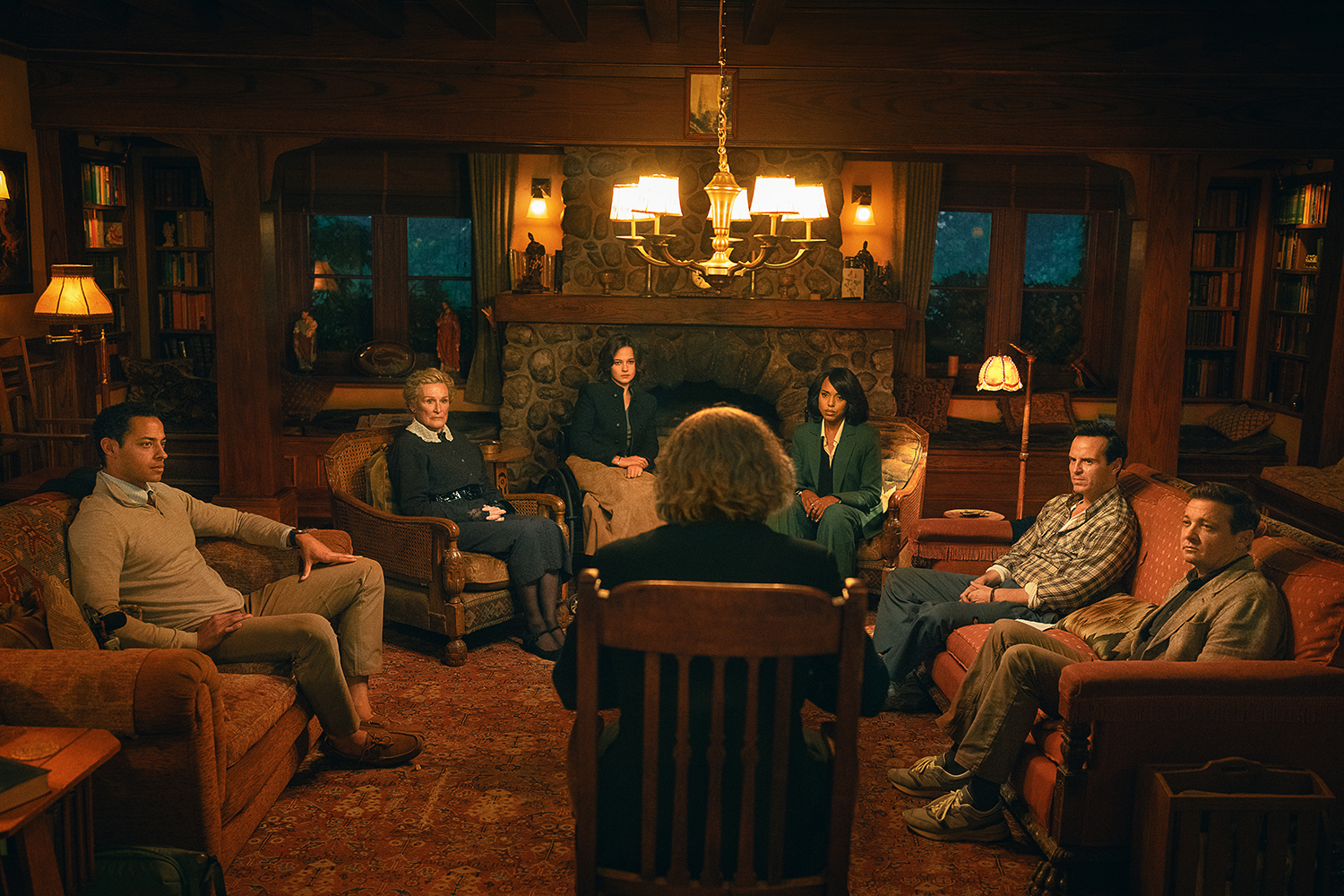
Wake Up Dead Man: A Knives Out Mystery. (L-R) Josh Brolin, Daryl McCormack, Glenn Close, Cailee Spaeny, Kerry Washington, Andrew Scott and Jeremy Renner in Wake Up Dead Man: A Knives Out Mystery. Cr. John Wilson/Netflix © 2025
Another scene in the church I wanted to ask about was the meeting between Blanc and Father Judd. How’d you and Rian pace the light coming in and out of the church?
Well, we’re doing that all throughout the movie. The first one between Jud and Blanc is one of the most fun ones. Blanc comes in and it’s sunny and they have their two speeches about the two approaches to faith that’s setting the groundwork for the whole character interaction throughout the movie.
As Blanc gives his speech about reason over faith and the sun goes away and it becomes that dark, steely overcast, and then as Jud gives his rebuttal speeches as the sun comes out behind him and is flaring the lens. Because we did all of this work in prep to make it, the technical part was already taken care of so that we can hone in on what we want exactly when we’re shooting.
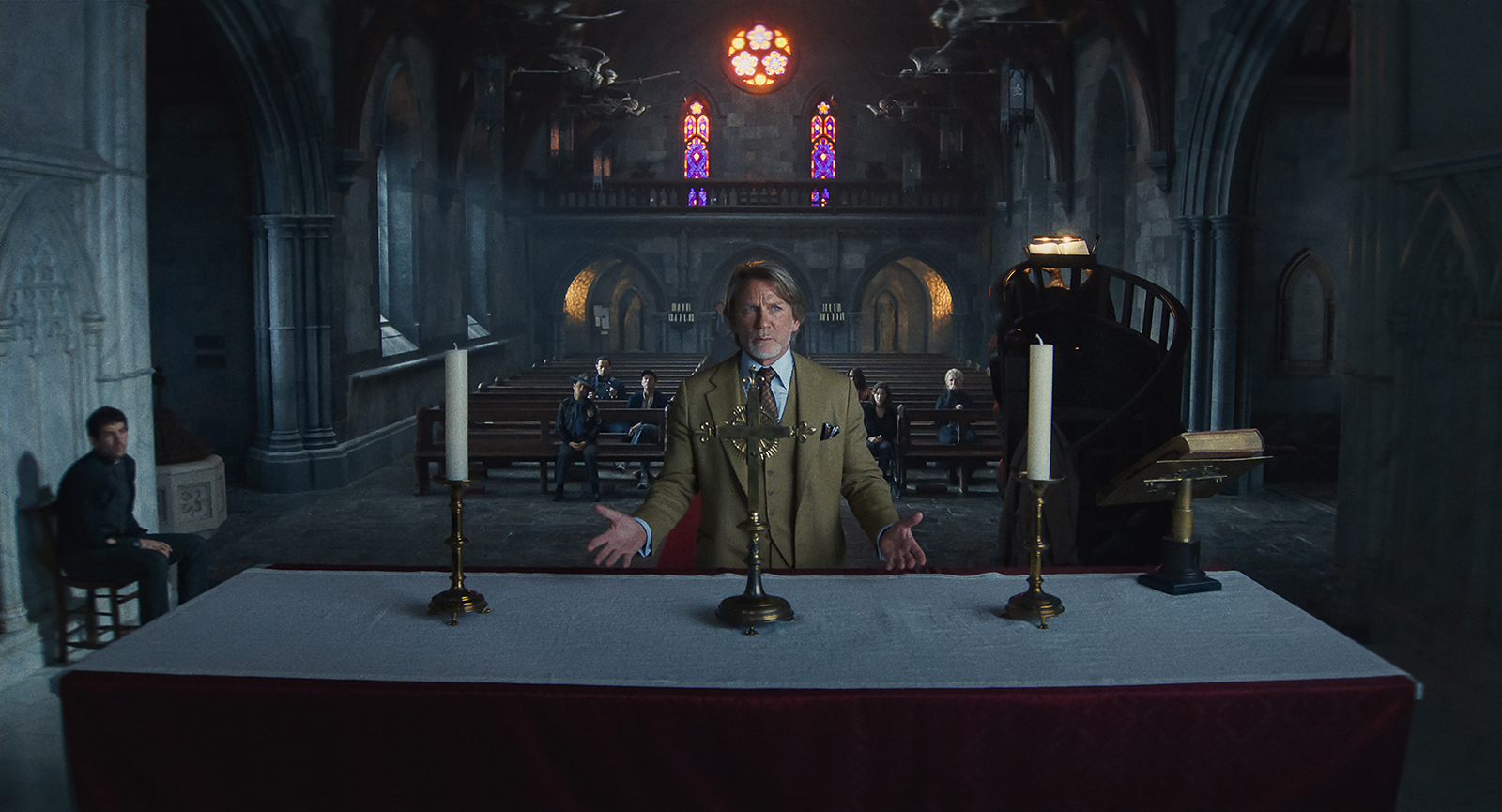
Wake Up Dead Man: A Knives Out Mystery. (L-R) Josh O’Connor and Daniel Craig in Wake Up Dead Man: A Knives Out Mystery. Cr. Courtesy of Netflix © 2025
How’d you hone in on it?
I have this custom light control software that I’m operating. I can just make super subtle finesse changes. Rian knew, okay, when the clouds cover the sun, when Blanc starts to talk, it’s going to be shorter. And then when Jud’s giving a speech, it’s going to be much longer. With Blanc, it’s almost setting the stage for it, whereas with Jud, it’s coming out over that period. We need this to be programmatic, repeatable, dependable to where it’s happening on the same line and over the same duration and for every shot and every take so that they can edit the movie together. And also that its reliable actors are giving these big performances. We can’t be like, “Oh, sorry, the lighting queue didn’t work. Can you start over?” It’s got to be repeatable, dependable, all of that.
Given the pacing of Rian’s movies are so unique, does he give himself many options for post on the Knives Out films?
Rian knows how he’s going to cut it, and it’s not like, “Hey, this doesn’t work, and we’re always finding it.” But I think sometimes people think that that means that that sticks you into no options, but it’s the opposite. When you really shoot it like that, it actually gives you more options unless something’s actually a one or usually if you shoot something with the edit really in mind with a really clear plan of how it’s going to cut together and how it’s going to feel. Then even when you do either change the idea or just need to finesse the idea that’s more conducive to it, not less.
Do you and Rian have a general philosophy about how to best tell the story when you have an ensemble together? What are you looking for?
Well, it’s very much about feeling the dynamics of how everybody’s in the space and how they’re relating to each other. We very consciously do not want it to fall into that ‘90s TV cutting pattern where it’s literally a bunch of closeups of people isolated in the frame, and then the editing becomes one head replacing another head. It’s not interesting. It doesn’t tell the story of how everybody’s relating to each other and to the space and to the drama of the scene.
The other thing is when you have a lot of people in a scene, especially when they’re even vaguely in a circle kind of all facing each other, it’s easy to get really screwed up with the stage line and then spiral out of control. We need this person from that angle. Now we don’t have this person from this side. And then when they look at each other, then when these two people look at each other, the stage line changes to them.
What we try to do is keep one strong line to the whole scene. This is the big conflict right here. It’s okay if individual shots cross their own line, and we even break that rule sometimes, but we try to keep the big line on the right side, on the correct side. It’s okay if individual lines, if somebody throws somebody a glance, it’s okay if their own line is wrong, as long as it’s right for the main stage line.
We’re sort of adding little shots here and there like, oh, you know what? This person gives a glance one time, let’s get a shot for that. We’re usually doing that not because of their minor stage line for that one glance. If their stage line for that one glance is wrong, it’s fine. The reason we’re actually adding a shot there is because we want to connect them, maybe in the shot that we have of them. It wasn’t whether the stage line’s right or wrong, it’s that when they turn their head, they’re really profile and it’s a moment where we want to connect with them, and that’s why we would do the additional shot more than the stage line.
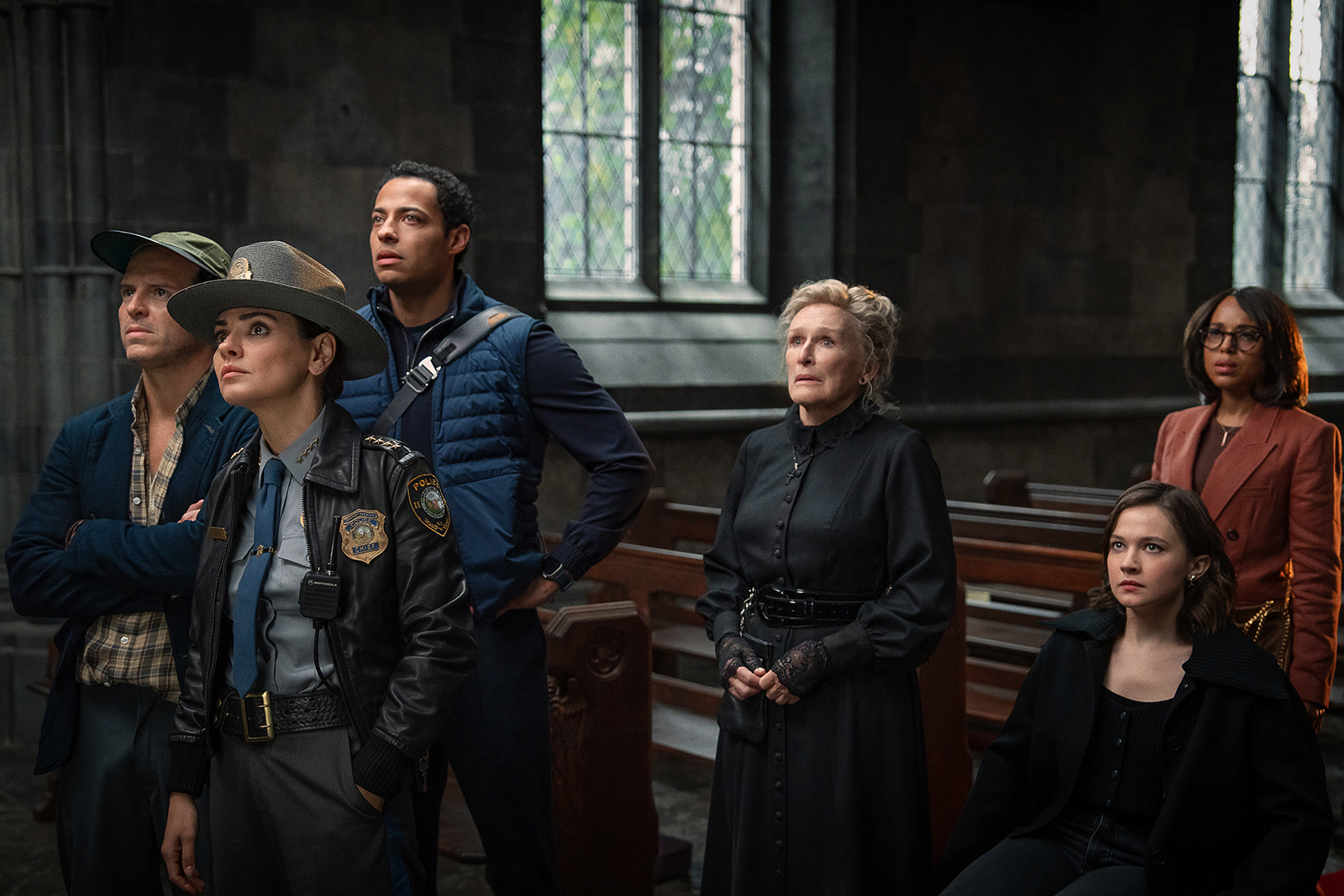
Wake Up Dead Man: A Knives Out Mystery. (L-R) Andrew Scott, Mila Kunis, Daryl McCormack, Glenn Close, Kerry Washington and Cailee Spaeny in Wake Up Dead Man: A Knives Out Mystery. Cr. John Wilson/Netflix © 2025
When the truth comes out in the end, when a confession is made, how’d you want the light to tell Martha Delecroix’s (Glenn Close) story?
Well, there’s the big scene in the church right near the end where I kind of did this thing where she really feels kind of ensconced and light. It was motivated by the idea that all the lights filtering in through those church windows and bouncing off the floor. It was also a bit of theatrical and heightened realism.
How fine of a line is that creating theatrical realism?
Describing it sounds paradoxical, but when you get into the groove of it, it actually makes more sense than doing either of the other two things on their own. If you don’t have something to grip onto, you can spiral. If a poet’s got the meter and foot and rhyme scheme that they’re trying to fit things into, that’s not necessarily a straight jacket. It’s where the creativity comes from is you’ve got to make it fit that.
 Rating: PG-13