Picture credits: Netflix / Getty Images
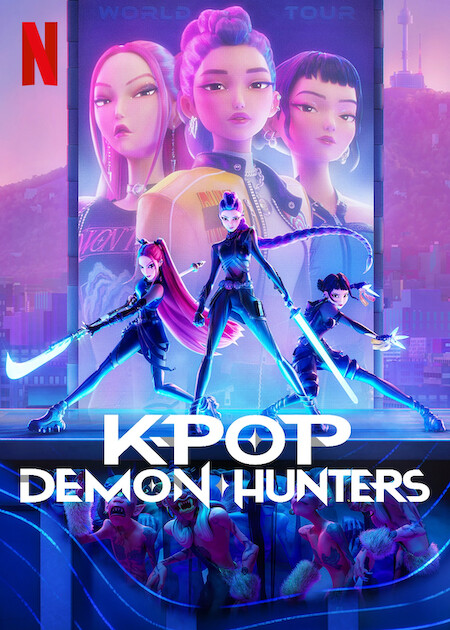
KPop Demon Hunters is a joyful, action-packed spectacle. To call the movie a crowd-pleaser, at this point in its reception, is understating how it has moved — emotionally and literally — audiences across the world. The animated, music-loving tale of HUNTRIX dispensing of demons and delivering catchy tunes is the rare movie these days that becomes a phenomenon.
The KPop-driven heartfelt action all started with Maggie Kang. The story artist previously worked as a story and storyboard artist, including titles such as Kung Fu Panda 3, Puss in Boots, and Rise of the Guardians. Alongside co-director Chris Appelhans, KPop Demon Hunters marks her feature directorial debut. In short, what a debut. Appelhans, too, has been in the animation world since 2006’s Monster House and made his directorial debut with Wish Dragon.
Together, Kang and Appelhans deliver what’s quite possibly the defining animated movie of the year. We caught up with them recently to look back on the process of creating the movie and the reception upon their recent trip to South Korea.
Given the perfect unison of action and music in KPop Demon Hunters, what did you both hope to achieve with the musical-action set pieces? In early animatics, what did you learn that would or wouldn’t work?
Chris: Getting his dance-fighting thing to work felt a little scary. That could be goofy if the music isn’t great. Above all, we always needed to have character in the action. The plane fight, for example: they’re kicking ass and it’s tightly choreographed, but also, they’re annoyed that they can’t eat their ramen. There’s a playfulness to it that helped make them fun characters, not just badass fighters.
We trusted our animation team at Sony. You board it as much as you can because when you get into that level of choreography and the tightness of the edit, you can get a certain resolution, but beyond that, you need to get into the hands of the animators. We had animators that could do a 2D pass where they would do a 2D camera move, overlapping action, and all the sheets of perspective and foreshortening.
Maggie: That bathhouse shot at the very end was done in 2D, hand-drawn and figured out. And then one animator led that whole action and the handoff between all three girls, which is brilliant. We didn’t have a lot of R&D time for any of this, so it was working with an incredible crew at Imageworks that were up to the challenge.
Each action scene has its own color. For example, the luminous green for the bathhouse fight. How’d you want color to define the action scenes?
Chris: The biggest influence on the visuals was trying to push towards music videos and editorial lighting that you don’t typically see in animation. We would pull these reference boards that could be everything from the bathhouse fight in Eastern Promises, which is very atmospheric, beautifully shot and very clear. And then we would pull music video references where you have strong gel lights and colorful rims. Every time music came on, we wanted it to have, at the very least, a slight music video aspect. That was fun to mash that up with the costume work we did on the girls and the elevated design of their features. You get this pleasing K-pop aesthetic even in an action scene.

KPOP DEMON HUNTERS – When they aren’t selling out stadiums, Kpop superstars Rumi, Mira and Zoey use their secret identities as badass demon hunters to protect their fans from an ever-present supernatural threat. Together, they must face their biggest enemy yet – an irresistible rival boy band of demons in disguise. ©2025 Netflix
Great to hear that Eastern Promises was a reference for KPop Demon Hunters.
Chris: Some of our references are wild.
Maggie, what about Charlie Chaplin for you? He made movies that were pivotal in your upbringing, and you can see his sense of humor and action in your movie.
Maggie: Buster Keaton, Charlie Chaplin — they’re silent filmmakers and rely on acting and pantomime to convey emotion and comedy. I think that helped me as a story artist: how to communicate through posing. I’m not a big action person. I could give you an action scene, but do you really want one of my action scenes? I think that takes a very specific skill set to pull off.
For me, it’s all about what’s happening within that action scene, all the character moments. That’s my approach to any scene, whether it’s action or an emotional scene. Imageworks is great at balancing, being able to pull that off.
There were shots I was stressed about putting into production because we hadn’t figured them out. The choreography with the action and boards — the animators just took it and also had full control of the camera. They were the ones placing the camera, motivating action, and giving all that fluidity and the forced perspective that’s very anime-inspired. Credit to them.
Nothing but credit for their work with the concert crowds in this movie, as well. How’d the animators achieve the level of scale and variety?
Maggie: That was a huge undertaking. Imageworks uses a great system for creating crowds. You have to think about the amount of designs that are required so you don’t see the same face all the time. There are also costumes constantly changing between the characters in the crowd. The team was called Stray Crowds, because of [the band] Stray Kids. They were so great, and some of them excelled so much on their crowd shots that they got more shots of the main characters.
Chris: Their crowd is a character in the movie — the fans. I remember thinking so many times, seeing the animation of maybe a medium crowd shot, the amount of genuineness. We would be like, “This is the moment where everyone gets butterflies in their stomachs,” and the animators would make this group of fans feel that. It’s a big part of buying into the concept. If it feels forced or fake, you don’t get on board.
Such a delicate balance between the music and the sound effects in the action, but the sound team makes them really sing together. How’d the sound department balance the sound effects with the music just right in all the action?
Maggie: We are living within a pop song. We found that if we added too many effects, it would take away from the music. We wanted to treat all of those music scenes as music videos. When you watch a music video, you don’t tend to hear sound effects within it. We wanted to stay loyal to that.
There were a few moments where if there’s a punch or some sort of accent we wanted to emphasize, then we would lean into a sound effect there. But especially for the music sequences, we stripped most of it away.
Chris: Our music editor and sound designer — if there was a bonk because Zoey is hitting a demon with the water heater mug, they would pitch that up so that it was in the same key as the song. You could get a bonk and a bonk, and they would go with the melody. The sound effect would be present, but the song wouldn’t be stepped on.

©2025 Netflix
Maggie, something triumphant about the third act battle is Rumi using honesty in both her art and friendships, and that is how they succeed in battle. Even when you pitched this seven years ago, was that a part of the story you wanted to tell?
Maggie: Seven years ago, it was just a concept. I honestly didn’t know what I was getting into. It sounded like, oh, putting together demon hunters and K-pop, that’s fun. And then once I started to dive into it and figure it out — even the plane fight scene before any of the mythology was figured out — I was like, oh no, I have to figure out so much in order to execute this. What happens and what’s the choreography? What happens when they kill the demon?
Thankfully, Chris came on and we honed in on the mythology. We gravitated towards inner demons, that of the main character struggling with inner demons, her inner demon being a literal demon. We always knew we wanted the power of music, and wanted the fans to contribute at the end of the movie as a big source of power for these girls. The final battle in this concert arena was in the first draft of the movie we wrote, and we refined it and figured out a song to go with that. A big, long journey that took a lot of refining, but it was an idea that was there when Chris came on.
You two took a trip to Seoul. How’d the food and weapons there inspire what we see in the movie?
Maggie: We went to an namsan tower to check out the location where the final concert was held, and there happened to be this weapons demonstration there. We held some of them. They were massive and incredible. I was holding Mira’s weapon, the gok-do, and thinking about her swinging it around. The amount of force she needs to exert for it to look graceful was like, wow, this is going to be a powerful woman.
We wanted to feature a lot of traditional Korean weapons. There’s a lot of Korean, Chinese, Japanese overlap, of course, because of history, but we also wanted them to feel magical, like sonic weapons created from the Honmoon.
Chris: Even designing them, a signature that could give them uniqueness was — they might have slender arms, but they have little deltoids and some muscle there. They have that gymnast strength in their design. It shows up subtly in their upper body in a way that looks cool and makes you believe the fighting aspect a bit.
How does animating food compare to action?
Maggie: Food is very hard to do in CG.
Chris: Hard for it to not look gross and not look fake.
Why is that?
Chris: It has to do with the photography and the quality of the materials. A lot of times what makes food look good or not is the implied temperature or the moisture level. If any of that feels off, as humans, we’re good at saying, “That doesn’t look right.”

©2025 Netflix
Maggie, what were some dishes and snacks that were very important to the film?
Maggie: The odeng soup, when they go to the restaurant, looks so scrumptious. Every time we did reviews with food, we were just so hungry. Everybody wanted to go to K-Town and grab Korean food afterwards.
One of the things I really wanted to do was not feature kimchi. I didn’t want the association of Korea and kimchi, because it just feels like we’ve done that. I don’t want our culture to be defined by this one food that seems to dominate our culinary identity. It was important to feature a lot of different types of food, but also common food that most Koreans normally eat, like ramen and gimbap.
I think a lot of us were kind of embarrassed to take gimbap to school because of the fishy smell of the seaweed and kids being like, “What’s that?” To see it now represented in an animated movie, with kids seeing it and normalizing that, it makes us proud as Koreans who had to feel a little embarrassed about taking it to school. It’s cool to see how Korean culture has come such a long way.
What else have you found fulfilling about the film’s reception?
Maggie: I just wanted to show things that I wanted to see, and I didn’t realize that there was an entire country that wanted to see that, too. When I go to Korea, they’re so proud of this movie. I didn’t expect it, and it wasn’t something I was really thinking about when I was making it. It feels amazing. I’m honored to have made something that means so much to Koreans.