Picture Credits: Netflix / Getty Images
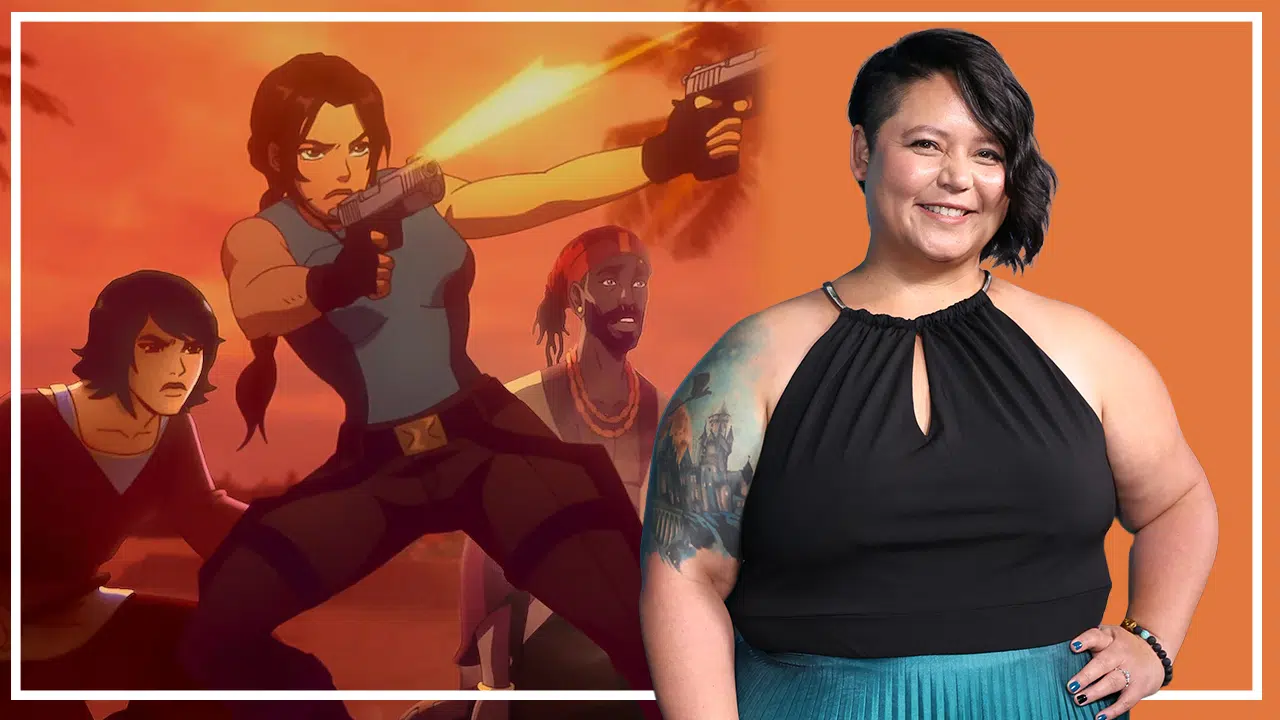
Tomb Raider: The Legend of Lara Croft never falls short on adventure. With season two, Lara Croft (voiced by Hayley Atwell) faces the sort of globe-trotting challenges, on land and sea, brimming with liveliness. There’s a new level of glee to the animated series, which sees Croft reconnect with the people in her life as well as her purpose in the world.
Tomb Raider: The Legend of Lara Croft comes from showrunner Tasha Huo, who’s hopeful we’ll one day see more of her take on Croft. Netflix announced season two as its last, but Huo has more stories to tell. Meanwhile, the storyteller is busy showrunning a new hit animated series, The Mighty Nein.
Huo is a writer’s writer. She co-hosts a screenwriting podcast, The Act Two Podcast, alongside Josh Hallman. After a break from the show — which any screenwriter should listen to — Huo spoke with What’s On Netflix about putting together season two of Tomb Raider: The Legend of Lara Croft.
With season one, you got a lot of set up done. Where’d you want to take Lara Croft from there in season two?
It was great to finally move Lara past having to deal with her past trauma. The goal of season one was to say, okay, Lara is a fully formed person now. We no longer have to deal with the elephant in the room that has been there in the games this whole time.
The problems she’s going to start having in season two are related to her and her issues, not about some father figure in the past. If you sense that there’s more fun, I think there kind of is because the trauma’s behind us, and now we’re dealing with the remaining issues.
Lara relishes the adventure more this season.
I think so too. Season one came from a very personal backstory. In some ways, the adventure was being driven by her own sadness, and that’s just not there anymore. There is a freedom for her now to start getting into the Tomb Raider that we know and love from the early games.
Such as a heist episode you got to write for Lara Croft. How much wish-fulfillment did that involve, writing a classic heist for Croft?
In the writing of it, I got to reference some of my favorite heist movies. The director and I would talk about Ocean’s 11 and our favorite heist moments and movies. She made sure that the artists all saw these movies referenced in the script so that we could narrow in on that fast-cutting and music.
We get to see a flaw of hers in that episode: she can’t play it cool.
She’s so awkward.
What flaws did you want to explore more in season two?
In the games, she was very quirky and she had a very fast wit. Beyond that, not a lot of great relationship building on Lara’s part. Just by the nature of playing a video game character in many ways, but also, the character that they built was not as friendly as, for example, Nathan Drake in some of those Indiana Jones ways.
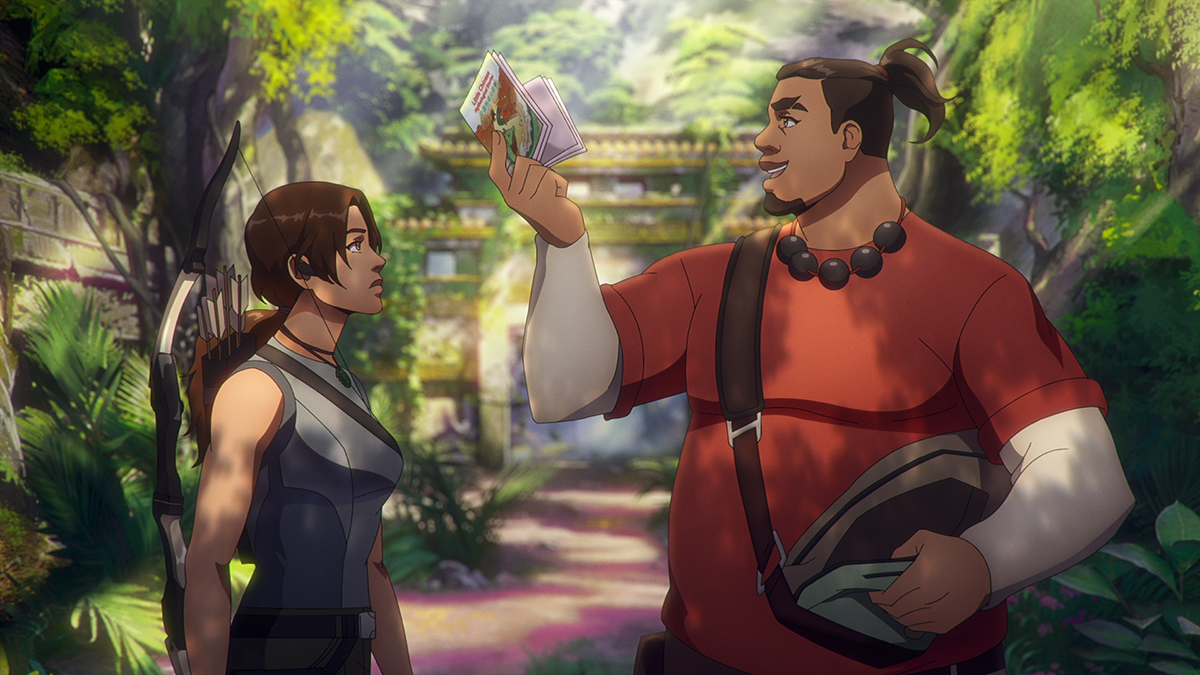
One of her big flaws is awkwardness — being unable to communicate with people. This can get her into trouble in relationships, but also as an adventurer out in the world. You see this with her trying to talk to Eshu (voiced by O-T Fagbenle), and Sam (voiced by Karen Fukuhara) has to interrupt and be like, “Okay, let a normal person come in and have this conversation.”
How did you land on West African mythology? You can go so many different directions, but what about mythology was best for season two?
It was blue sky thinking with my other writer, Shakira Pressley, and Troy Dangerfield, who was our writer’s assistant and a fantastic writer himself. Our homework was to go home and research any mythology that we felt we hadn’t seen before.
We took away a lot of the obvious options or places in the world, and tried to hone in on underrepresented cultures and mythologies. We narrowed in ultimately on either Indigenous American or Yoruba West African, which came from Troy and his research.
I wanted to do Indigenous America, but the more we dug into the research and the stories that we would have to tell, the more it felt inappropriate for us to be telling that. It was a conflict for me because if you don’t tell it, then it doesn’t get seen. But if you don’t tell it right, that’s a disservice. As a person with a history degree, I know I would do as much service as I possibly could, but would that be enough?
There was a lot more I think we could dig into with Yoruba culture. Both Troy and Shakira are African American. We could dig into themes of Zip (voiced by Allen Maldonado) being African American himself and not knowing his history.
There’s a story where Zip talks about how he skipped out of school one day when they were doing Heritage Day, because he does not know where his family is from. A lot of people take that for granted. “Yeah, my family’s from Ireland, I can trace them all the way back.” Zip couldn’t. The story comes from Troy, which was so impactful and became a big part of the story.
How’d you want to craft Lara’s journey from there?
Once we started getting into it, we wanted to explore this idea of how Lara goes into all these other cultures in the Tomb Raider games. In any of these kinds of adventure games or stories, it’s usually the white dude or the white lady who goes in and fixes everything.
We’re like, well, Lara thinks she has to be that way because that is where she comes from. But when she gets there, she realizes these people know more about their culture than she does, so how can she be of service to them? That helps her understand the culture more. It makes her ultimately stronger.
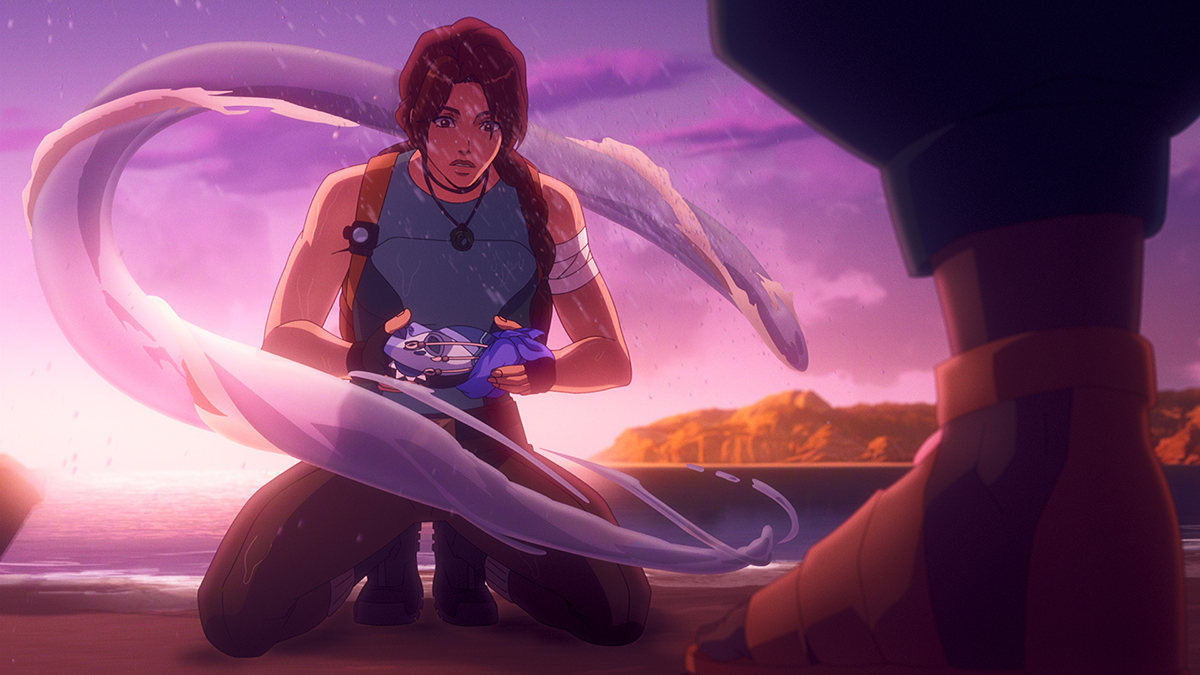
Tomb Raider: The Legend of Lara Croft S2. Hayley Atwell as Lara Croft in Tomb Raider: The Legend of Lara Croft S2. Cr. Courtesy of Netflix © 2025
You portray voodoo as a force of good, which is often not how it’s depicted in films and television. How important was telling that authentic story?
I love Sam’s speech in episode three when she’s like, “You don’t know anything about this. Voodoo is a unifying philosophy.” That was also new to me. The more I researched it, the more I learned.
What I loved about Tomb Raider historically, from when I played as a kid, was that it taught you all of these things that you just never understood or heard fragments of growing up. It made you want to dive in more. Hopefully, it does the same for other people because what Sam says is correct.
We did have a consultant across the show who would help with history — a cultural consultant. There were things that I got wrong in the script when it came to voodoo, and she would be like, “Actually, the item in the shop would look more like this or this phrase that this person uses is still not quite accurate. Let’s maybe frame it something like this.” We were always very careful about how we were portraying cultures that are foreign to all of us.
Do you use any of your own travels as inspiration for Tomb Raider?
Episode four when we go to Ireland. There are shots in there that are directly taken from a hike that I did in Ireland where I nearly died. There’s a sign that they all pass of a person falling off a cliff and Uchu laughs. It’s an actual sign that I saw as I was on this insane hike on the cliffs.
So, it’s bringing in life stories. I tell a lot of screenwriters: go out and live your life, because the thing that seems totally mundane, like a walk on the Irish cliffs, ends up becoming something inspiring that you can put into your work.
So you’re saying you are Lara Croft.
I mean, listen, you said it. I did not [Laughs].
After writing Lara Croft, how do you think you’ve grown as a storyteller in how to craft action and adventure?
As it comes to adventure, I have to figure out how to make it alongside the artists and directors. Having to do that has really honed my concept of how important it is to give the audience an experience. Sometimes we throw scenes in because we need it for plot or character, but if I leave that scene and I don’t know what experience I’m giving the audience, then that’s a problem. The scene could still need to function plot-wise or character-wise, but if I’m not leaving the audience experiencing something in particular on a ride, seeing the whole show as a rollercoaster, then I’ve done something wrong.
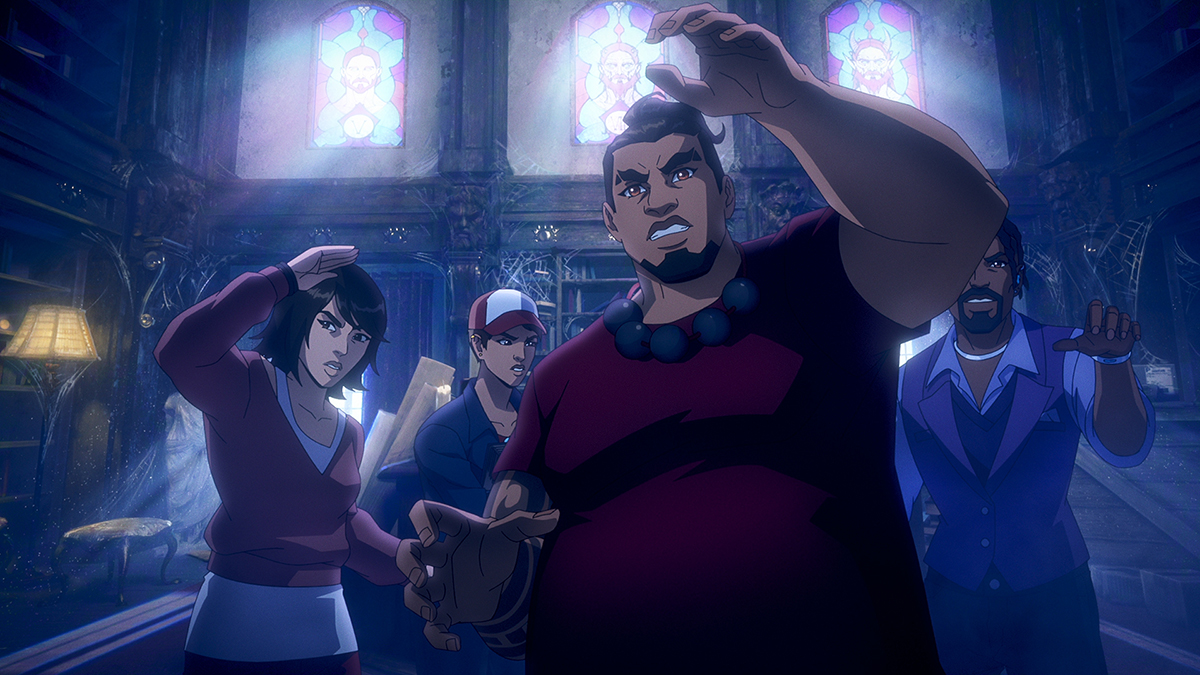
Tomb Raider: The Legend of Lara Croft S2. (L to R) Karen Fukuhara as Sam Nishimura, Roxana Ortega as Abby Ortiz, Earl Bayron as Jonah Maiava, Allen Maldonado as Zip in Tomb Raider: The Legend of Lara Croft S2. Cr. Courtesy of Netflix © 2025
You’ve said before it was a bit tough enjoying the success of season one of Tomb Raider. Now that the work is done and season two is out in the world, can you enjoy the success this time around?
It’s tough because the way that the show was marketed was this is the end of Tomb Raider. Season two is the last season you’re going to see on Netflix, in particular. I don’t know, it’s both joyful to see it finally done and to see all of the artists have their work seen. All the hard work that we’ve done over five years is over, so there’s a relief to that, as well as a pride in my first ever show that I’ve been a showrunner.
The flipside of the coin is that it’s over. It doesn’t have a great [audience] score on Rotten Tomatoes. It’s not this runaway hit. And so, it’s this combo that a lot of creators have to come to terms with when things that you love don’t come out to the fanfare that you had hoped.
There has to have been some fulfilling reactions too, right?
I’ve definitely gotten personal emails from people who have the same feelings I had as a kid with Tomb Raider, which is like, Lara changed my life; she made me think differently; the fact that Lara started opening her life to friends made me want to open my life to friends. All of those mean so much to me – and that’s why you do it.
I’m very proud of the show. It’s a dream job to work on Lara Croft. Holy shit, little Tasha never imagined she would ever get to do something like that. So, there’s definitely a lot of pride involved and a wish for it to continue. There’s so many more stories we have to tell. You’re hanging onto this hope of, “But can we tell more?”
What lessons, as a showrunner, did you learn on Tomb Raider that you brought into The Mighty Nein?
A big thing you learn as a showrunner is, or hopefully learn as a showrunner, how important collaboration is and how your ideas are often not the best ideas or your ideas definitely need the tires to be kicked.
You may hold the overall vision, but you have to absolutely be open to your writers and their genius, and that’s why they’re there. Collaboration definitely made Tomb Raider a lot better. It was something I fought for – to have more writers because in animation, you don’t typically get to have writers. It’s the showrunner, and then you maybe freelance some scripts out, but for the most part, it’s you crafting the whole story.