Now is the worst time to be a cinephile from a suburban household. You thought last year’s Weapons would bring you nightmares of residential living? August 2026 doubles down with two creature features that’ll make you quiver in your boots and raise your picket fences even higher. Call me Mugatu from Zoolander with the way I’m going: “Nuclear suburban family sci‑fi thrillers? It’s so hot right now.” While Ewan McGregor and Anne Hathaway have the freedom to stay outside while dinosaurs stomp through their suburbs in David Robert Mitchell’s The End of Oak Street, Greta Lee and Wagner Moura can’t even set foot outside theirs in Louis Leterrier’s latest post‑apocalyptic survival thriller, The Last House.
Frankly, Netflix’s post-apocalyptic thrillers are the worst subgenre the service offers. At best, they’re completely mediocre; at worst, the concept far surpasses the execution. Unlike Bird Box or Extinction, The Last House is by far the simplest—which should make it the finest of the subgenre by default. Despite hinging on a premise that reflects our pandemic lockdown experience, this family thriller is engaging, albeit narratively thin.
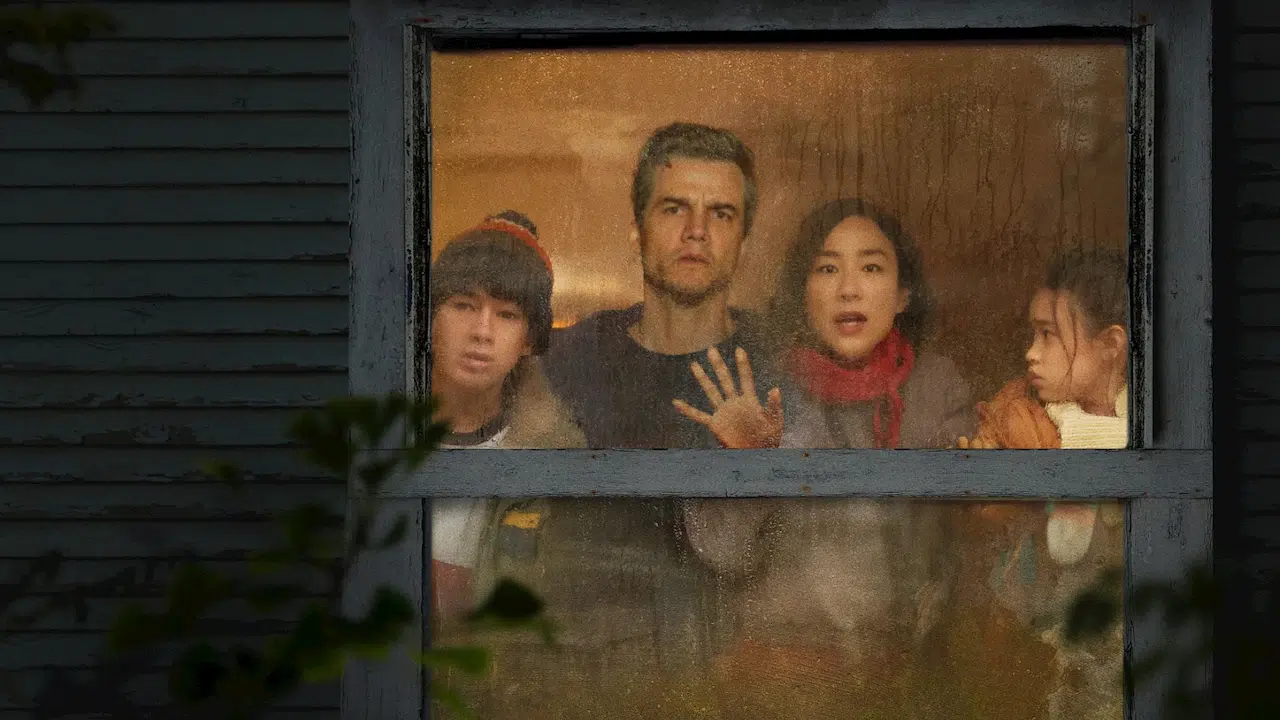
The film follows a suburban family: Jason (Moura), an idealistic do‑it‑yourself fisherman carrying the weight of his family on his shoulders; Riley (Lee), his strong‑willed wife; their two young children, Graham (Noah Alexander Sosnowski) and Ruth (Riley Chung); and their dog, Cassidy. It seems like an ordinary morning—kids on their devices during breakfast, parents discussing housing issues (the foundation is weak, and the chimney is the only thing preventing the house from caving in). But just as the family is about to buy a Christmas tree, they can’t open their front door. Nor their back door. Nor their windows. And the internet is down. They soon learn all their neighbors are in the same predicament—and anyone left outside can’t get back in. The moment it rains, ominous, monstrous creatures spawn and hunt any human left outside.

The Last House. Riley Chung as Ruth in The Last House. Cr. Courtesy Netflix © 2026
Initially, the family tries to make the most of the situation: no mortgage to worry about, and Jason has more time at home with the kids. But soon enough, as expected, they start to go a little stir‑crazy. The family drifts apart, and drastic, messed‑up sacrifices have to be made for their survival.
The first thing to think of when watching The Last House is a COVID‑19 metaphor, as if the film were capitalizing on the trauma of lockdown. It’s something I wouldn’t put past writer Matthew Robinson, who penned Gore Verbinski’s anti‑AI satire Good Luck, Have Fun, Don’t Die just last year. The film captures a mix between an early Shyamalan flick—with its sense of mystery and dread building on the unexplained—and the Darwinist isolating nature of This Is the End, down to sharing similar beats. The narrative is broken into chapters spanning days, weeks, and even a time skip that sees an older Ruth (Emma Ho) and Graham (Gabriel Barbosa). The film is at its most entertaining when challenging the family dynamic, watching them teach themselves makeshift tools for resourcefulness or evade the creatures that threaten them. It’s engaging and heartfelt to see them come together and embody the titular “last house.”
Although the movie quickly gets used to its one‑set format, it succumbs to the Netflix cliché of prioritizing plot over character. Ideally, the family is charming, but they’re so woefully underwritten. Excluding Moura’s Jason, who is only slightly nuanced through his optimistic perspective—you don’t often see a father lean toward idealism for survival in these kinds of movies, so it’s a nice change of pace—the family remains surface‑level throughout the film’s lengthy progression. Mostly, the children suffer from this: Ruth is precocious, Graham is angsty. Perhaps that comes with the suburban territory.
Whatever falters in Robinson’s script, its structural prose uplifts Leterrier’s direction. The Last House marks the Fast X and The Transporter director’s first foray into a sci‑fi pseudo‑horror setting, and at best, he evokes a claustrophobic sensation through the span of time. But he fails to elicit any mood from the isolation, struggling to deliver the chills he attempts to manufacture. I don’t see The End of Oak Street until next week, but even the promos capture genuine chills, already bolstered by a filmmaker more proficient in horror. There’s one effects‑heavy action moment toward the climax that bears a Fast & Furious engine and is executed more assuredly than any of Leterrier’s weak horror exercises.

The Last House. Greta Lee as Ann in The Last House. Cr. Chris Baker/Netflix © 2026
Despite the generic, predictable strokes it paints, I was completely engaged. A lot of that is heightened by Greta Lee and Wagner Moura, along with the young actors playing Graham and Ruth. Lee and Moura provide weight to their performances, encapsulating their joint resilience with passion. Their slow descent into dysfunctionality—despite a relentless spirit—makes the film’s grounded emotion against the apocalyptic situation completely palpable. Though it doesn’t hold a candle to their recent work (Moura in Secret Agent or Lee in the simultaneously released indie Late Fame), they’re fine for what the film tasks them.
Certainly, there are worse survival offerings than The Last House, but there’s better elsewhere. It’s paced well but runs 15 minutes too long, dragging out conflict that could have deepened its characters, while also having a rushed climax that feels like an afterthought, summarizing years of struggle in a 5‑10 minute showdown. Still, it’s more entertaining than most Netflix survival thrillers—it won’t make you cover your eyes and ears like Sandra Bullock—but ultimately, it’s fairly forgettable. The Last House has its moments, but they evaporate as quickly as the rain that brings the creatures.
Watch The Last House If You Liked
- Brick
- Signs
- A Quiet Place
- Leave the World Behind
- 10 Cloverfield Lane