Courtesy of David Fortune
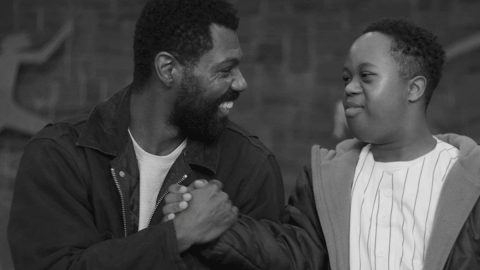
Color Book is a remarkable film. David Fortune’s feature directorial debut is a movie that connects to the gut, the heart, and the mind. Fortune wanted to portray a wide variety of emotions in his black-and-white drama, and it’s no small feat that he does just that in a tender story about a grieving father (William Catlett) and son (Jeremiah Alexander Daniels) trying to make it to a baseball game.
Every emotion rings true in Color Book, which was inspired by Gordon Parks’ photography, Carrie Mae Weems‘ Kitchen Table Series, and “the observational viewpoint” of Saul Leiter. After receiving acclaim on the film festival circuit, Color Book has now made its debut on Netflix.
The global reach for this intimate father-son story is, to Fortune, a great opportunity. “To share this story about two small souls in Atlanta that’s going to connect to people around the world means everything,” Fortune told What’s on Netflix. “To put Atlanta on the map, where everyone can experience the city, our lingo, our dialect, the way we talk, the way we interact, our mannerisms – it means so much. There’s no better place to show this film than on Netflix.”
This is such an intimate film. How’d you want to create intimacy between the father and son as well as the movie and audience?
There are so many ways to go about it. I didn’t want to rely on verbal dialogue to build that intimacy, but more so on visuals. Whether it’s the visuals of the hands threading the string through the beads, or the feet dancing on the wood, or the hand smack on the table, I wanted to show intimacy through body language. I felt it was sincere and would connect Lucky and Mason together, but then articulate that love to the audience as well.
These close-ups of hands, of touch, just feel so personal, like out of true memories. Did you draw on any childhood memories for Color Book?
To be honest with you, I didn’t have my dad in my life because he passed away when I was two.
I’m sorry.
No, not at all. So, I never had any of those memories. But I think about those times I had with my mom. My mom raised nine children as a single parent. Thinking about those moments – how she raised us, how she connected with us – whether she expressed it through love and intimacy or whether she got frustrated because she was raising nine children as a single parent, I drew from the things I saw within my mother. I placed them in Lucky.
What did your first draft look like for this? What feelings were you getting out on the page right from the beginning?
So, my film school professor, his name is Avery Williams, gave me this quote: “Done is better than perfect.” And so, the first draft was done, but it certainly wasn’t perfect. It was an ugly draft. However, there was beauty in it.
The main thing I wanted to know when I got to the end: did I feel something? And that’s something I knew was special in the story. It still had a lot of clunks. It still had a lot of uneven elements, but the spirit was right. You can always lean into that. If the plot’s not clear, do you feel the characters? Do you feel their humanity? Do you feel their struggle?
If you do, then I think there’s something there to be told. And that’s what I felt about the first draft I wrote.

Courtesy of David Fortune
There’s so much left unsaid in the movie. How did you express heavy silences on the page?
I usually don’t write a lot of dialogue. I focus on characters’ emotions and their actions. Visuals travel faster than words. If this can be shown, why say it? So, how do I show tenderness? How do I show love? How do I show anger? How do I show fear? Instead of writing those in dialogue, I write them through the characters’ actions. I live through that type of visual medium.
The movie has that tenderness you wanted. How did you want to create that personal experience even in sound?
Sound was key. I incorporated sound in the screenplay because I didn’t want to utilize a score to bring out the emotion within the story. I wanted to use the soundscape around them to create that tension or that intimacy.
In the scene where Lucky goes to the junkyard to recover his wife’s items, there’s no score in that moment. You hear the tension with the chirping birds, the howling winds, and even the creaking cars. I wanted the sound of the environment to build that tension or that sorrow rather than utilizing a score.
Even in the screenplay. I write “silence” into the script because I want the audience to feel that emptiness.
Courtesy of David Fortune
You made a black-and-white movie that is full of light. What effect did you want black-and-white to have in Color Book?
It started back when I did the short film Us, which was also funded and supported by the Netflix Content Creators Program. When writing that film, I wanted to focus on the story of a father and son trying to learn how to play baseball together. I wanted you to be locked into their experiences.
I thought about black and white as a tool to convey those emotions and actions. In black and white, you don’t see the distraction of the blue sky or the passing red car or the yellow sign. All you can see is what’s happening in front of the camera – what’s taking place between the characters.
When I put that lens on and watched the movie from that perspective, all I could do was follow these characters. All I could do was immerse myself in their fights, but also their joys. Black and white helps accentuate that. It quiets your focus on their performance and not the world around them.
A black-and-white film that is a clear influence here is The Bicycle Thieves. That movie had a profound effect on you, right?
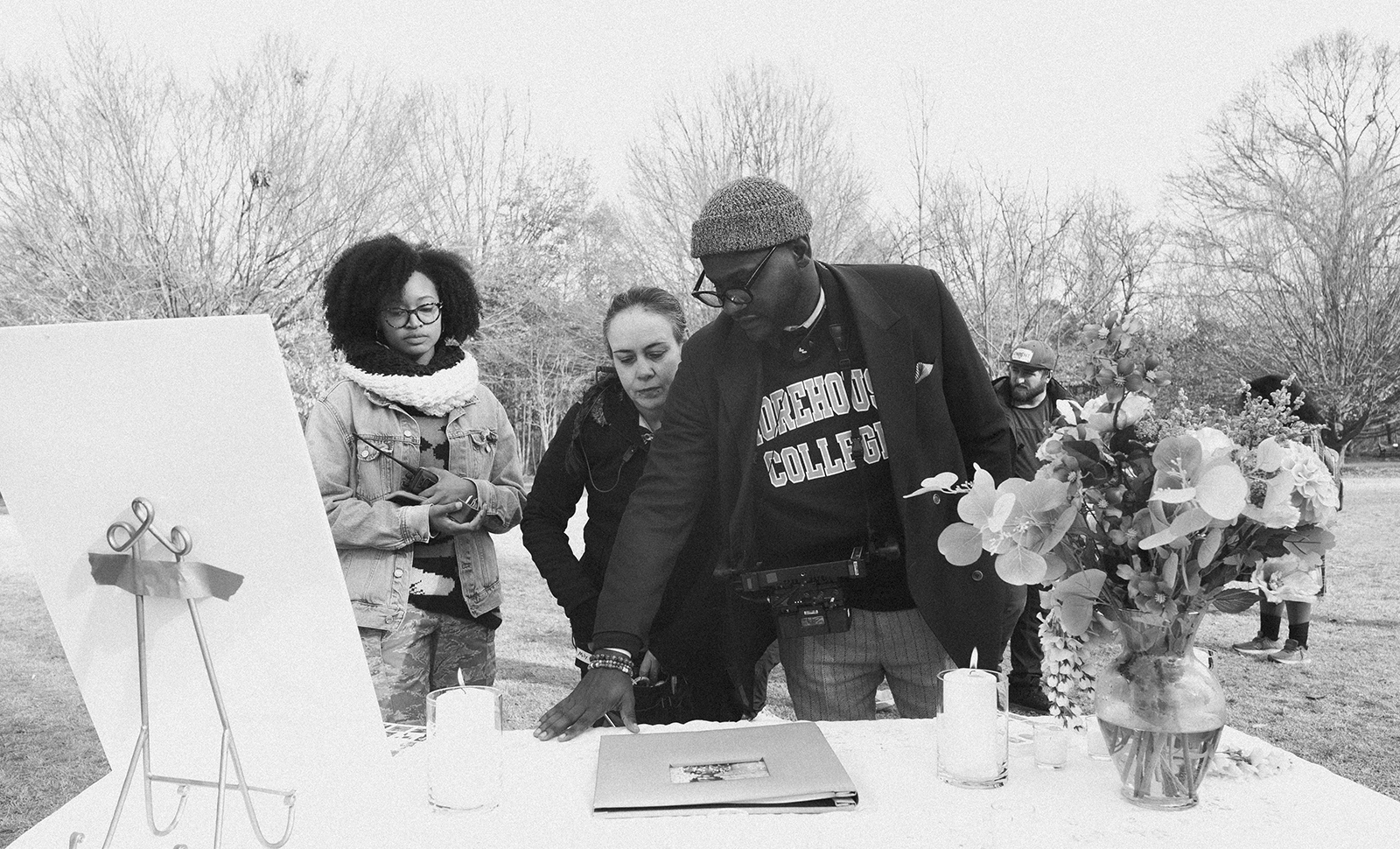
Bicycle Thieves inspired me to be a filmmaker. When I was at Morehouse College, I was taking a film studies class and my professor showed Bicycle Thieves. I remember seeing that film, despite it being spoken in Italian, shot in black and white, and made in the 1940s. It reminded me of my community in East Atlanta.
I was so moved by that that I decided the emotions that movie gave to me, I wanted to give to others. So Bicycle Thieves was a huge inspiration not just for Color Book, but for making films in the future.

Picture Credit: Netflix
There are so many different ways to go with black-and-white photography. What guided you and your cinematographer on when to go harsher or warmer with the light?
It all depended on what the emotion of the scene was. If there was a flashback sequence, and it was a warm flashback sequence, we approached it with a more blooming white tone that felt very heavenly. If there was a performance that had a lot of conflict, then we made sure to put a lot of shadows and contrast to reflect those conflicts and fights. If there was a sense of neutrality, we made sure that the black and white was balanced to reflect that evenness and the idea that these two characters are on mutual ground and sharing mutual emotions at that point in time.
Seeing this world and these characters so vividly, when you started casting, what qualities were you looking for in actors to play Lucky and Mason?
With Lucky’s character, who’s played by Will Catlett, I was looking for an actor who could give me a five-tool performance. Someone who could give me anger, frustration, joy, sensitivity, fear, and surprise. I wanted the whole gamut because Lucky is a complicated character. He deals with complicated emotions after losing his wife but still being left to raise his son as a single parent. I wanted all those emotions.
Then I thought about it and realized, well, you’re now looking for a perfect actor, David. But I was familiar with the work of Will Catlett, and I saw that he was able to tap into all those emotions in his previous projects. I knew that he was someone I wanted to portray Lucky.
With Jeremiah Daniels, Mason’s such a joyful kid. He leads with love. He leads with energy. He leads with laughter. I wanted an actor who naturally had that. He didn’t have to perform it. He just needed to exist within it. Jeremiah, if you meet him, and I hope you meet him one day–
I hope so, too.
You’ll see that he’s the most fun child you’ll meet. But I also was looking for depth within him. The thing about Jeremiah is that when he shot this film, he was 11 years old. However, he carried himself as if he were 13 or 14. He was mature beyond his years and able to tap into those emotions as if he were five years older than he actually is.
It’s a really beautiful portrait of how a child sees the world. How did you want to visually communicate how Mason sees the world?
When I first was visually approaching this film, I wanted to shoot it in all wides. I thought about Alfonso Cuarón’s Roma and how we observe these characters from a distance. Through observing these characters from a distance, we relate to them and connect to them.
So, in shooting this, that was the approach with me and [the cinematographer] Nikolaus. But then you see these performances happening with Will and Jeremiah, and it was like gravity pulling the camera closer and saying, “Hey, we need this camera to capture these emotions, to capture these interactions that are happening between me and my son.”
That’s what led us to go close and focus on the eyes. It was because of the emotion that these actors were performing. Through their performance, it drew us a lot closer than we anticipated.

Courtesy of David Fortune
Steven Spielberg is famous for getting iconic performances out of kids. He has always done so because he treated a child like any other actor, no matter their age. Was that your approach as well?
I treated Jeremiah as I treated Will. I spoke to Jeremiah in the same tone I used with Will because I wanted to hold him to the same standard. You’re doing a job, you’re coming in to work, and you’re providing a service the same way Will is.
And that helps everyone involved. It helps him as well because he feels like he’s not being treated like a child. He feels like he’s being treated like an adult. Jeremiah bought into that.
And so, with directing Jeremiah and Will, it was about allowing them to exist within the scene. I took my hands off a lot of moments and allowed them to play, allowed them to fight, allowed them to figure it out. We just captured it as if it were a documentary.
I found that to be useful for them because there was no pressure or anxiety that they had to get the scene. I knew it was going to reveal itself. I just wanted to make sure we captured it honestly.
Color Book is now available to stream on Netflix.