Picture: Netflix / Getty Images
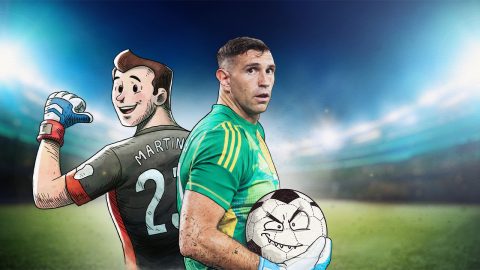
Emi Martinez: The Kid Who Stops Time does not work like a regular sports documentary. Starting out as a fully animated kids’ series, it ended up taking on the shape of a documentary, with bags of magical realism and gorgeous hand-painted animation. The man responsible for the doc’s visual design is Liniers, or Ricardo Siri, who has spent decades honing his craft as an illustrator.
His style blends an innocent, imperfect presentation with significant depth, able to communicate the biggest ideas through the simplest visual language. Siri, who grew up in Argentina but now resides in New York, has had run-ins with the national side before, most notably working with the great Lionel Messi on a live mural painting in 2010.
We caught up with Siri to chat about his passion for drawing, his work on the documentary, and refusing to go digital.
What does your day-to-day look like as an illustrator?
My day job is a daily comic strip. I’ve been publishing this daily strip for 25 years now, it’s called Macanudo, which is an Argentinian word for ‘Everything is Fine,’ which is a situation that never happens over there, except in soccer, I guess. I also publish graphic novels and books for kids through a label in Buenos Aires where I publish other people’s books. On top of that I have a friend who’s a musician, called Kevin Johansen, and we do shows together where he sings and I draw.

Picture Credit: Netflix
What inspired you to start drawing?
When you’re a little kid, if you’re good at soccer, you’re popular and people love you. If you’re not good at soccer, you stay in class and you go, “fuck it, I’m gonna just draw Star Wars stuff.” It was me and other kids without good coordination that would stay and just draw horror stories and a lot of Star Wars, and so when I was 10 years old it was very clear to me that I had to be a cartoonist. But then you’re 18 and you’re a moron and they ask you what you want to do for the rest of your life and I started studying law. That sucked. Then I did advertising for a while. That sucked. So then I said “I’m just going to do cartoons and be poor.”
Has it been difficult to stay afloat all these years?
I was extremely smart. Instead of studying law, I married a lawyer. Now I can’t get a divorce, because I’m pretty sure I don’t own any copyright of my stuff. I have no idea what I’ve been signing over the last 25 years. But of course, at the beginning, it’s this financial suicide. My brother, who’s 10 years younger than me, bought a car before I could. This is also back in the 90s where there was no real internet, Argentina was in a big crisis, nobody was publishing anything. I always wanted to be in a newspaper, that was the thing I wanted, to have that daily strip spot, and at some point something opened up, and I just got in at the last second, like Indiana Jones, and once I was on the inside, they couldn’t stop me.

Picture Credit: Netflix
What’s your relationship to football like?
It was an antagonistic relationship as a kid, but in Argentina, it’s like a second religion, or even the first. I remember watching Maradona win it in ‘86, and then lose it in ‘90. I ended up doing some illustrations for a book on the 2014 World Cup in Brazil and I managed to convince my newspaper to send me out there. They said, “But Ricardo, you know nothing about football,” But that was the point; I was the common man. I tried to sell it like I was Steinbeck. I ended up going for the first and last week and it blew my mind. It was a lot of fun until the last five minutes, then it sucked because of that little German asshole. But no, it was amazing, this multicultural party. I love football because I can’t understand how they do what they do, my brain doesn’t work that way. What Messi did last night, I just can’t believe it.
As an Arsenal fan, I should hate him, but I absolutely adore the guy.
If you like football, you love him. Like, if you love painting, you love Leonardo da Vinci, it doesn’t even matter if he killed your grandparents or something.

Picture Credit: Netflix
Who first reached out to you about the Emi Martinez documentary?
It was [screenwriter] Hernán Casciari; he’s kind of a famous guy in Argentina. He publishes a lot, he has a magazine, he does theater, he’s this all-encompassing character. He called me, saying he might have something for me. I had so many assignments at the time, I told myself, “just say no. It’ll be fun to have a coffee with this guy, but just say no.” We sit down, get a coffee, he goes, “the project is an animated show with Emi Martinez,” and I’m like, “Sure, yeah, let’s do this.” Do you remember the save he made?
Kolo Muani in the World Cup Final.
In the universe next door, where that goes in, I die six months sooner. This man gave me an extra six months to spend with my grandkids or whatever, so I owe him a show. At the time, it was a show but they found out how expensive the animation would be. Then we found some other guys who wanted to do a documentary and they meshed it together. These are two very different versions of storytelling, and [director] Gustavo Cova made it work. It’s really fun, because I’m getting a lot of kids flipping out over the cartoon aspect of it and then the parents are happy to watch something with their kid because they’re into soccer.
Did you do any of the animation yourself?
My career is just illustrating and whenever I do animation, I feel horribly guilty, because I send designs of the characters and the backdrops, and then there’s a team of heroes that ruin their posture over months and months to make them move. There’s a lot of adaptation you have to do for a character to be animated, and then suddenly you go “Is that my drawing or is it not?” But in this case, they were very respectful of my drawings.

Picture Credit: Netflix
Your work helps bring out multiple sides to Emi Martinez as a person. The innocence off the pitch and the spikeyness on it. Did he have any notes for how he was depicted?
The times I spoke to him during the production, he was the sweetest guy you ever met. The only thing he told me to change was the ears. He wanted me to make his ears smaller because I had a very cartoony version of him with silly cartoony ears. I said, “Whatever you want, Emi.”
You do all your work on paper with watercolors and ink. Did you ever consider switching to digital?
I’m very into EI – Emotional Intelligence, that’s where we’re going. I think people are going to start going back to the theatre and asking for singers to get rid of the auto tune. All this AI slop is making everybody angry, so if you see my strips, if you Google a little bit, you’ll see that I do everything with watercolor, and like I’m very old school. I’m like Geppetto because I need to see the humanity in the thing. I like that Bob Dylan has a weird voice. I like to see those Michel Gondry movies where you can see how he’s doing the effect, but it still works. In my work, every now and then, I color outside the line, even characters will change size or whatever. If I wanted my art to be perfect, I would just listen to Beethoven. The reason I listen to the Ramones is that I don’t want my art to be perfect; I want my art to be fucking alive.