Picture Credit: Netflix / Kevin Lingenfelser on Instagram
Man on Fire visual effects supervisor Kevin Lingenfelser needs to write a book. The visual effects supervisor has not only witnessed but crafted digital and practical Hollywood wonders throughout his career. He worked on Armageddon, Waterworld, I Robot, True Lies, Freddy vs. Jason, The Mummy, and Midnight Meat Train, to name a few epic titles from his career.
The Emmy-nominated VFX supervisor continued to build expansive worlds on television with shows like Preacher, The Orville, and Resident Evil. With Man on Fire, however, he had to make sure the effects were more grounded and invisible. Whether it was explosives or gunfire, as he told What’s On Netflix, Lingenfelser wanted the work to remain invisible.
Whether you’re working on something fantastical, like creatures for Resident Evil, or something more grounded like Man on Fire, do you always have a common goal for the visual effects?
Absolutely. It all boils down to the most photorealistic visual effects that I can achieve with the people that I’m working with to each show regardless of the subject matter. With the Saltwater Crocodile [from Resident Evil], everybody knows what a crocodile looks like, but we’re making it a hundred feet long. Everything else is blown out of proportion. Everything’s got to scale up. Everything’s got to be proportionate.
But then when you Man of Fire, we have a lot of what I consider invisible effects in the show. We were working mostly in Mexico City and it needed to work for Rio de Janeiro, which it did. We had to be cognizant if there was Spanish signage anywhere in the shots; we had to change those to Portuguese. Both the main guys, Yahya and Bobby Cannavale, liked to wear sunglasses, so we had a lot of reflection removals to do.
On a grander scale, you end the premiere episode with a massive explosion. Where’d the work begin there?
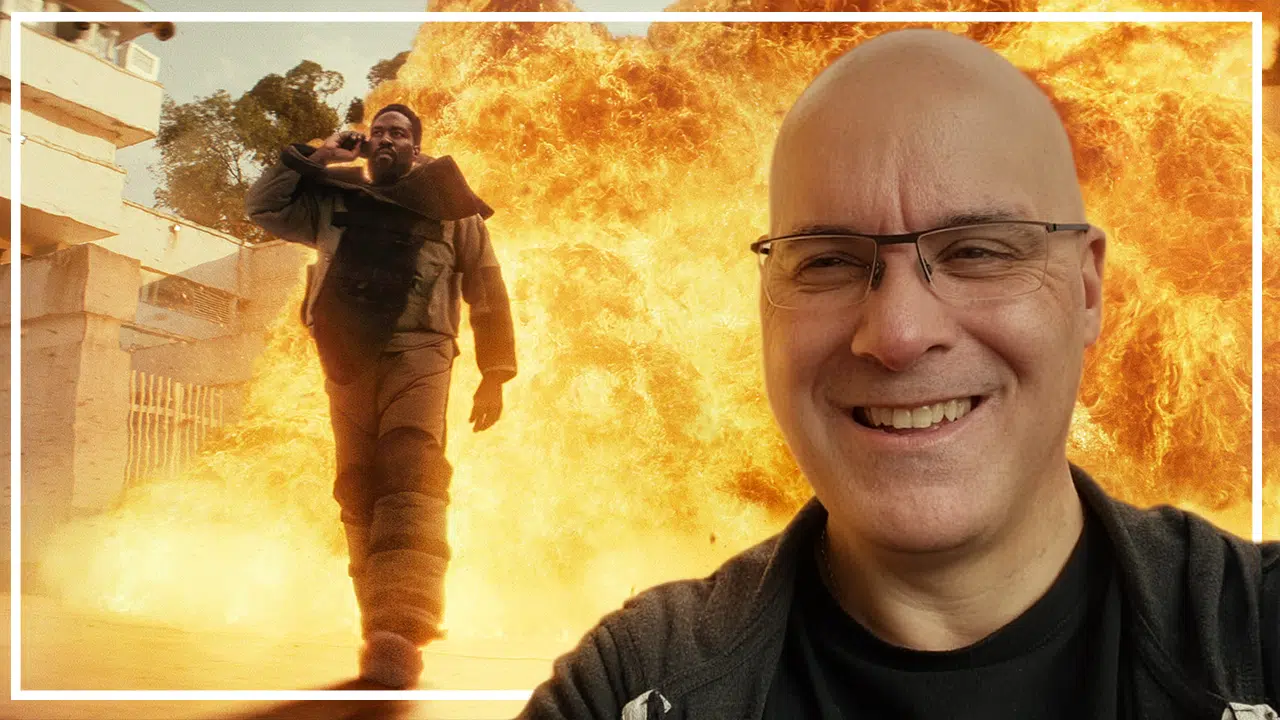
Doing the actual destruction of the condo building effects simulations with RISE Effects. The sequence right after, which we were supposed to shoot on location, was postponed twice due to inclement weather. The rain and lightning kept delaying us. Netflix had a safety person on site. She basically told us the rules and we couldn’t do it, so we ended up having to shift the whole shoot [of the aftermath] to this warehouse that was not set up for production filming at all.
It was a derelict, vacant warehouse. We lined three quarters of it in blue screens and we shot that sequence of him walking from the cab up to the destruction in that environment. But the distance was so short we had to do it in two sections. We had to make it seem like the road and the travel that he was doing was longer.
Also, we had to be aware of where Poe was in the sequence. The way it was originally envisioned, it seemed like it was going to play longer, but in the edit, they cut it in such a manner that it was shorter travel. So, we had to do all this work to make sure everything was in continuity and no one was aware of the fact that this was not done outside. That was the main goal, and that was done by SSVFX.
You couldn’t tell that the aftermath of the explosion was shot in a small warehouse.
I think it was a great success because when we were shooting that, nobody thought it was going to work. Everybody thought that sequence was doomed. It was like, okay, we’re doing this now with a blue screen. We were supposed to do it for real, but no, they killed it and it ended up really well.
How is it doing just gunfire and gun smoke these days? Did those come a little more naturally or is it always a challenge?
It can be, yeah. On Resident Evil, all the weapons were 3D printed, so none of them, other than a trigger, were functioning. The actors had the mime kick back on the rifles, we had to do shell ejections, and stuff like that. It was the same thing here.
The effects team in Mexico City did have an armorer and we were able to get airsoft weapons. So, there are several shots where Creasy fired his pistol during the airport attack. Those were airsoft, but we still added the muzzle flash and still had to add the shell casing eject out of the port. We had to do all that for that whole sequence at the end.
Any impacts on walls and the surrounding, that was all us. It was constant muzzle flashes and casings. Of course, it wasn’t just showing casings ejecting. We had to keep track of them when they would land on the floor, to make sure that they were always there and present.

MAN ON FIRE. Behind the scenes of Episode 101 of Man on Fire. Cr. Juan Rosas/Netflix © 2026
What reference did you use for the explosion in episode one?
At first we went down this road, not very far, but this idea that it was almost a controlled demolition. I watched hundreds of demolition videos of buildings and structures from around the world. And then when we started testing that, it was Kyle Killen, the showrunner – to his credit – who said, “No, I kind of want this to look dirty. This is a terrorist bombing. There’s not going to be anything really controlled about this.”
We still looked at those references and looked at other terrorist type events that had happened. We used a reference to a small community in Russia that had been targeted by terrorists. Housing complexes were destroyed. There wasn’t any footage of the actual bombs going off, but there was footage of the aftermath.
The lobby was the first explosion. Obviously, we wanted the foundation of the building affected first. Then midway up we added the second larger explosion to cut the building in half and help it fall away from Poe. The thing with controlled demolitions, a lot of times they pancake straight down. We went out of our way with the two explosions to make it look like the building was severed, cut in half, and then the back half tilted and fell away from her. It worked out pretty well and was done by RISE FX.
What kind of timeline do you get on a show like Man on Fire?
I started this show I was hired on in June of 2024, the first day of shooting was August 19th of 2024, and then we wrapped in February of ‘25. But getting back to that one question you asked early on, whether you have a large budget, small budget, whatever limitations, the end desire, end result is always the same. You want to just always provide the best visual effects you can. That is my job.
Obviously, building destruction people will be like, “Oh, that’s visual effects.” But we don’t want them saying that because it looks bad. It’s like, okay, we know they didn’t go out and destroy a building, but then that whole sequence where he’s walking to it, we don’t want people to even realize that, oh no, that was a massive visual effects sequence, because most people tend to think that that was done live.

MAN ON FIRE. Billie Boullet as Poe Rayburn behind the scenes of Episode 102 of Man on Fire. Cr. Juan Rosas/Netflix © 2024
So that’s just one of the examples in the show that was really cool to work on. A lot of the stuff I’ve worked on in the past, like the iRobots, the Armageddons, and TV-wise, Agents of Shield, Preacher, you knew upfront you were dealing with visual effects-heavy shows. Here, the visual effects serve the story, blend into the rest of the visuals of the show; they’re not intrusive or they don’t bump. That was the end game.
You often try to work on projects or properties you’re a fan of, right?
I try to work on stuff that I’m a big fan of. I went after Resident Evil because I was a big fan of the games. I love creature work. That’s some of my favorite type of stuff to do. Even though I knew going in that I was like, “Okay, just so you guys know the fans, they’re going to be rough on this.”
As a casual Resident Evil fan, I thought it was fun, but some of the discourse around that show was just brutal.
Yeah, but it’s always good to hear someone likes it, because that was one where I’m very proud of every creature that we did. Every episode had something in it. We started with the Caterpillar. Something that even the head of Constantin was like, “No, that thing looks like a turd.”
When we do this stuff, we do storyboards, we do previs, and then we do initial animations. We usually do that with gray shaded versions of the creature, and that’s what it was that the head of Constantin saw. Yeah, it may look like a turd, but that’s only because it doesn’t have the textures, the color, the lighting, the rendering, and the compositing done to it yet. I said, “Don’t worry, by the end of it, it will look like it’s supposed to.” That Caterpillar’s based off of a real-world Caterpillar. The director had found it. I loved the kind of green and red or orange-ish color to it.

RESIDENT EVIL, CR. NETFLIX © 2021
So we’re always dealing with stuff like that too, like, “Oh, this isn’t going to work.” I was like, “No, my job is to just ensure everybody, nope, don’t worry. It will work. We will get there.” A lot of times that means showing stuff sooner than we might like to, but if it alleviates fears, that’s just part of the job.