Picture Credits: Getty Images / Netflix
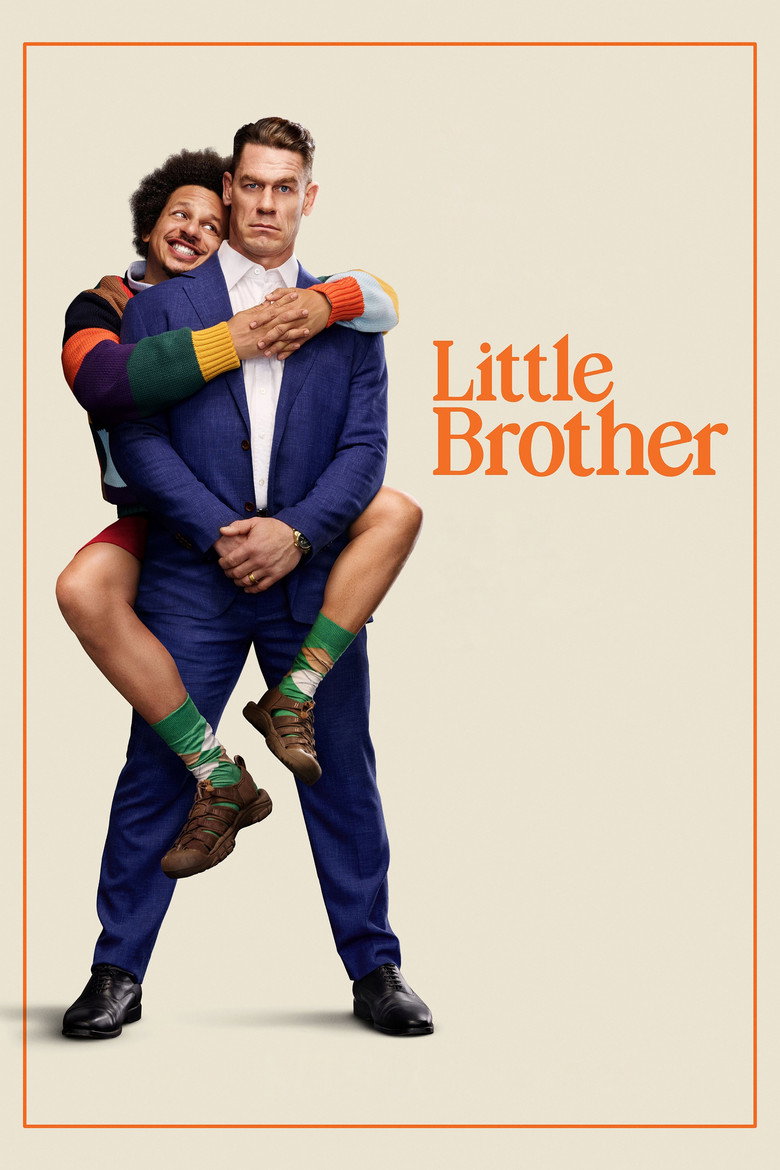
Fresh off Clint Bentley’s Oscar‑nominated Train Dreams, production designer Alexandra Schaller (House of Spoils, After Yang) trades rustic forestry for the real estate realm in Little Brother. Going from riding vintage trains to crashing Porsches, Schaller let her inner real‑estate‑reality‑TV connoisseur run wild designing Little Brother’s fictional world of NYC Hustlers — the in-universe reality TV show realtor Rudd Landy (John Cena) pursues to make his star turn with. Though shifting genres in her first comedic project, Schaller’s design philosophy remained the same as for a dramatic project, as the Matt Spicer-helmed film draws from 1990s comedy influences by shooting like a drama with naturalistic environments. It’s all part of the joke.
In our conversation, Schaller discusses constructing major sets like the Landy family home on a soundstage, convincing director Matt Spicer to get a reality TV star to cameo, and crafting and building elements for the destruction-heavy gags of Eric Andre’s character, Josh.
Coming off of Train Dreams, you went from a rustic, woodsy set to Little Brother, which feels more industrial. What was the shift in style and upscale contemporary class for the whole Landy orbit?
Alexandra: On Train Dreams, we built a ton of stuff, too; it was just designed to be invisible. Whereas on Little Brother, we built a ton of stuff and they were just sets that were more easily recognizable. Or, I should say, hopefully they don’t look like built sets, but they were just environments that you’re more accustomed to seeing as a set build, as opposed to building gigantic trees or fire towers or trains or things like that, which typically you shoot for real.
And did you shoot on location? What did you have to build, as opposed to using interiors that were already pre-established?
On Little Brother, well, we built the Landy house entirely on a soundstage, both floors. Some of it was cut out, but that’s okay. I know it’s there; I feel it. So that was a very big stage build. And then we shot a lot on location, but we did a lot of builds on location. So Josh Landy’s house—Rudd’s brother in the movie, played by Chris Meloni—his house was, I mean, completely transformed from top to bottom. We used the bones and the architecture of the place, but we covered all of the surfaces. The homeowners, who were living there part of the time we were transforming it, were kind of tripped out by what we were doing because we put in loads of cool wallpapers. Some were metallic. We made the columns in their house mirrored. They were just like, “Whoa, where are we?” And we were like, “We’re making a party house.” But that’s the thing—I feel like a lot of the movie was curated on location from the top down.
What was your research like to capture the authenticity of the real estate landscape for the film?
Okay. Well, it’s kind of embarrassing, but I definitely went down the Netflix real estate reality TV hole. Firstly, I love reality TV—it’s a guilty pleasure. And then I watched all the seasons of Selling the City and Owning Manhattan. I already loved the French reality show; I think in English it’s called The Parisian Agency: Exclusive Properties. I love it because that’s the best way to see inside these luxury homes and how they are staged and all of that stuff. So I did that. And I even convinced Matt Spicer to give Eleonora Srugo from Selling the City a cameo in the film because I loved it so much.
So she’s in there because of you?
She is, yeah. I told her, too, when I met her. Of course, there are also interior design magazines, renovation sources, and a lot of Instagram, because I follow a lot of design accounts and my Pinterest algorithm knows me really well at this point. Yeah, a lot of different stuff.
Do you keep a Pinterest for the work that you do?
Every movie has a Pinterest, and it’s built out. It’s always secret, because we have to keep everything about the movie under wraps, but my whole department is on it and it’s very, very intensely built out, specifically by set. And then sometimes there are even subcategories for parts of the set. So on this movie, we did a lot of very large-scale building, actually. But because we’re doing so much building, there’s a section for entryway doors, bathroom doors, the floor, the vaulted ceiling—whatever it is.

Little Brother. (L to R) John Cena as Rudd, Eric Andre as Marcus in Little Brother. Cr. Clifton Prescod/Netflix © 2026
How is it building pieces that are going to be played for laughs?
Well, I think that it was really important to Matt Spicer for this to feel like comedies from the ’90s that weren’t brightly lit and oversaturated, where the environment does a lot of the telegraphing that something funny is going to happen. Those movies from the ’90s that he loves are shot like a drama, basically. And so, by having a sort of naturalistic environment, it really allows the comedy to shine. That way, the whole thing doesn’t become ridiculous—it’s just the situation that’s ridiculous.
What was the scouting process for both of the Landy homes?
Well, because we were building Rudd’s house on a stage and we knew that pretty early on, it was really about finding the right exterior. I have to say that we scouted and scouted and scouted and scouted all over New Jersey—that’s where we shot—to find the right exterior. It had to work to establish the home, because there are so many beautiful, fancy parts of New Jersey, but we wanted to make sure that Rudd’s house wasn’t too beautiful.
It wasn’t too fancy. We told ourselves a story: okay, maybe he lives in a beautiful neighborhood, but maybe his house is the smallest house on the street. So it’s still lovely, but it’s not like, “Wow, some huge mansion.” It’s a house they bought when he was earlier in his career and gradually renovated over time, which are some of the details that I put into the house on the stage.
And then for Josh’s house, we had to find a big, fuck-off party house that was also elegant and felt wealthy, but felt different from Rudd’s. That was a long, long, long, long process. We eventually landed on a house that has an incredible view of New York City and a pool, and we made VFX alterations to the exterior to make it our own. We did all of that stuff I mentioned inside, too.
What were some of your favorite rooms in Rudd’s place?
Well, gosh, it’s hard to pick. I designed the whole house with the camera in mind, knowing that they would probably want fluidity and flexibility, especially playing off Eric’s very physical style of comedy. So, I designed the house with a lot of depth, so that you could see from room to room and really move the camera on a dolly or with a Steadicam without flying any walls. I feel like you get to see a lot of rooms at once in any direction that you’re looking. I kind of love that, but what’s my favorite room? I love the bedroom. Yeah, I love their bedroom. It’s just this very quiet, serene, and peaceful space that we imagine was curated by Deirdre, played by Michelle Monaghan, while Rudd is just freaking out inside it.
Speaking of Eric’s physical style of comedy, tell me about the recovery center and the air ducts where he falls straight to the ground. What went into preparing that while keeping the camera in mind?
We shot that way, way out in New Jersey at—I think it was a summer camp or something like that. We wanted it to feel like somewhere that was far away from where most of the movie takes place, and I feel like we kind of nailed that. Again, we used the real spaces, but we painted everything to create a cohesive color scheme and put in a bunch of details. In every set, we knew that things had to be damaged, so we always accounted for that. The air duct was a pretty fun build that we did on location; we just used the location as a little mini-stage, and that was pretty fun. We had Eric falling in various different rooms, and yeah, it was pretty funny.
Did you have to build it from the ground up so you could reset it quickly after he falls, or did you have to reconstruct it every time you went “back to one”?
A little bit of both. We actually bought a real air shaft, customized the bottom, and worked with special effects and construction to create a flap that he could safely fall through and that would be easily resettable.
Can you tell me about finding the right color scheme for the film and making sure it has its own distinctive visual style and feel?
Totally. The task was to make everything feel grounded but a little bit aspirational, and also to have fun with it without being too loud. There’s actually a very subtle red, white, and blue color scheme throughout the movie that gets intensified and recalibrated as it goes. In the townhouse, again, it’s very subtle, but there’s a theme of stripes that starts there and gets more distorted through the other sets. Then Rudd’s house is very subtly red, white, and blue. I think you might only notice that on a second rewatch, if you know to look for it. The theater we shot in was very red, so I designed the logo and the brand identity of Big Brother Little Brother with a mostly blue logo. That, again, furthers this idea of red, white, and blue, but super subtly.
And then Josh is the one who’s outside of that color scheme, because his environment is sort of black, sexy, mirrored, metallic, and kind of in-your-face.
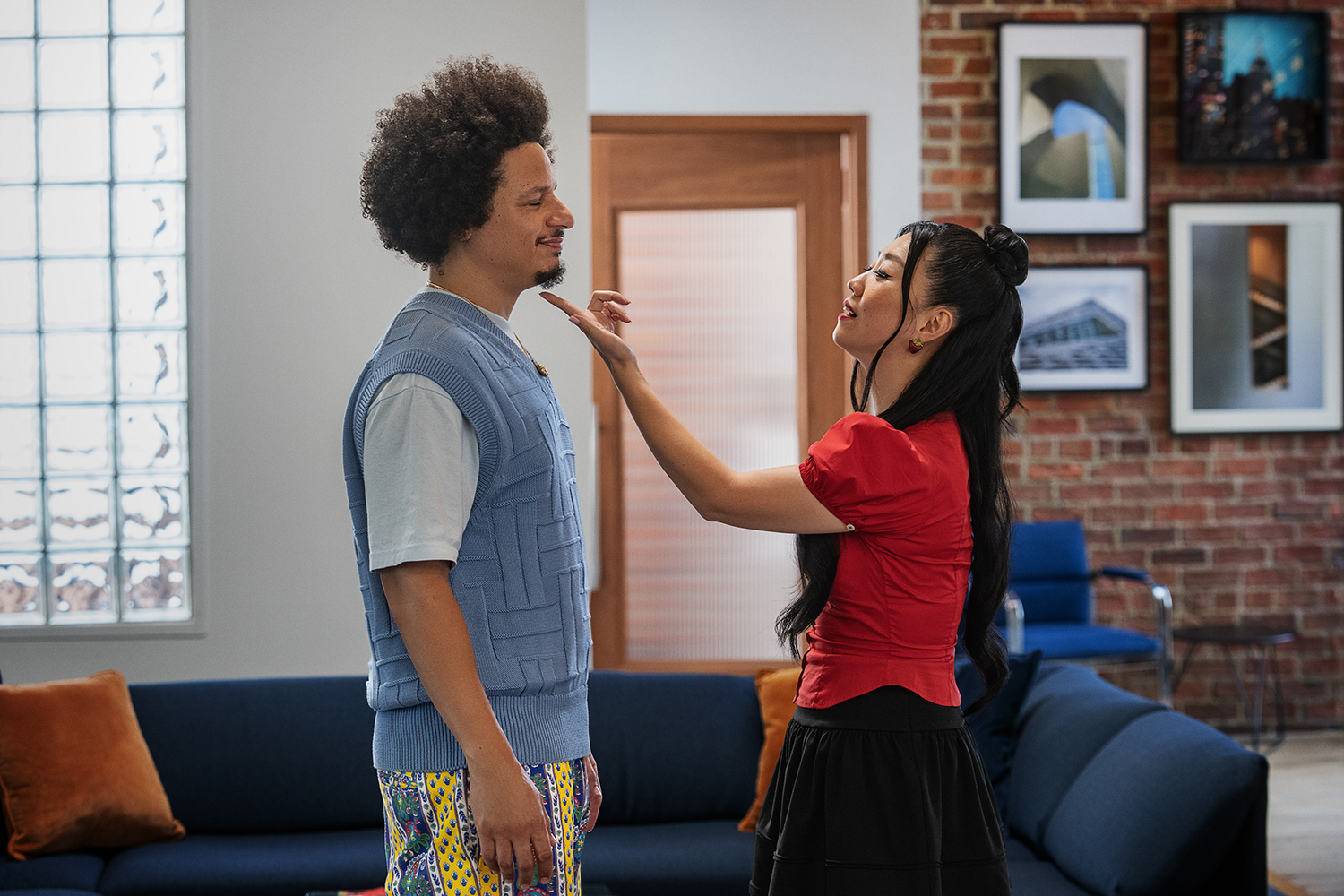
Little Brother. (L to R) Eric Andre as Marcus, Sherry Cola as Mia in Little Brother. Cr. Clifton Prescod/Netflix © 2026
What about finding the brand identity of Big Brother Little Brother? I love the little angel wing on the bottom half of the B.
That’s very observant. We tested a lot of B’s, I will say. My graphic designer was very patient with me. How did we find it? There is a real organization that is similar. What was interesting is that although they met in the ’90s, most of the story takes place today. The way I came up with the logo was actually by first figuring out what it would have been in the ’90s, and then how corporations update their branding today. So there’s a harmony there, and I was inspired by similar real-world organizations and other companies that have updated their brands over time. With the angel wing, we wanted it to feel like a hug. That’s what it is—the brothers are hugging each other inside the ‘B’ of the logo.
How did you build out the little stand with the logo in the background when they’re in the lobby?
The step-and-repeat? Construction built it, and then the set dressing was added. I insisted that it had to be sequins—it had to be shiny. It felt like the whole climax had been building to this, only for it to be destroyed. So yeah, we built it out of sequins. Our set decorator, Jessica Petruccelli, found the perfect materials; it was a big cross-departmental collaboration.
There’s actually a step-and-repeat in the movie that’s one of my favorite sets ever, but it was cut. It was for the mattress charity event, which was a really fun set to design because, again, it’s something you might not notice. It’s a mattress charity, and Deirdre is standing on a stage talking about all the donations, but if you look closely, you’ll see that the stage is actually made of mattresses. There was a mattress/sleep theme silently woven in throughout. When you came in, there was a mattress step-and-repeat—I’ll put this on my Instagram because I loved it—where it looked like you were walking in and having your photo taken, but you appeared to be lying in bed.
Out of all the places that were destroyed—not to play favorites—which one did you love seeing get destroyed the most?
Oh, I think it has to be Marcus’s car—specifically, the crash at the beginning. We had so many multiples of Marcus’s car, and we had so much fun with all his bumper stickers. Honestly, because I was there when they were shooting it, I audibly gasped when it happened. So, I would say it’s that. The reason we decided we had to build the townhouse was because of the stunt with John and Eric going up and down the stairs, and falling down the stairs in a wheelchair. We knew we couldn’t do that in someone’s real house, so that was pretty fun, too. But I would say Marcus’s car—and the Porsche, too—was really fun. We did a lot of practical effects there.
Did you have to build that car, or did you have a vehicle that you destroyed several times?
No. Well, Marcus’s car was completely totaled, but with Rudd’s car, we employed a little bit of movie magic. We did have multiples of the car, but we did not destroy actual Porsches. That would be crazy! Yes.
Like an entire pile-up in New Jersey, with people saying, “Oh, there’s another Porsche.”
Yeah, I’ve actually done so many projects with car crashes and stunts. Now I’m the car crash person. I don’t know how that happened, but here we are.