Picture Credit: Getty Images for Netflix
Himesh Patel returns as Dr. Watson in Enola Holmes 3. The actor made a cameo as Sir Arthur Conan Doyle’s iconic character in the second film. This time around, Patel gets to portray Watson as a man of honor, knowledge, and family.
He makes a character who’s been played countless times feel familiar and new in the sequel. The actor, who did splendid work in Yesterday and plays a role in Christopher Nolan’s The Odyssey, is proud to have played the good doctor with a long history on film.
“Firstly, it’s a privilege,” Patel told What’s on Netflix. “I’m glad I got to put my spin on this character because I’ve admired it all for so long, but I hope that it’s a version that sits alongside all the various brilliant versions that have come before. One thing I know for certain is that this is certainly a unique version of Watson – and that’s something I’m very proud of.”
You made a cameo in Enola Holmes 2. Between the second and third film, were there specific ideas building for you about how you’d want to define Watson?
What excited me was the unique thing of not really seeing Watson around Sherlock. Usually with any version of Watson, you’re seeing him in the context of Sherlock, naturally. The opportunity we had here was to see him outside of that context.
In a maybe slightly similar context, he’s still following Holmes around while they try to solve a case. But his relationship to Enola is very different. It’s a sort of mentorship relationship, and that was really fun to play because I think it brings out maybe a interiority of Watson that we don’t necessarily always get to see.
Watson talks about his backstory, his time in the war and the horrors he saw. It’s a big scene in Enola Holmes 3. How pivotal was that scene for you in how you wanted to play him?
It was the bedrock of this version of Watson from the beginning. Even back on the second film I was having those conversations with [writer] Jack Thorne about where he wanted to take this story and take this character. He had those ambitions back then. I loved that. To see it finally on the page was fantastic.
I think he’s done a wonderful job of crafting the story that way. I really admire everyone from Philip to Millie to all our other producers that wanted to go there, that they wanted to explore themes of colonialism of that era. As I say, it was the bedrock of the backstory that I built for this version of Watson, really.
What was interesting was there are little peppers of that context within the original books because that was all present. That was the present day for Arthur Conan Doyle. Though maybe some of his original points of view were not as palatable to us today, it was all there. For us to have taken that and then brought it into a whole new context, it’s really cool.

Enola Holmes 3. (L to R) Louis Partridge as Tewkesbury and Himesh Patel as Dr. Watson in Enola Holmes 3. Cr. John Wilson/Netflix ©2026.
When you read Jack’s speech for Watson about his time in the war, how’d you immediately want to play it?
There were a few twists and turns with that one. It’s a moment that Tewkesbury is in. He’s in pain because he’s realizing that his father might not have been who he thought he was. There’s a betrayal there.
Then you’ve got Watson talking about him, maybe feeling betrayed by his own father, but also by a sort of wider context. It kind of spoke to me, to be honest, about maybe a thing that we still have in the UK. It’s hard for us to talk about these things. It’s hard for us to really confront our past colonially. It’s why I admire what we’ve tried to do with this movie, because we don’t always talk about this stuff because it is painful.
It’s painful to have to contend with something that you really loved and still love, will always love, maybe not being quite as pure as you thought it was. That’s a painful thing for anyone to have to sort of grapple with.
Did you talk to Jack and Phil much about how they wanted to be respectful telling that story?
To be honest, there wasn’t much to really dig into there because they were clearly very sensitive to that to begin with. The work had been done and was there on the page. They balanced it out well.
How much do you return to Arthur Conan Doyle when playing Doctor Watson? Do the original stories inspire you as well?
One thing really made me laugh when I was reading and listening back to the stories. There was a common thread of Watson, because obviously it’s all from his point of view when you read them, as they’re from his diaries, and how many of the stories were like, “I was just trying to have a quiet evening. I was just sitting down for a cup of tea when suddenly the doorbell rang and Sherlock walked in. We were off on another adventure.”
I always found that really funny. The poor guy’s just trying to live a life. It’s not that he is being forced into doing any of this; he wants that. Actually, what it is with Sherlock is not only that he’s found a friend, but that he likes the thrill of what they get up to.
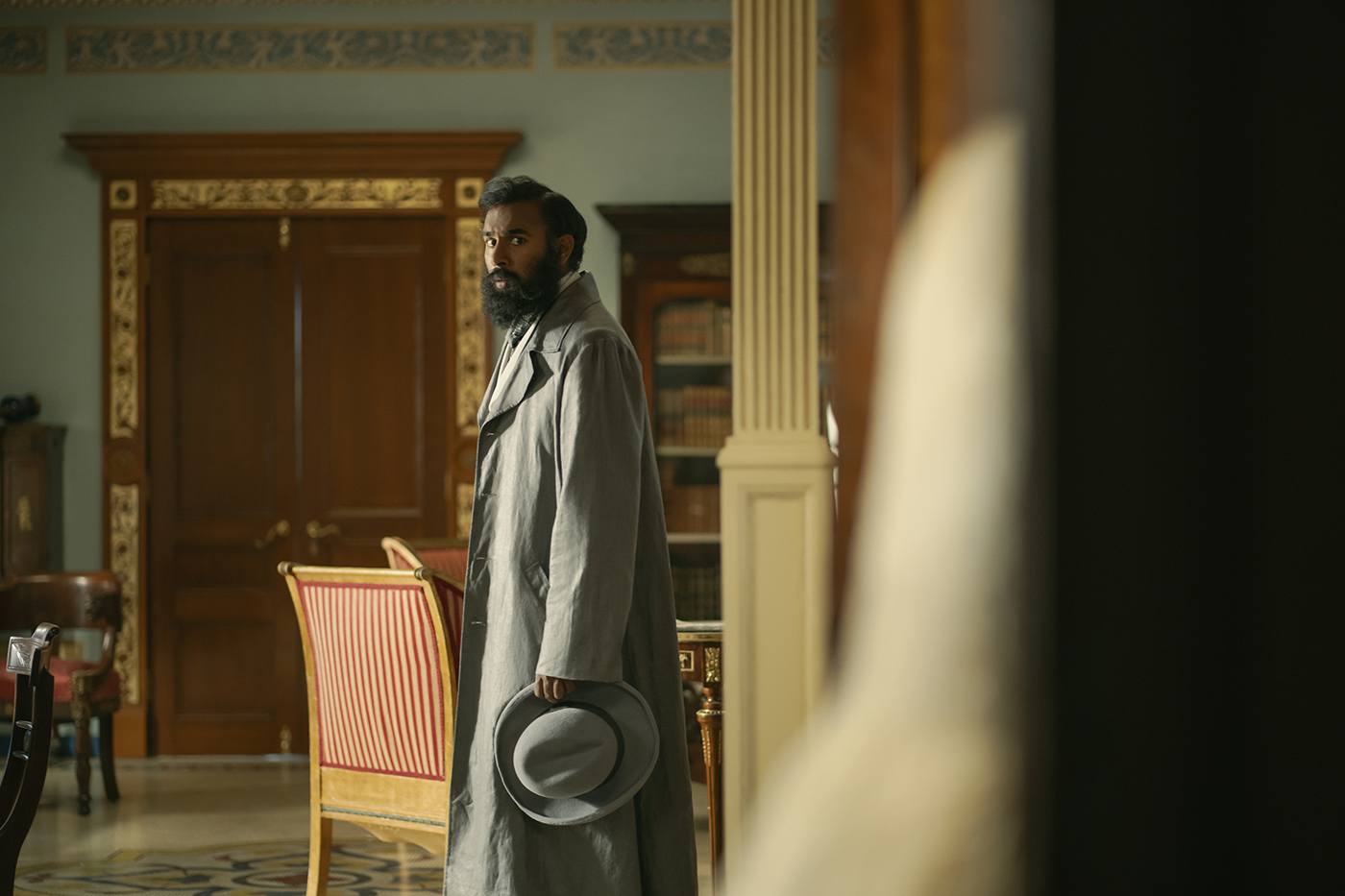
Enola Holmes 3. Himesh Patel as Dr. Watson in Enola Holmes 3. Cr. John Wilson/Netflix ©2026.
For Watson’s worldview, what are some really key characteristics for you that define him?
There were so many specificities to this version, and that’s what I really loved about it. We talked about his kindness, his humanity, but that’s a kindness and humanity that’s born perhaps of being a minority, being someone who has maybe been undermined, been seen as other by people. I always felt that he’s found some safety and some sense of home amongst Sherlock, amongst Enola, amongst that family. He values that highly.
He also values honor. You play that scene very well and tell that story in Watson confronting Brigadier Sam (Jason Watkins).
I really enjoyed that. It’s a sense of defiance. He’s been here before. When we were working on that scene, it made sense. Jason Watkins, who’s in that scene, he’s such a fantastic actor. All those subtleties were there in his performance as well, the way he’s dismissive of Watson. It was fuel for me. This isn’t the first time that Watson’s been in a room and barely been acknowledged. Those are the subtleties of, I suppose, the racial politics of the time that I’m really, really glad that we weren’t shying away from in this movie.
I spoke with Sharon Duncan-Brewster today about playing Moriarty. You’ve said listening is a big part of acting. What were you hearing and reacting to when you acted opposite of her?
Oh, what I was excited about for her was we both had a slightly similar thing [in the franchise], of having a reveal towards the end of one movie that was then going to be contextualized within another movie. I find that moment at the end really powerful with her.
Really, she’s talking about her pain. She’s talking about what’s led her to do what she’s doing, which is what was stolen and maybe what has been hoisted upon people and what’s been taken from people. I thought that was fantastic writing, of course, but I think Sharon’s performance was brilliant. It adds a whole layer of context to Moriarty and who she is and why she is.
It’s a great motivation. In another movie, she’d come close to being the hero.
The best villains have sound motivation. They have to have motivation that you believe. They have to have an ideology that they’re following and going about it in a way that’s far too damaging to those around them. But they have to have an ideology. She certainly does; it’s one that you can really understand.
Villains are usually juicy roles, but what do you relish about playing a hero like Watson?
I think playing a hero, especially in a context of a movie like this that’s grappling with moral complexity or maybe lack of complexity, I suppose, when you think about it in a certain way… Watson finds himself someone who has maybe, to Moriarty’s eyes, gone over to the dark side, has joined the enemy, whatever.
But I think it’s that he’s someone who has chosen to see the best in people, to have hope, to have belief that things can be better. It’s a nice thing to play a character who embodies that because it’s nice to be reminded of that as a person. It’s better to have hope. It’s better to have a belief that things will be better, which I think we all need.
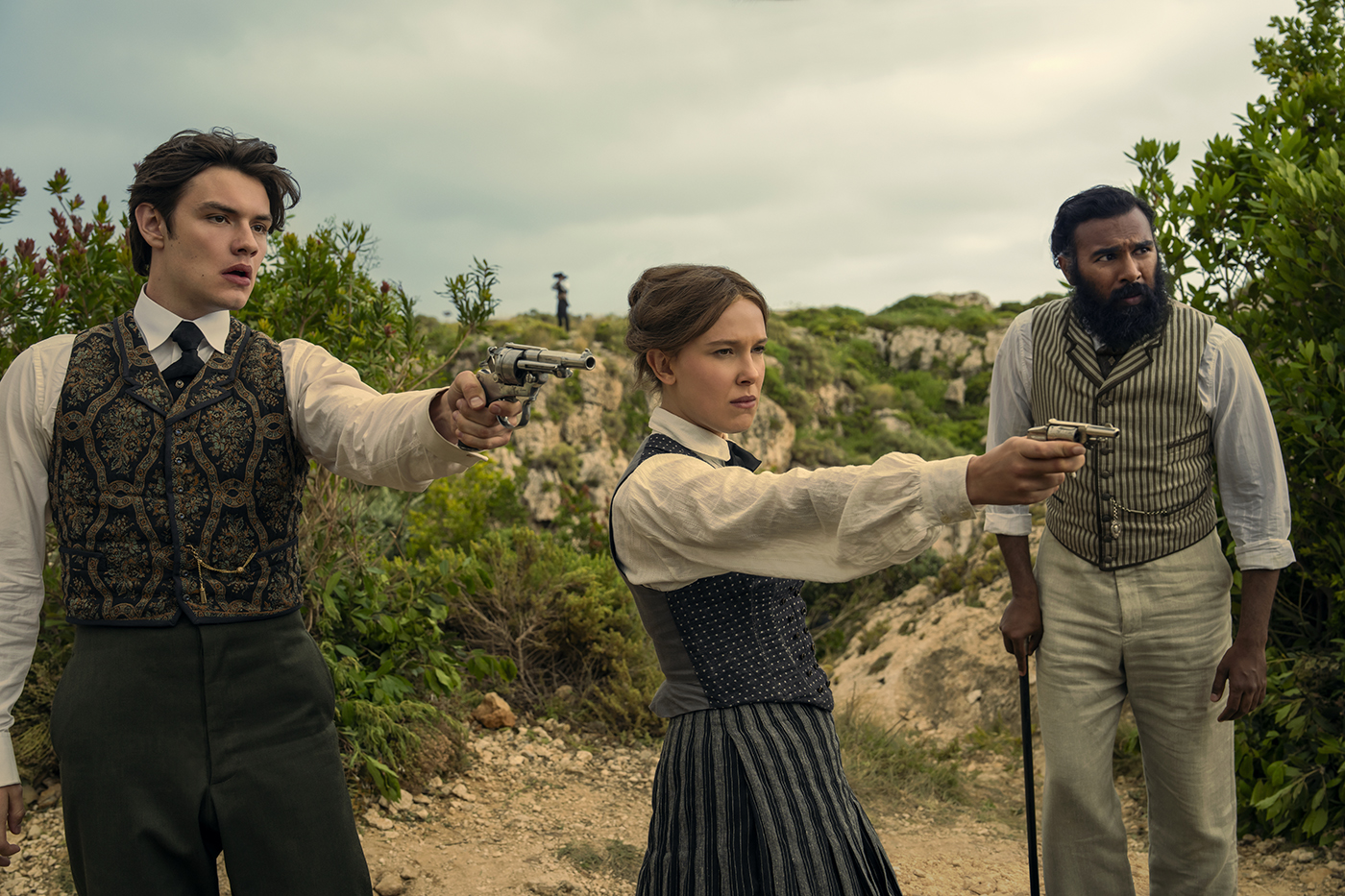
Enola Holmes 3. (L to R) Louis Partridge as Tewkesbury, Millie Bobby Brown as Enola Holmes and Himesh Patel as Dr. Watson in Enola Holmes 3. Cr. John Wilson/Netflix ©2026
He’s also very dapper. How’d you and costume designer Consolata Boyle want to make his presentation as honorable as he is?
It’s very important to me. Consolata Boyle, a costume designer, did a phenomenal job. She’s the most kind of quiet, unassuming woman, but she’s a genius. Beyond what she built for myself for Watson, the world that she’s built for every other character, everything is so specific.
Speaking for myself, a huge part for me with any character is their costume. It informs who you are, what you choose to wear, how you choose to wear it. With something like this that’s period, it throws you straight into that world the minute you put it on. I’m eternally thankful to her and her entire team, and what we made there.
When you’re on a movie set, does your mind ever wander back to the shenanigans on [HBO’s] The Franchise?
My mind goes back there all the time, because though in The Franchise we were exploring the most extreme, insane version of making, in that context, a superhero movie. There’s just stuff that happens on any film set. Even if it’s the happiest film set, there’s stuff that happens, miscommunication or something unexpected. More often than not, you have to laugh because it’s just so funny.