Picture Credit: Netflix / jonathanbnicholas on Instagram
Jonathan Nicholas captures the grace and intensity of America’s Sweethearts: Dallas Cowboys Cheerleaders. The cinematographer, who’s been with the show since the beginning, always wants to serve as more than a fly on the wall. The Emmy nominee and co-creator of Brand Films, which specializes in lenses, immerses viewers in the world of the Dallas Cowboys Cheerleaders.
“I just want to be as invisible as possible and capture the most beautiful images that represent what they can do technically,” Nicholas told What’s On Netflix, “and just make them look as good as possible.”
The cinematographer previously worked with America’s Sweethearts creator Greg Whiteley on Cheer and Wrestlers. He’s got an eye for sports—which he recently told the site all about.
You use a great camera rig for this series, called The Mantis. How’s it changed how you shoot?
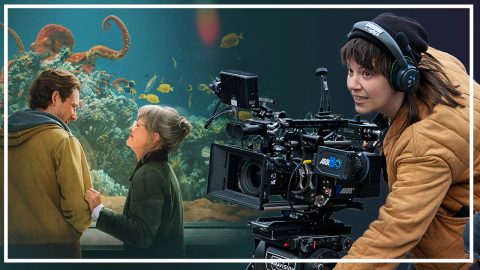
For me, it’s a magic bullet. Within five seconds, I knew it was going to be an amazing tool. I went and scoured the grounds and found my buddy Clint, who was going to be my B-camera operator for season two. We started using it and got him to come over and try it out, and I saw his eyes light up as soon as he put it on. I go, “Right?”
I told him, “Look, I am dead serious. I will buy two right now, but I need them next week. I start shooting next week.” He was thinking, “Okay, what? Sure. Yeah, just send me a personal text after today and we’ll figure this out.” Basically, all of a sudden, I got two pre-production models, and I was the first to have one out in the field for any kind of doc work.
I’ve been a huge proponent of it ever since. Everyone who’s come up to me over the last couple of years saying, “Hey, I’ve been thinking about getting one of those.” I’m like, “Don’t think, just do it. It’s the best tool you’ll have.”
Perfect for sports.
Yeah, it’s fantastic. With the Mantis, I can go back to my 15-year-old, easy-to-break Three Arm [rig], the 3,000 we called it, and my old vest I upgraded to a newer gimbal vest. It’s more comfortable carrying around a lot of weight. I can go for hours and hours.
I can push it all the way to the ground and scrape the ground, knowing that my focus puller’s got the focus and I can at least see the frame. I know that I’ve got the framing I want and then just boom all the way up to eye level and circle around somebody. It is extremely smooth for handheld.

Picture Credit: Netflix
As a cinematographer who’s also operating a lot of the time, obviously you plan a lot, but how much of what you shoot and how you shoot on a series like AMERICA’S SWEETHEARTS: Dallas Cowboys Cheerleaders is based on instinct?
We’ve kind of gotten into this state and this style of shooting for five years now, starting with Greg on Cheer season two. We then went and did Wrestlers. I always have my HEROES prime lens that I shoot on. We shoot everything on primes unless we have to be on zooms for games or something, but I kind of have my go-to lenses.
I put on a 35 whether I’m going to someone’s apartment or into a practice. You’re just asking the producers, “What are we trying to accomplish here? What’s the storyline?” That’ll tell me, before I put the camera on, whether I’m turning lights on and off.
You want to create an effect greater than being a fly on the wall, right?
It’s full frame. It’s just that sensibility that you’re not really a fly on the wall backed away – you’re right there experiencing everything with them. When I was coming up on reality shows, you had 10 cameras and they’re all backed off and they’re all punched in with a long lens on a zoom.
That’s what I love about our style: you’re right there with the person going through whatever experience they’re having. You feel like, as an audience member, you’re right there with them. Either you’re holding their hand as they go through it or you’re not afraid to go through their emotions with them.
And that’s something that, if I bring any other operators on, I ask them to study our past shows and understand the feeling that we’re going for. I’m not scared to be close to our subjects. We spend so many days with them.
Greg’s two main rules are: fight for as many days of production as possible, and get the best camera package and the best audio package possible. So for season three, we had 85 shooting days – that’s about a quarter of a year rolling. After that many days actually shooting with these women, whether it’s my attire or how quiet we are or how respectful we are, I’m right there, but they tend to forget I’m there a lot of the time.
What relationship do you want the camera to have with the athletes on America’s Sweethearts?
I remember last year during training camp, one of the rookies we’d focused on the year before walked into the locker room. She said, “Hey, oh my God, it’s so good to see you. I didn’t know you were here. When’d y’all get here?”
I’m like, “I’ve been here for two weeks shooting. I’ve put a lens on you multiple times a night.” Huh, am I that forgettable, or am I that good at my job? I’ll take it as a compliment that I blend into the background as much as possible.
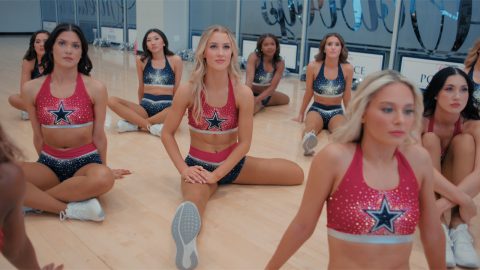
Obviously, you have to shoot a lot of dancing on this project. How do you want to give the full scope and scale of their numbers? Do you almost treat these moments like a musical?
Not really musicals. I did get a compliment years ago when I was a young camera operator on this show for ABC called Duets or something. I was doing the behind the scenes with some big artists and the director after that came by and was like, “You have really good musical intuition. I can tell you’re listening and you’re finding the opportunities to move when the music’s ramping or slowing down.” I took that as a pretty good compliment.
With Cheer and Wrestlers, we’re around these athletes a lot. We’re sticking with them for months and months. We truly dive in and we’re there as much as they are for practice. I mean, talk about repetition, they do the same thing for months and months and months, same dances. So you’re learning with them, you’re learning as you go, you learn how their bodies move, the music is embedded in your brain.
Then you just have to try to find the best lens and placement for it.
It just takes a certain intuition, but also, I have a really good team around me as well and you just get obsessed with what’s the best position, the best lens to be at for this time in a dance.

Picture Credit: Netflix
What about when shooting more dramatic, personal moments? How do you stay respectful?
You can tell someone’s having a hard night, maybe in training camp. You might be getting whispers in near that they might be getting let go. So you don’t want to let on and add too much pressure. Maybe you get a long lens and get the closeups with them that night.
You and your wife, Jacy, started a company that rents lenses to productions. What lenses do you think capture the intensity of the show best?
Bandit Film is basically me and my wife investing in lenses that we believe in and that we want to work with. And so, we then purchased the Minolta [lenses], and they’ve been working on Dallas Cowboy Cheerleaders ever since. They’re beautiful.
How so?
They already have this built-in softness to them. Like I said, 35 is my favorite lens to use for Verite. And then with collaboration with my colorists, Marco and Cindy, they created this beautiful palette that I think is one of the most unique looking shows on TV right now. So, very proud of the look and very proud of how we pulled off some amazing images.
You shoot anamorphic too, right? What effect do you want to create in that huge frame on gameday?
I wanted to do that. I’ve always wanted to shoot anamorphic for doc work, but I’m not a big proponent of changing formats. We couldn’t really afford season one budget, but then we got really popular and got to come back. I really want this superhero feeling and a Wonder Woman kind of feel when they put that on, because they all call it the uniform. They call it the superhero outfit. They all feel there’s power behind it. I wanted to implement that look along with how they felt.
So the rule was anytime they’re in their cheerleading outfit and in the spotlight in the public, whether it’s going to these big, big appearances like they did in season two, the Tyson fight or being on the field for “Thunderstruck,” I wanted to have that anamorphic look and feel. It’s a little bit sharper.
You’ve said you want to create a big, almost Hollywood sense of scale with those scenes. What does AT&T Stadium give you as a setting? What does your eye appreciate about that place?
Being a newer modern stadium, I think all the light elements that are going on in the background just create such interesting texture. And then with [owner] Jerry Jones’ massive window that faces, I think the Southern Hemisphere, his controversial windows with the sunlight comes in and sometimes blinds football players. I’m running around a stadium looking for those massive pockets of life to point the lens at, get fun looking flares going on.

Picture Credit: Netflix
That’s good for your work.
Yeah. It blinds the receivers, but it makes our images look pretty awesome. I love those late afternoon games where that sunlight’s coming in perfectly.
With this series or Wrestlers, what do you appreciate about shooting these stories of athletes just pushing their bodies and minds for spectacle?
I think before this show, someone asked me if my daughter wanted to be a cheerleader for the Dallas Cowboys, I’d be like, “What? No.” But knowing how hard these girls work their entire life from age two or three sometimes, not knowing they would end up on the Dallas Cowboys, but obsessed with dance and knowing that’s their passion, that’s the only thing they know how to breathe is by dancing. I think it’s the same thing with me and cinematography and storytelling.
Their shared passions that there’s nothing else they’d rather do with their life but dance. Everyone says that Dallas Cheerleaders are the pinnacle of any kind of professional sports dancing. It starts with Dallas and trickles down. The girls have worked that hard to dedicate their life so much to that, to getting on that team.
Once they’re there, then it’s like, well, now I’ve got to continue this prestige, and they’ll do anything to do that and put their bodies through hell. There is knowing there is a finite window that you can be a cheerleader. Most of them only go to five years if they do that. Some go to six, they push through, but they see this as one of their pinnacles in life. They’ll push through any injuries and get over it and train hard and do rehab and do what they have to do.
The dedication is incredible.
They do it even knowing that there’s probably going to be surgeries down the line. I mean, it’s almost like an inside joke that they joke about. “Yeah, I’m probably going to be getting hip surgery or foot surgery, but my doctor’s telling me, well, if you’re going to do one more year, let’s just go one more year and then when you’re tired, then we’ll do the surgery.” There’s no point in doing a surgery or fixing something, since you’re going to go back and reinjure it again.” They pushed through a lot of pain for their careers.