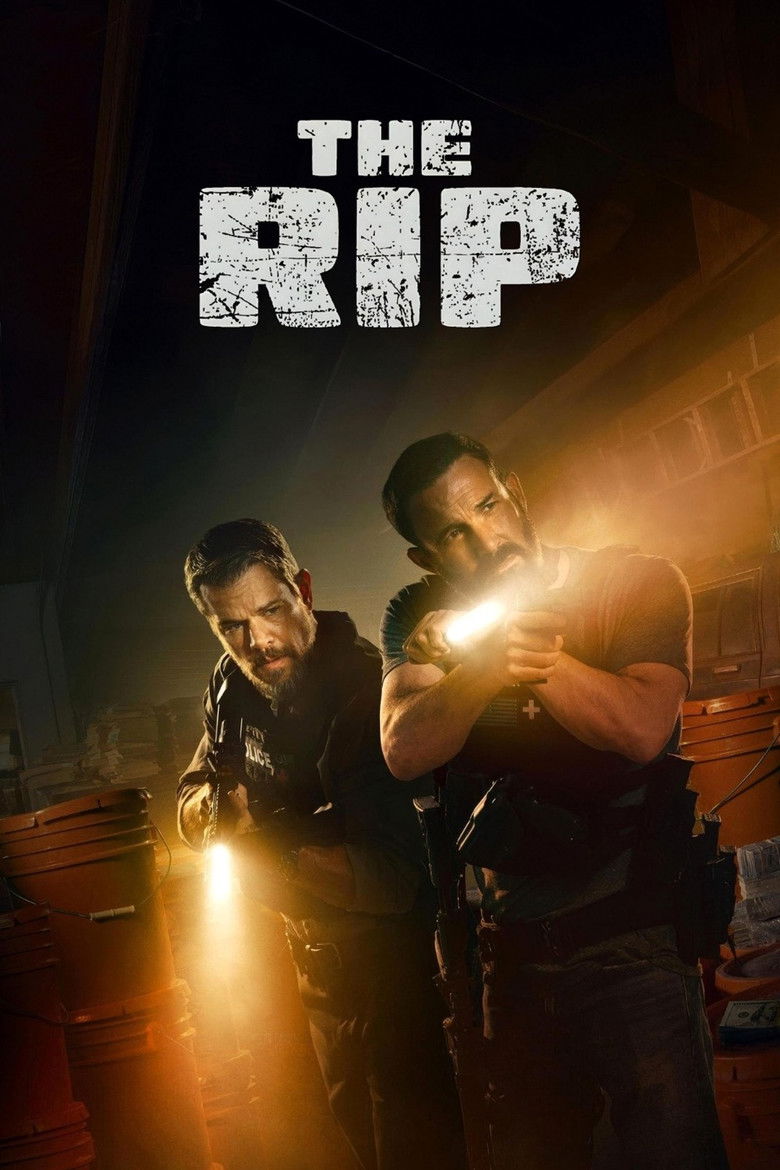
THE RIP. (L to R) Steven Yeun as Detective Mike Ro and Teyana Taylor as Detective Numa Baptiste in The Rip. Cr. Warrick Page/Netflix © 2025.
With The Rip, costume designer Kelli Jones helps craft characters who pop off the screen with a grounded but eye-catching style. While Joe Carnahan’s film is mostly set in a house stacked with cash, the scope feels bigger because the characters, in how they look, walk, and dress, plays real in the stylized film. Authenticity is what Jones chases.
Her past work includes Sons of Anarchy, Straight Outta Compton, and Shot Caller, not to mention more poppy works like Venom and Day Shift. In the city of Miami, although shot in Jew Jersey, Jones continues to paint authentic characters. Recently, she spoke with What’s On Netflix about designing costumes for the film’s eclectic ensemble.
Let’s start with J.D.’s (Ben Affleck) pair of Jordans in this movie. How did those come about?
I always use Nikes in my movies. Even from one of the first projects I did, it was Air Force Ones. I knew I wanted to do some Nikes. I talked to a lot of the narcotic detectives down there, and a lot of them wore Vans. And so, I brought in Vans and some Jordans, but the Vans just didn’t hit. It didn’t resonate. The Jordans looked better. It’s such a cool, effortless staple. I didn’t want him in a boot, so it’s a little street and a little cool. Ben is very well-versed in sneakers, clearly. I brought him three pretty specific ones based on the conversation we had, and that’s the one that we landed.
When you’re looking into narcotics officers, what caught your eye?
Streetwear. A lot of them wore track jackets, baseball caps, but I didn’t end up doing a lot of sports team gear. I didn’t really get that on anybody. I tried. I was going to do that with Nix (Kyle Chandler), and then it just didn’t resonate, because he was in a uniform. Originally the illustrations for Nix in some sort of Miami sports team swag. But other than that, they kind of look like the guys that they’re tracking.
So setting a movie that’s mostly in one night comes with a lot of complications for everyone. What are some of the biggest ones for you and some of the ones maybe an audience member would not think about as a nightmare for you and your customer and your team?
The absolute biggest nightmare is that we did not shoot that movie in Miami. We shot it in the cold fall in New Jersey. I think they all ended up wearing exactly what I would’ve put them in, ultimately, but not exactly what I would’ve put them in if it was set in Miami.
There was the cold element. I mean, that cast was rockstars. When I first met Teyana, she was like, “Listen, if I’m cold, I don’t even know if I’ll be able to act. Please don’t put me in a tank top.” And I’m like, “We won’t. We’ll put you in long sleeves. It’s super thin.” And then it got to the nights where they had to be outside all night, no jackets, just vests or their T-shirts.

THE RIP. (L to R) Ben Affleck as Det Sergeant JD Byrne and Matt Damon as Lieutenant Dane Dumars in The Rip. Cr. Warrick Page/Netflix © 2025.
What do you find most fulfilling about immersing yourself in these worlds as a costume designer? What is the ultimate tangibility you’re always looking for?
I want it to look real. There’s a lot of this style ‘ll see on TV and in the movies that looks manufactured. It’s almost an intangible thing that you can’t really understand when you’re looking at it. It’s a feeling you get from watching these actors in their clothes. It doesn’t look like how a cop or criminal would really dress. It looks like how somebody thinks they should dress.
Judy [Becker], the production designer, came up to me on set and went, “Oh my God, Kelli, you did such a fantastic job. Every time I see these guys, I think they’re someone from the crew.“ That’s the biggest compliment of my career – hearing that it looks real.
Those first few days of prep you’re doing in Los Angeles, what does day one look like? What is the practical and the creative work?
A little chaos. The thing about when you prep in LA but you’re shooting somewhere else, my crew is going to be in that place that we’re shooting. Most of the time, even if it’s a week to six weeks to two months in LA, it’s not a big crew. They want to keep it compact because you don’t get the tax credit in LA, really. You get it in New Jersey. And so, I had two people helping me. I had a supervisor and I had an ACD and we just went through the boards and Joe said what he liked and didn’t like.
Where’d you start with Ben? What was discussed and discovered in his fittings?
I made a couple jackets for Ben. I had used this tailor for 20 years, and I went to his office, and he was like, “Oh, that’s so weird. I just went to Ben’s office and brought him suits that I made for him.” So he already had his chart and everything. I made him a couple jackets that didn’t end up making it to the film, but that was just something that was nice to have in the fitting.
And then it was the T-shirt and jeans, which everyone would think would be easy. I do have to say, I think the first one he tried on, Ben was like, “Yeah, this is great. I’m really picky about T-shirts.” I think it was the first one.
I don’t have 10 fittings with these guys. I have one fitting, hope that you’re at least going to get on the right track and keep the train going on the second fitting. And then maybe you get a third – and that’s it. There’s not a lot of time.
I always know the exact vision that I want, so it’s just a matter of getting it to be the right fit. We ended up making the vest or the jacket for Matt, his police jacket. We made that, but I just wanted to get the right fit.
What about the color palette? Green, for money, was big for Joe and his cinematographer, so what about yourself?
Joe had this color palette thread throughout the movie where green was for the money. You see in the pants of Nix – he’s wearing a green uniform in the beginning. You wouldn’t even know this unless we’re saying it now. Green uniform, and then he has green pants on towards the end. And so, then red is for Jackie. Blue is for the cops.
When I first fit Matt, I did these Dicky pants. I just wanted to get a good pair of pants on him, good carpenter pants. And I did some Dickies, and then it was a little green. I didn’t really notice it was so green until I saw the picture after. It didn’t really read that green when it was mixed in with all these other colors, all of these browns and tans that I had in his line. But it just veered a little green, but the fit was just perfect. I was like, “You know what? Why don’t we dye it?”
What about Detective Lolo (Catalina Sandino Moreno)? She’s by far the most punk of the group.
There’s a TV version of a female detective, and then there’s the female detective. That’s how I see it a lot of times when I see TV and film. And so, some of them wear button-up shirts from James Perse that are kind of soft. That used to be the go-to if you wanted to do a TV detective, but they’re more street cops.
So talking to Catalina, we wanted to veer a little bit more punk so that it wasn’t so just basic. The first board she showed me, I think she had blue streaks in her hair. We really did it up with the jewelry. And then I always wanted a graphic on the t-shirt just because I think it would just break up the monotony of so much solid, because there is a lot of solid in this.
It’s tricky with the graphic, though, because you don’t want it to pull focus in every scene. It can’t be that loud of a graphic or anything that doesn’t go with the color palette. Joe has been friends with Juanmi, the DP, who was in a punk band when he was younger. Joe emailed me one night and was just like, “Why don’t we surprise Juanmi? Let’s do a graphic of his band, but put Juanmi’s face in it.”
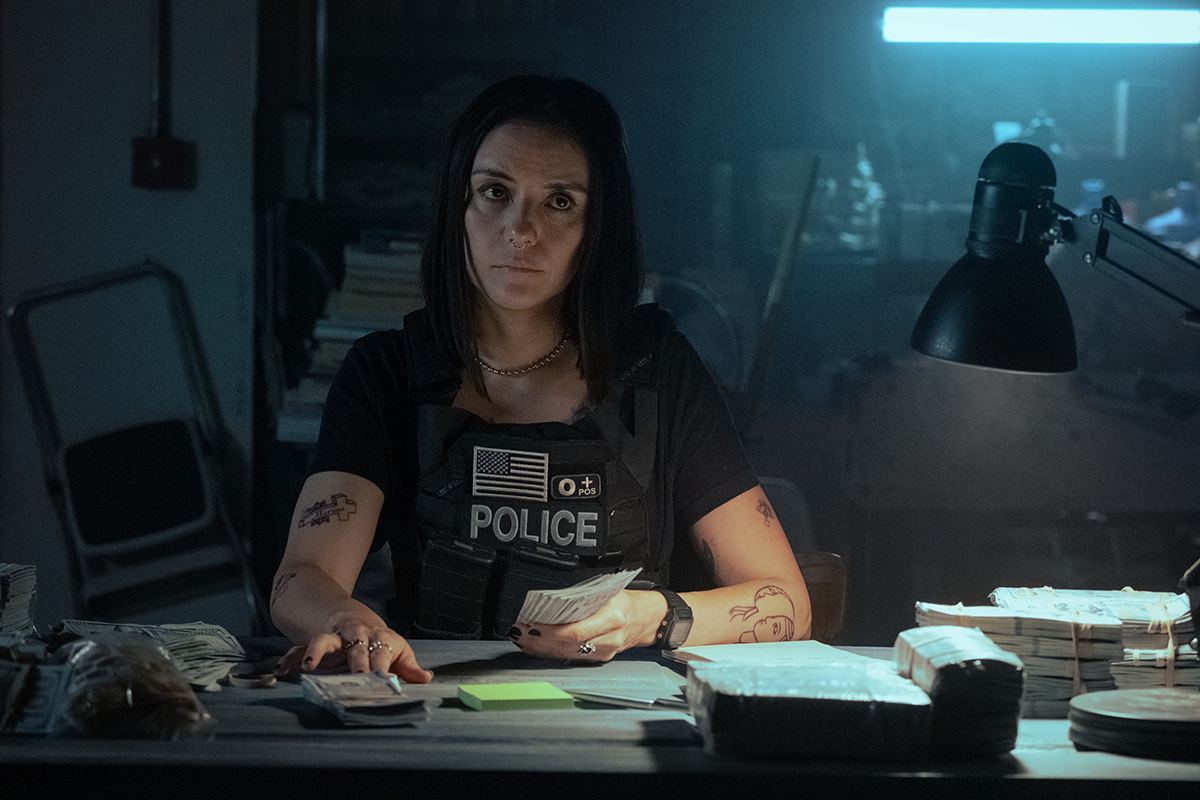
THE RIP. Catalina Sandino Moreno as Detective ‘Lolo’ Salazar in The Rip. Cr. Claire Folger/Netflix © 2025.
To wrap up, what does the Artist Equity deal with Netflix mean to you? [Note: Damon and Affleck’s production company ensures bonuses for crew based on streaming success.]
The producers said something to me after I was hired, like, ” Oh, so this is what Artist Equity is doing with this film and there’s going to be this backend bonus. ” And I’m like, ” Come on. If that is true, they should be knighted within the industry. It’s just unbelievable.” And then Matt talked about it a little bit in the fitting.
There’s been so many decades where the crews don’t get appreciation. To have even a little bit of that and have a little bit of light shown to where, oh my God, we can actually see a financial bonus or bump after this if it does well? I don’t even know how to wrap my head around it yet, because we’ve all been conditioned that it’s like this is the paycheck you get and the only people that get backend in are producers, directors and the actors. It’s just incredible, even if it’s a dollar, you know what I mean?