Picture Credits: Netflix
The Whisper Man is another sinister piece of storytelling from director James Ashcroft. The filmmaker behind Coming Home in the Dark and The Rule of Jenny Pen is very adept at creating these fully realized nightmares that are all too real. He again strikes that note of sheer terror in The Whisper Man, which features two unsettling exchanges between Robert De Niro and Michael Keaton.
These scenes between screen giants do not disappoint. De Niro, playing a retired detective, seeks information from the titular killer he caught. “The interesting thing about those scenes with Bob and Michael is that they’re incredibly nuanced performers,” Ashcroft told What’s on Netflix. “They’re very different energies and very different men, but it makes for a compelling tennis match.”
A room with De Niro, Keaton, and Michelle Monaghan sets high expectations. The film delivers on them. Ashcroft told us how it was done.
There is a lot of anticipation built up for the meeting between Frank and Pete, partially because it’s Robert De Niro and Michael Keaton. I see you’re already smiling thinking about this scene.
Absolutely. Those are some of my favorite scenes, the Keaton scenes in the film. Those were some of the best days that we had on set. There was obviously a lot of expectation with those actors being in the room, but I just love the way we introduce Frank as a character.
It’s fantastic. It starts off so cordial between Pete and Frank, and then, just descends into what we get. When you read that interrogation scene on the page, what were your immediate instincts for it?
I think when you have a character like Frank Carter, someone who’s cast a very long shadow over the story itself and all the other characters, it’s important to offset how you first introduce them. Introductions are everything. So, doing the exact opposite of what you might expect is something that’s a lot more appealing and engaging and gets you leaning forward.
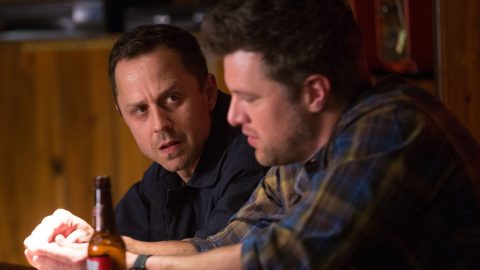
I always had in my mind a sense of two old friends meeting at a pub. Everything on the surface is played in one way, but as the scene goes on, it becomes very apparent what’s actually bubbling up underneath the surface. There are old tensions.
It’s one of those dialogue-heavy scenes where so much is left unsaid still. Do you, Michael Keaton, Robert De Niro, and Michelle Monaghan talk about what’s happening in between the lines?
You want to set the table, obviously, for all the actors and everything, but I think that’s very much done and held in the script. And then you want to step back and make sure that you’ve got parameters around them that allow them to play and explore and embolden them to try different things while always keeping that game at play.
For those scenes, I did give them separate notes, though. Normally I’ll deliver a note to the whole group, but with that sort of two sides of the tennis court as it were, I would have team Monaghan-De Niro would get one set of notes and then team Keaton would get another.
Also, it was about letting the scene play out over and over and over again. We could have shot that scene for a week and probably had a different version with every single take that we had.
What were those notes you were giving?
You don’t want to give away too much of your toolkit. I think with Bob and Michelle, it was always about, how do you take the high ground at any time? How do you be more civilized or more polite than what you are receiving?
With Michael’s character, Frank is a master manipulator – and manipulators are very good at getting you talking. It was always about keeping them on side, but how do you also get that final say? And every single compliment always has a little bit of a dig at the end.
I always read Frank as being incredibly sinister. He should also have an annoying quality of being around this guy is going to grate after a while, such as his narcissism and his ego. So we’ve probably all met people in our lives who are a little bit like that and we can draw from.

The Whisper Man. Adam Scott as Tom Kennedy in The Whisper Man. Cr. David Lee/Netflix © 2026
Prison letters from Frank to Pete are revealed later in the film. Similar to the diaries by John Doe in Se7en, were all the letters actually written?
[Laughs] Yeah. We got Chase Palmer, a screenwriter, to draft some of these and then the props department obviously had to write these out. Also, how could we scan those letters and you get a sense of the depth of depravity that’s in them? What are those sort of key phrases or turns of phrase that are going to jump out and pop where almost like you don’t get a chance to read the entire sentence? Chase did it. I’m sure it was a great day in his household the day he had to come up with those because they really are quite horrific. But you just want to get a sense of, again, his shadow and what this long shadow of Carter’s cast on De Niro’s character.
It helps create that shadow with an actor as big as Michael Keaton. It’s such perfect but unexpected casting for a serial killer. How’d you land on Keaton?
I know Michael’s played villainous characters before. Why I think he’s so great in this is because in many ways he’s not what you expect, but also Michael is an incredibly positive, humane, empathetic person, human being. He’s the complete antithesis. I think that’s much more interesting when you meet a character who has that sense of self-improvement in them, but also, you’re watching a guy and you know that he’s killed half a dozen kids. There’s something that doesn’t quite match up there in terms of what your expectation is.
It’s lovely seeing someone like Michael who clearly relishes every minute that he has on screen. It’s in all of his work. He’s so engaging and you can’t take your eyes off him.
You wanted to weaponize his charisma, basically.
Why not? Why not? Everyone else has.
There’s a horrifying shot of him in the second scene between Frank and Pete. Keaton literally licks his chops. Is a creepy touch like that discussed or is that just pure instinct from Keaton?
Yeah, no, that’s very much about how close we are to him. That whole scene with Frank is you want to get a sense of this guy is right in your face and every single gesture should feel invasive and disgusting. He speaks in a very quiet voice, but it should feel like he’s talking right in your ear.
There were countless examples of what Michael did when we shot those scenes. Christopher Tellefsen, our editor and I, were spoiled for choice with all of these actors, but in particular those scenes. It’s often what’s happening between the dialogue with Bob, Michelle and Michael that becomes very loaded.
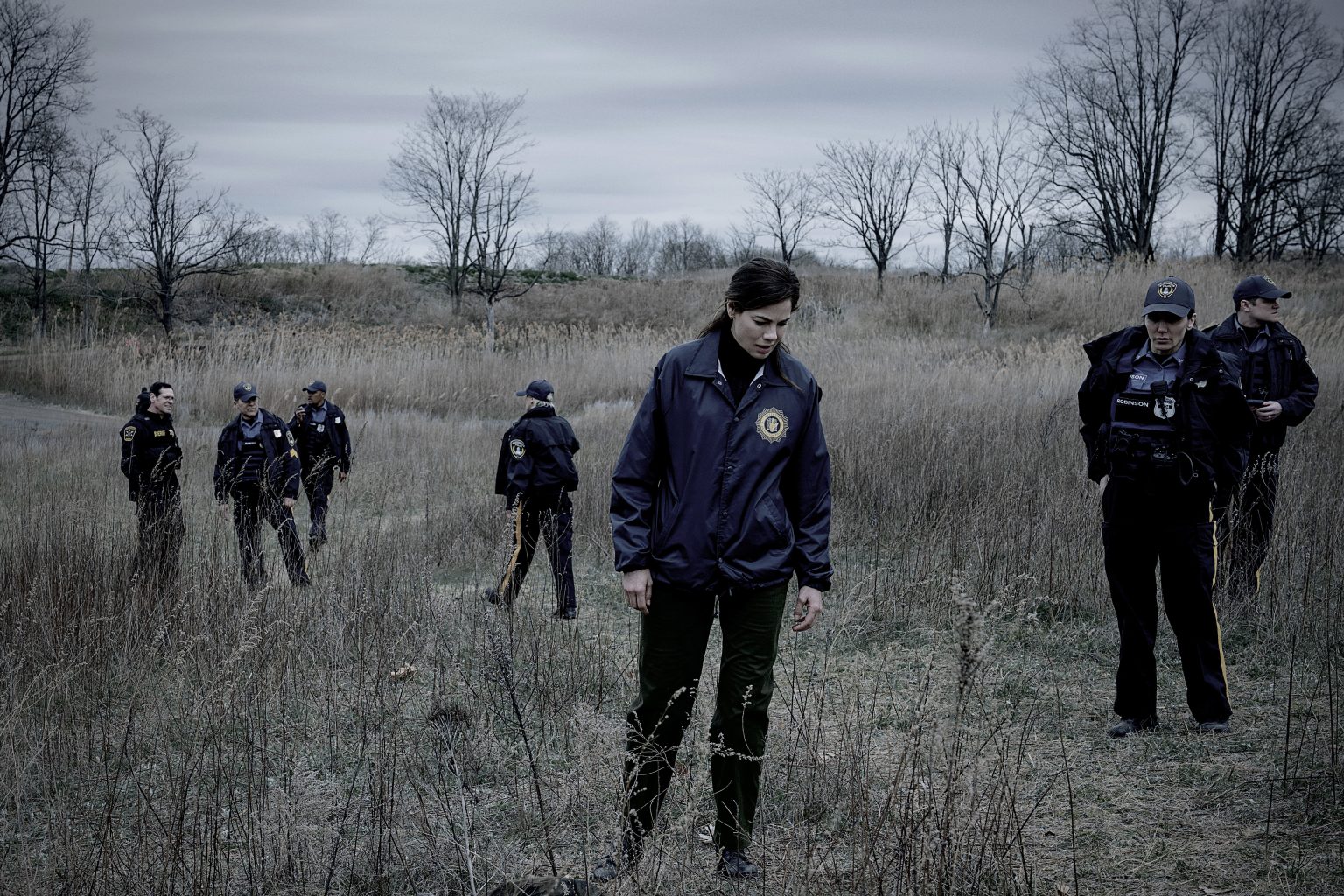
The Whisper Man. Michelle Monaghan as Amanda Beck in The Whisper Man. Cr. David Lee/Netflix © 2026
With your cinematographer, Peter, how did you both want to light and shoot the Frank and Pete meeting?
We wanted a sense of claustrophobia. We built that set in a very long hallway because we couldn’t find a location that was perfect. Anastasia White, our incredible production designer, came up with this notion of building a set in the middle of a hallway and creating this long tunnel. You get an incredible sense of depth behind the characters, but they’re about half a meter away from one another.
So that containment was very much key to the location that we created. But also the lighting, prison lighting isn’t very flattering. Everything is cast with a slightly sickly tone. So we wanted a sense of, once De Niro and Michelle leave the prison, they’re just gasping for air, just like they want to get away from this. They can’t get the filth off them fast enough.
Great De Niro performance here. He’s just carrying so much weight on his shoulders and trauma in his face. On set, what about his performance was really connecting with you?
Bob’s obviously a legend. He’s done a number of different kinds of roles and different genres, but one thing I find Bob inherently has is that he’s an incredible listener and emotes so much from doing so very little. I find the scenes where he’s listening that you are getting so much, he’s saying so much without having to say anything at all. It’s in his reactions.
And so, editing Bob in that sense was kind of hard because you’re so spoiled for choice in the edit suite. There’s so many different moments where we’re like, “Oh, we want that moment.” It’s like, “Well, the film’s going to be four hours if we have all of these moments that are great, so you have to make a decision.” But Pete, his character is the very definition of still waters run deep. Bob understands the potency of stillness and silence.
I’m a fan of your movies. There’s a darkness to them that’s all-consuming. What draws you to the darker corners of horror and thrillers?
Well, this is probably the lightest film I’ve ever done, so that’s sort of saying something. Look, I think there’s a lot of healing to be found in the dark. Yes, it’s one thing to explore the light as it were, but if we don’t unearth those trickier subjects or more confronting themes, then how can we ever expect to move forward from a past that’s been overshadowed into a future that’s a lot more empathetic and filled with hope? This story, I think, embraces that at its fundamental thematic level.
You seem to really try to understand evil. Your villains are scarier because they’re so human.
My wife would say I’ve probably done something very, very bad in a former life that I’m still trying to figure out or have penance for. But I think that the main thing that we all carry within us is both this constant struggle and negotiation of the light and the dark within ourselves. It’s ongoing. Most of us walk in a gray space – and I think it’s fundamentally a human and humane question to explore those aspects of self. I’m drawn to these characters.