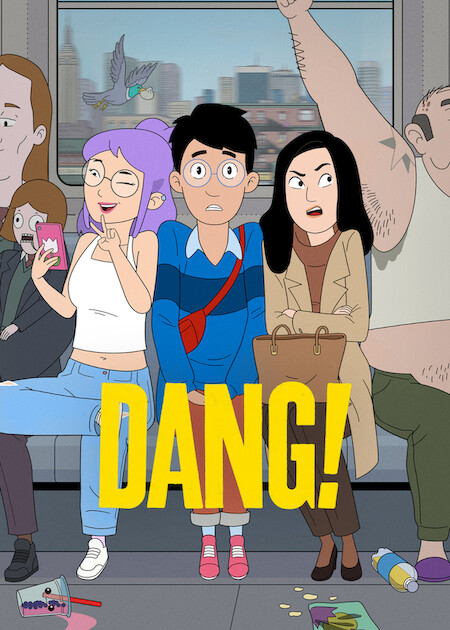
The story of Dang! follows a trio of siblings: Andrew (Andrew Law), Eunice (Poppy Liu) and Ruthie (Stephanie Tsu) as they navigate the self-inflicted complications and conflicts of their lives in New York. Andrew and Eunice have lived together in the city for some time, their older sister Ruthie – the favourite child due to her financial success and being married – has kept relatively distant. Until now, anyway. Created by and starring Law (who is also co-showrunner alongside Matt Murray), the sitcom premise kicks off with Ruthie’s sudden visit to her younger siblings, the supposedly more together older sister revealing she is also a mess, pregnant via her married boyfriend Peter (a typically fantastic Sungwon Cho, maximising his minutes) who is a chauvinistic nightmare of a person. (She also works for what sounds like a hybrid of Tesla and Uber, with incredibly evil-sounding hints at her day job piling up by the season’s end.)
Dang! feels like part of a trend, as Netflix’s animated series seem to be getting into the family comedy business: immediate comparisons to the deeply flawed and self-involved trio of siblings with take the mind to Raphael Bob-Waksberg’s recent (and excellent) Long Story Short. Where that show leapt headfirst into the awkward complexities of a semi-autobiographical family unit over decades, the family dynamic of Dang! is mostly defined by its needling at gen Z affectations.
Law’s past credits as a writer and story editor on The Good Place and Silicon Valley are also evident in Dang!. The show has overlapping interest in self-absorbed idiots trying to make something good of their lives, and the digital livelihoods and languages which enable the character’s worst qualities. Eunice tracks subscribers to her Onlyfans-esque channel where she streams herself stepping on various baked goods, Andrew posts gossip about the workers at the company he founded, the list goes on.
But as it needles at contemporary urbanites (the first episode alone has jokes about phone calls being “like assault”, being stuck in debt to Klarna, there’s lot of jokes about therapy speak used for ulterior motives), the writing begins to slip into continual cultural references. Even though it’s cute that Hayley Williams makes an appearance as herself in a dream sequence, as with any comedy of this kind it’s hard not to think about the expiration date of these punchlines, especially when a similar gag pops up with a tribunal featuring Chrissy Teigen and Rina Sawayama. It feels a little unimaginative that the joke is simply that a celeb cameo is happening.
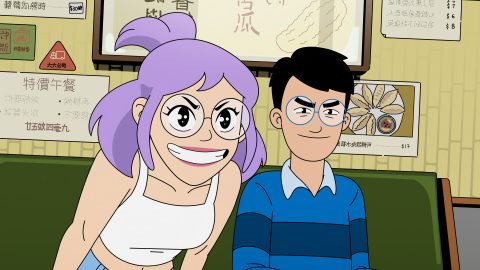
The animated gags, at least, often alleviate the flatness of Dang!’s verbal jokes. The series also perhaps doesn’t quite have the visual idiosyncrasy of something like Long Story Short, but it’s pleasant to look at, and the animation from the studio Titmouse has a lot of very restrained posing in the acting, lots of clean digital lines, flat cartoonish shading and soft shapes.

Dang! S1. (L to R) Poppy Liu as Eunice Dan and Andrew Law as Andrew Dang in Dang! S1. Cr. Courtesy of Netflix © 2026
The subdued production design as well as the realistic proportions and gait of the characters makes the moments of surrealism feel even more so; restrained design contrasting with some rather outlandish slapstick, like Eunice bouncing off of several cars like a pinball (and getting up unscathed).
Outside of this, the punchlines feel strained. Andrew getting caught up in a massive lie and ordering a bunch of stuff because he doesn’t want to get into a conflict might be the first genuinely good Gen Z bit of the show, but the hand is still overplayed It’s a shame because the project seems like it might be close to Law’s heart given its angle on family, about a clash of LGBTQ+ culture with dogmatic religion and even anxieties around Asian fetishism when dating.
Further to that, the show begins from a point where it deliberately makes it difficult to feel sympathy for these characters, highlighting their worst tendencies and their contempt for viewpoints outside their own. It’s something of a battle to find more flawed minority characters on screen (take for example the rather intense discourse surrounding Perfidia Beverly Hills from Paul Thomas Anderson’s One Battle After Another), which makes the struggle of Dang! to land jokes with a real sense of incisive bite, all the more disappointing. The better moments of Dang! arrive when Law leans into the cast being mean failures and less so when they’re kooky sitcom roommates, though there are moments of saving grace (like when Andrew begins a question to his own sister with “hey, you’re Asian-“). Another is Eunice’s boss – a bizarre and intense supporting character who somewhat recalls Mr Boss from Smiling Friends, mostly in how the animators frame her as part neurotic supervisor desperate for validation, part monster: in one moment she walks straight through glass and stands as if the shards sticking out of her aren’t even there.

Dang! S1. (L to R) Andrew Law as Andrew Dang and Poppy Liu as Eunice Dang in Dang! S1. Cr. Courtesy of Netflix © 2026
MVP OF DANG!
He’s not in it that much, but the voice actor Sungwon Cho maximises his minutes as Peter, Eunice’s (married) boyfriend for whom she falls head over heels. The joke is that this infatuation is entirely inexplicable because Peter is utterly and obviously terrible. It’s thanks to Cho’s deadly serious delivery of some of the most off-putting and clichéd chauvinist lines that the contrast becomes incredibly funny. He’s not in much of Dang!, but his performance is probably the most memorable.
THE VERDICT
Dang! has a good premise and many thoughtful episode ideas on paper, especially as it examines the intersection of identity of its characters, but the gags themselves feel repetitive, and struggles to surprise even as it leans into raunchiness. The jokes don’t land as often as they need to, which undermines the series (deliberate) foregrounding of selfish, childish characters because it’s simply no fun watching them stumble into various mistakes.