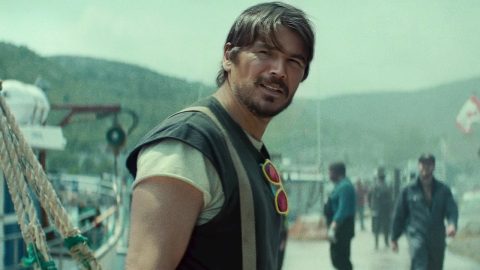
Picture Credits: Netflix & Josh Telles/Deadline via Getty Images
Below is catnip for seaside horror stories fans. If anyone is interested in tall macabre tales from the sea, then showrunner Jesse McKeown and producer Jessica Rhoades have got the show for you. When strange and violent happenings begin in Newfoundland, ice fisherman Calvin (Josh Harnett) has a family and town to protect.
The first two episodes are chock-full of atmosphere and character. The limited series is six episodes long, so the story wastes no time creating these characters up and running in their surreal homeland. Once the madness truly begins, expect a little bit of Danzig and, as McKeown and Rhoades told What’s On Netflix at the Toronto International Film Festival, plenty of lovingly crafted moments of horror.
I went down the flamingo rabbit hole today.
Jesse: Well, it’s funny, that flamingo thing is real. It was my wife’s neighbor, a guy named Mark Ferguson, who works at the museum in St. John’s, Newfoundland, called The Rooms. He told me that story about the flamingo, how a flamingo had shown up in Newfoundland somehow and that some random person shot it, and now the flamingo is in the museum. I went and looked at the flamingo. I saw it.
But that just struck me as a very interesting detail about when things start going wonky with our environment. How does a pink flamingo from the Caribbean end up in Newfoundland? So as fantastical as this series gets – and when you see the rest, you’ll see it gets pretty crazy – it all came from something. It all came from real Newfoundland history or folklore that’s been around there for a long time.
Jessica: I’m really hoping by the end of the series the audience will have the experience that I think a lot of us had. I didn’t know Newfoundland before I picked up the script or started watching the series. By the end, you really feel like you know the place, you know people that are there, you know them very intimately, but also you, I think, are going to have a full, fun ride. Then you’ll get to your search engine and be like, “Wait, what? This, that and the other.”
Jesse: You learn things that I had to learn. Newfoundland is in its own time zone. It’s an hour and a half ahead of where we are right now [in Toronto], four and a half hours ahead of LA. It’s the only place that has that.
It’s in its own world, basically. It was its own country before. Most people in Canada don’t know this, but it was its own country for a long time until it joined Canada and became the 10th province in 1949. So, it’s a very distinct place that has its own sort of self-sufficient vibe.
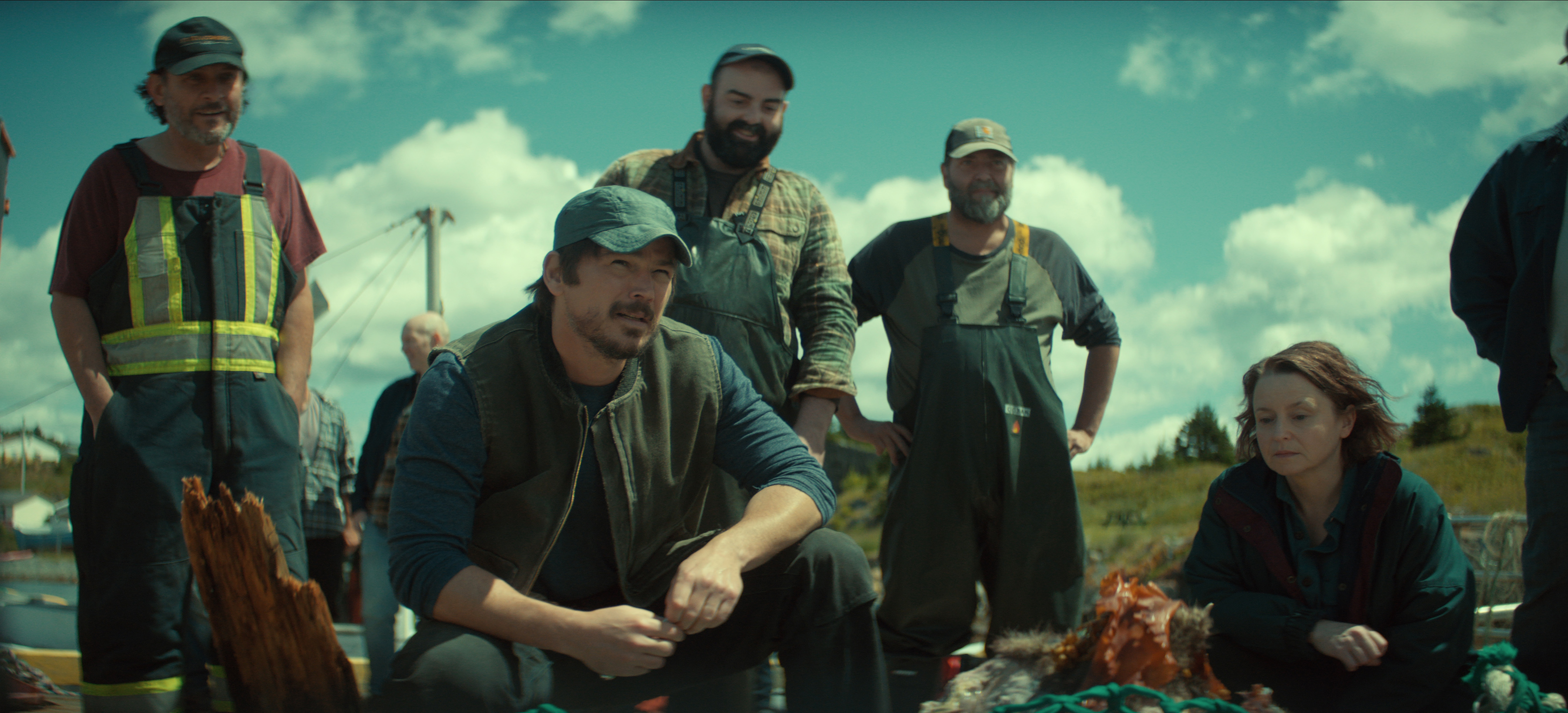
BELOW. (L to R) Josh Hartnett as Calvin and Willow Kean as Ruth in episode 102 of Below. Cr. Courtesy of Netflix© 2025
How is it getting filming permits there?
Jessica: Honestly, they were so supportive. They were so supportive of us being there. It’s a hard place to film, but not for the reasons that LA is hard, permits and other things. It’s hard because it actually takes rigor and the weather’s hard. I actually think they were extremely kind to us on that front. There were a lot of locals [on set], too.
Jesse: Everybody knows each other. It’s all phone calls. It’s like, “Oh yeah, I know buddy from the fire department.” That’s how everything works there. So they’ll make it happen, but it’s difficult because it’s physically difficult.
I was going to ask, reading the script, Jessica, did you think, this is great, but there’s a lot of time on the water. How am I going to get this done logistically?
Jessica: Luckily, we had a really experienced team in all departments. So you just put your effort together, and you kind of know what you can wrangle and what you can make. I think this show probably is more tangible than most shows. There are a lot of things that other shows would have shot in a tank, and like it or not, we had some incredible crew and craftspeople who were like, “We’re doing this the way we need to do it.” I hope you feel that, especially in later episodes.
Also, you feel old-school horror. You think of The Fog and Jaws. How important was it not to have a retro style but storytelling sensibility?
Jesse: Well, those are the kinds of movies that I grew up loving, and same with Jamie Childs, who is our director and executive producer and directed the first two episodes and the last episode. Those are just the kinds of movies that had that real handcrafted feel, had a point of view and they had interesting characters.
You look at a movie like Jaws. So much of what strikes me now is the Martha’s Vineyard locals and how much they added to the atmosphere of that movie. And so, we were all on the same page. We want this. The moment you set foot in Newfoundland, you go, “It’s all here. We just have to point the camera.”
Obviously, the production of Jaws is notorious. Do you look back at any lessons from previous productions on water?
Jessica: You learn something from every show, and then you’re always fighting your next battle. I think you have to, as producers, weirdly learn what you can and then shake it off. I know this sounds crazy, but you can’t go into the next production guarded because then a good idea, a bright idea, an outside-of-the-box passionate idea from someone is going to be shut down.
Our entire water team and boat team had such confidence from their years and years and years on the water. Some of the things I would not have found possible. You have to really lean into experience, and we had the fortune of doing that here.
Jesse: Everybody is a jack-of-all-trades in Newfoundland because everybody has different jobs. Everybody plays the guitar and is a trained actor and can work a boat. We were surrounded by people who were comfortable on the water, too.
Jamie and everybody, I feel like we were all steeped in the lore of Jaws. Jaws is just the air that we breathe. It’s so influential. So we knew all the problems on the water, and everybody says, “Oh, you’re crazy shooting on the water.” But knowing that going into it, we had an amazing team, and in some ways I preferred it.
Jessica: He’d be writing on the boat.
Jesse: I was so happy. I would be out at sea all the time now.
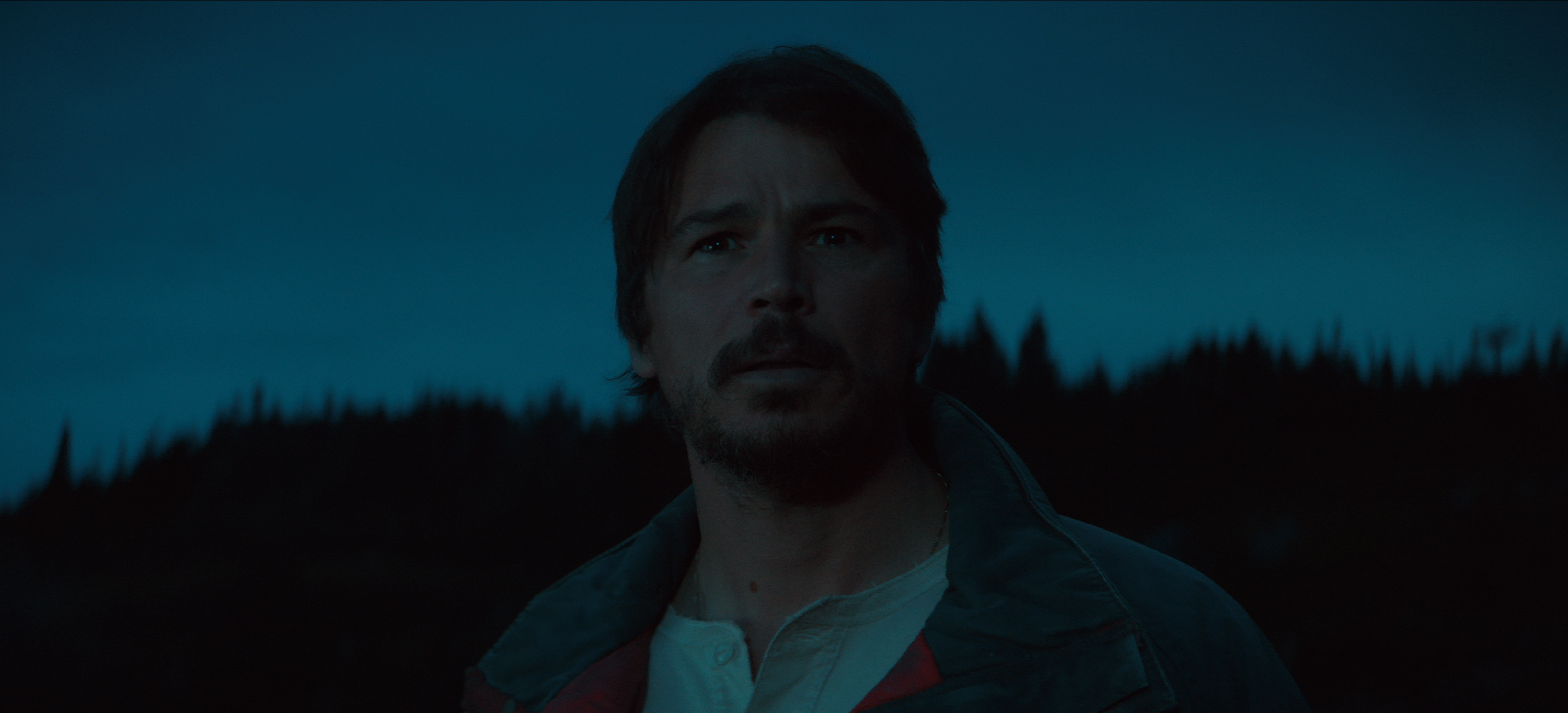
BELOW. Josh Hartnett as Calvin in episode 101 of Below. Cr. Courtesy of Netflix© 2025
That sounds like such a romantic writer’s life, writing on a boat.
Jessica: Totally. We’re like, “Where’s Jesse?”
Jesse: They gave me the captain’s quarters, and I was like, “This is the best office.” We had the best Wi-Fi in all of Newfoundland.
Jessica: No cell service, but Wi-Fi. You can’t call in, but we can text.
Jessica, when you started reading the finished scripts, what were you really responding to and encouraging Jesse and the writers to lean into?
Jessica: Jesse’s voice on the page and the cultural specificity of the characters, the turns of phrase that were very Newfoundland, we wanted to make sure that all landed.
Jamie knows his way around the genre. The technical aspects, he had so locked in that I felt like that was an area I was able to be like, “That’s great. Can we make sure that these people, these characters feel connected? Where are they at in the journey of the story?” Those were the places we were picking at and making sure, because it’s a taut — just to be boring — it’s a taut structure. We’re telling a big story in six episodes.
That’s not boring at all, by the way. Go on.
Jessica: So much had to land in each episode. You’re playing with the connections, the levels, what character knows what at all times. So those were the things I think we had most of our eyes on, at least for me.
Jesse: I was just so lucky to have a partner like Jessica who understood the show right away, understood that balance between character and genre and what it was I was really trying to do. She was fully supportive of that.
I also remember a conversation we had early on, just before we were about to start shooting. We finally chose the town that we ended up shooting in as our town, and no town that we could find was quite perfect to what was the town that was written. We were going to have to build this or take away that. So, there was some of that, and I was worried as a responsible showrunner. I was like, “Oh my God, are we going to be able to do all this? To create the bar and to have the boats come into the harbor?”
Jessica just said to me, in better words than this, but basically, “Don’t worry, you’ll know when we don’t have enough money. Tell the story that needs to be told.”
Supportive and foreboding.
Jessica: [Laughs] I think it’s hard. And look, it’s one of the things when you write a show as big as Below, but also it’s character-driven, you can second-guess yourself out of scale. You can actually, in an effort to be responsible, undeliver on one of the central premises, which is it is a big, fun thriller. It’s a ride, and it’s blockbuster on some level, even though it’s very, I would like to say, prestigiously character-driven.
But that’s a big ask. You have to deliver on it. Luckily, to be honest, we have partners in that because we’re up for it, but you do have to decide which are the places where you need to push the envelope because it’s going to show up on screen. It’s going to affect how audiences feel.
Would you say the house on the water is a good example of that?
Jessica: We did that practically.
Jesse: We actually sunk a house. Going back to your earlier question, that was just one of the things we all agreed upon. It’s like, if we don’t do this for real, then what are we going to do? It’s got to be for real, and then that will come through.
Jessica: You read a lot of scripts — myself, Jamie, Netflix, our directors, our actors, people read a lot of scripts. That’s the joy of our job. But it’s rare that a script grabs you from page one, right? The house on the ocean and the house sinking. So, a lot of us felt protective of it also because we had a real personal attachment to it. It was the reason we were there.
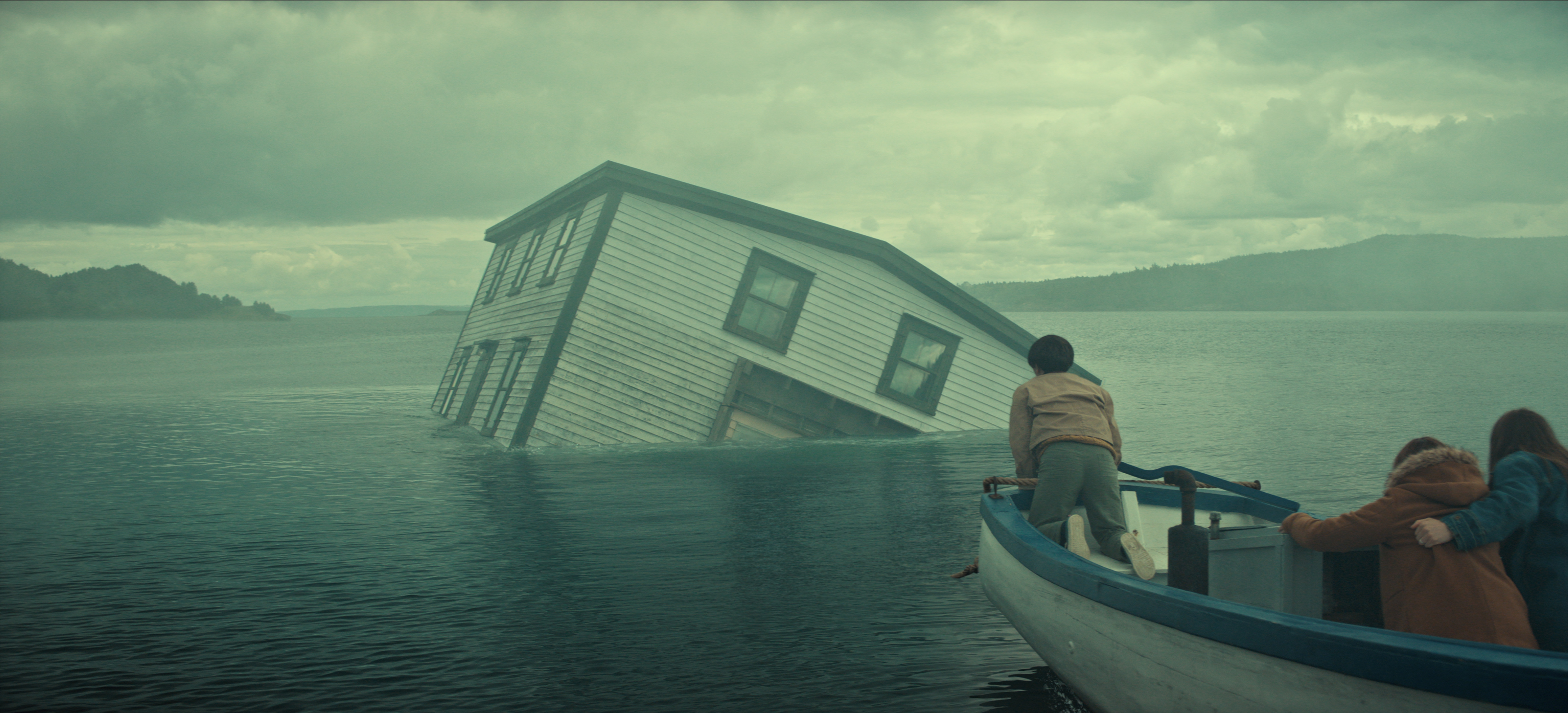
BELOW. (L to R) Azriel Dalman as Young Calvin, Kamryn Pliva as Young Ruth, and Rhiannon Morgan as Brenda Penney in episode 101 of Below. Cr. Courtesy of Netflix© 2026
At the end of episode one, without spoiling anything, there’s a pretty gnarly Danzig needle drop that really cements the tone of the show. Is that moment a good indication of where things go in Below?
Jesse: Just wait. There’s more of that in store. I think you’ll look back at that moment and that song in a new light. I’ll say all the songs that were chosen, they’re either songs that I’ve heard in Newfoundland that either came from Newfoundland or the kind of song that you hear on the radio or in a car or in a bar. It’s a very specific sort of vibe. I’ve kept a running list over the years of songs that I love that just felt right and the kind of thing that you might hear around the bay in Newfoundland.
Jessica: There are moments when you’re making a show, and they keep presenting themselves, where it’s a tone-check moment where you go, “Is everyone making the same show? Is everyone making the same show?”
To me, my favorite shows, whether I’ve been part of them or not, you can tell everyone was making the same show. Someone’s vision everyone was making. When we were trying to find the song, Jesse had a very clear idea of what he wanted that last needle drop to feel like. It took a moment to find the exact song, to be honest, but he knew what he wanted it to feel like, what he wanted to say.
That, to me, is all that leads me as a producer. I’m like, “What does it feel like? What does it feel like?” So when we put it in, what was so amazing about it was every single person was like, “That’s the right feeling.” And it’s a crazy feeling. It’s actually a big moment on a show.
And so it’s really nice that we had that early, right? We were like, “Okay, episode one, we’re making the same show. Let’s go.”
Jessica, you produce Black Mirror, plus produced Station 11. You’re no stranger to fantastical worlds. As a producer, what do you want to seek out of world-building on a show like Below?
Jessica: People would disagree with me, but I sometimes think full fantasy has it easier because I’m just going to believe anything I read as that world. I’ve levitated off of our ground. So, now I just have to learn what the world is and hopefully it architecturally stands up.
I think the harder thing is heightened grounded reality because you know this world. You understand what is untrue. You understand when you accidentally end up in that uncanny valley where you’re like, “What is this?”
So to me, it’s that marrying tangibility of the script. I think we executed this — hopefully people feel like throughout every element — but it feels like you know these people, you feel like they know their world, and then you need actors, even though they’re not from this world, to inhabit it and make it home.
Jesse: There’s a scene in the pilot where the whole family gets together and they eat Jiggs dinner, which is the traditional Sunday dinner that everybody eats in Newfoundland. As we were getting ready for that, our props master, Emma Monahan, called and was like, “Do you know anybody that can show me how to make a proper Jiggs dinner?”
I was like, “Do I?” So I called my mother-in-law, my wife’s mother. I was like, “Will you make a Jiggs dinner for Emma, our props person?”
Jessica: Going for son-in-law of the year.
Jesse: And she was like, “Yes, so excited.” And then I was like, “Okay, so she’s making it. Emma’s going to be there. I’m going to be there. My wife is going to be there. We might as well bring Jessica, bring Jamie Childs, our director, who’s going to be directing the scene so he can see.”
All of a sudden Josh Hartnett was there, Mackenzie [Davis] — all of a sudden it became like a party. Everybody got to experience the whole thing. And then that informed the scene. Jamie got to know how it looks and how it feels and how to shoot the scene. Everybody got an experience of it. So, it’s being open to that. There are other shows where a props master maybe wouldn’t have asked that question.
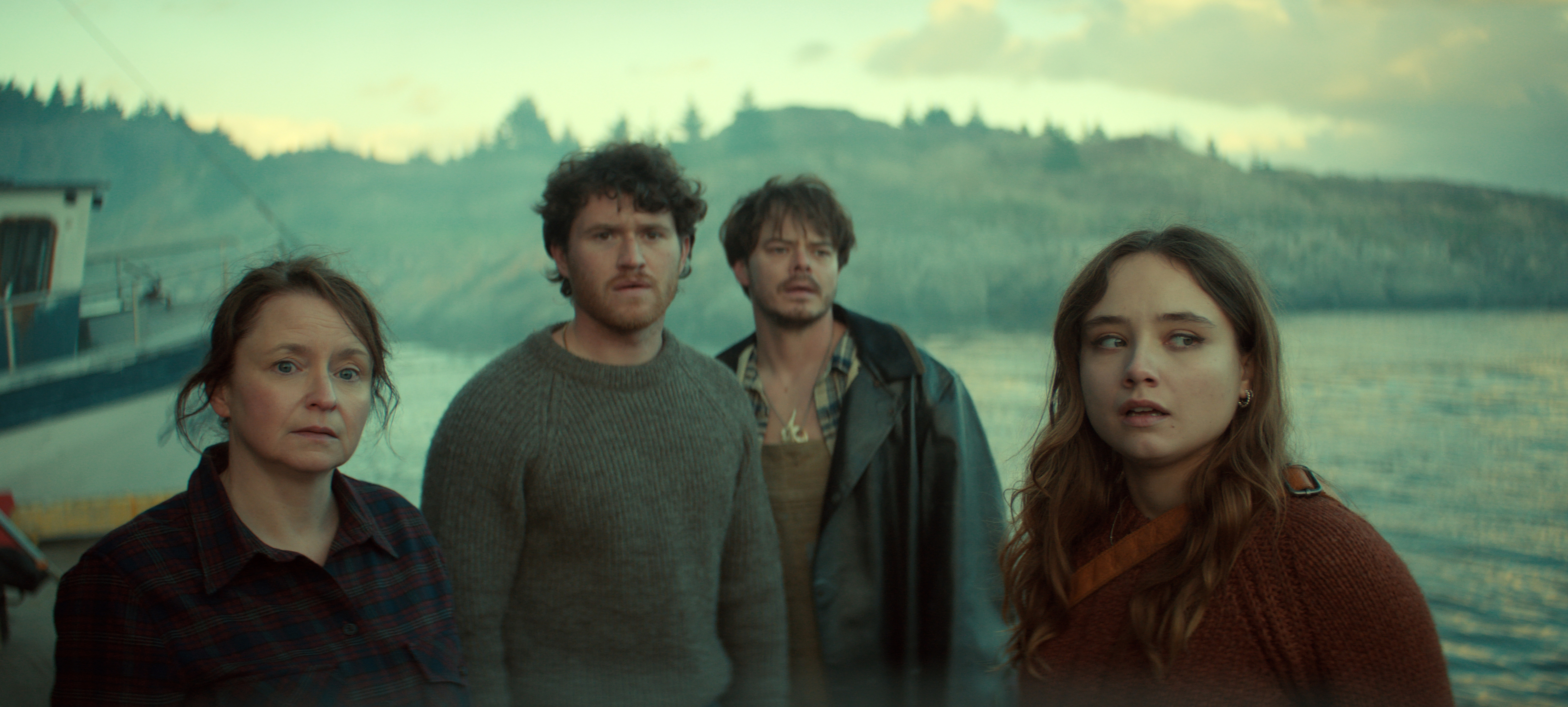
BELOW. (L to R) Willow Kean as Ruth, Rohan Campbell as Jay Penney, Charlie Heaton as Wade, and Ruby Stokes as Mary in episode 106 of Below. Cr. Courtesy of Netflix© 2026
We see this world mostly through the eyes of Josh Hartnett’s character. What qualities as an actor really suited the character Calvin?
Jessica: I had the fortune of working with Josh before on a Black Mirror episode. I had been able to see Josh inhabit a role that I also wasn’t expecting him in. There was a sturdiness and a fiber to him.
I don’t think at that point you’d seen him really be a father in that way, which is really a next generation for an actor. When we started talking about him, it was really exciting to us also because I think we wanted to play a younger father.
Jesse: Yeah, because he’s still a young man, but his family has already basically left, flown the coop. So it’s like, what is the rest of his life going to look like? Especially if he’s forced to start over somewhere else.
Calvin is having a little bit of a midlife crisis, and I think Josh really responded to that. He really responded to the family aspect of it as well. He’s a father of four, and he really embraced that role and that part, even behind the scenes with the actors.
He’s a man from Minnesota, you know what I mean? I feel like Minnesota is like the 11th province of Canada. So he identified with the accent, and they do something slightly differently. He was immediately fascinated by Newfoundland and went all in on it and had a wild experience doing so.
It was the perfect match. Just him as an actor, I’d always been a fan, but I just think he’s such a smart actor. He’s such a soulful actor and really pushes himself. It was a great match.