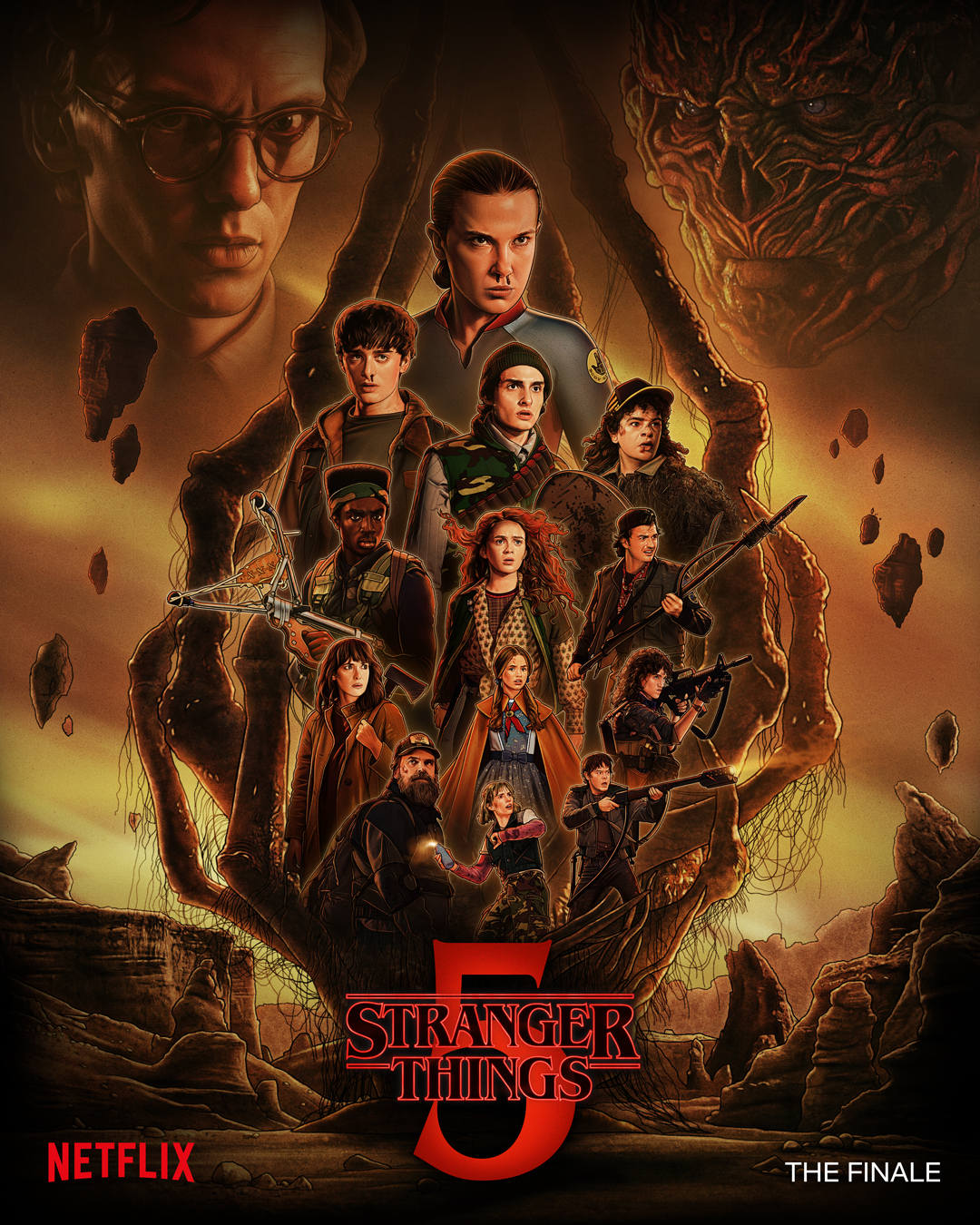
“We are the ultimate problem-solvers of all the music-related problems on the show,” says Lena Glikson. She’s the co-music editor of Stranger Things, a show famous for its pop culture-dominating needle drops. A part of Glikson’s job was to make the songs, score and the cuts match the shots just right.
There is a science to it, but plenty of room to get creative for Glikson – including providing vocals for the series. In the past, she’s worked in the music department for films such as Better Man, Babylon, Joker, and A Star is Born. Recently, the music editor for Stranger Things spoke with What’s on Netflix about the art behind the science for needle drops and Kyle Dixon & Michael Stein’s score following the series Emmy nomination which saw Glikson pick up her third nomination for Sound Editing for a Comedy or Drama Series for Stranger Things following her win in 2022 and subsequent nomination in 2023.
You mentioned you don’t get a lot of opportunities to discuss your work as a music editor. What don’t you get asked about Stranger Things that you’d like to address?
Each project is so different. Every music editor does their own kind of thing. In a way, the credit “music editor” can mean so many different things. We exist between different departments, between the sound and the music department. It’s very hard to sometimes categorize us because there is a technical part of the job, but there is also this huge creative part.
For example?
One of the things that I really appreciate about Stranger Things was that I was actually able to do a ton of creative things, actually make music. It’s just that music editors don’t always write music, but we still make music. I think it’s super cool because we become this middleman between the filmmakers and the composers. When there are any last-minute changes or maybe not the last-minute changes, you can be super creative.
I was fortunate enough to get a chance to be in super close proximity to the showrunners, the Duffer Brothers, and contribute to the music-making process in that way. I did become this ultimate problem-solver, introducing this new idea to Stranger Things that so many things could be enhanced emotionally, adding the vocals, and the Duffer Brothers seemed to really like that idea and the sound. I was so lucky and fortunate to also record some vocals for the season of Stranger Things, which was a lot of fun.
In terms of being the ultimate problem-solver, what are some common solutions and some uncommon solutions you found working on Stranger Things?
Basically, a lot of what you do as a music editor on a show like Stranger Things is shaping the music because our composers are incredible when it comes to making super unique sounds. One of the unique things about Stranger Things is the musical language of the show. The musical language that they create is a big part of the Duffer Brothers’ vision. And they’re super specific about start points for every single cue, where the cue ends, and the arc of the cue.
How closely do you work together?
I moved into the cutting room. Mine was right across from the Duffer Brothers, and they would just knock on my door and come in and be like, “Oh, we have this idea that we want to try. We really like this cue that our composers wrote for season two. How about we try for this scene?” They would send me a rough mock-up of what they felt could work.
Then my job would be to make it fit with the picture and enhance it. We have the stems that we can work with, all the separate instruments. You can deconstruct them. You can add things. You can mute things. You can transpose things. You can change the tempo. Basically, my job is ultimately to do that – helping the Duffer Brothers utilize certain pieces of music or sounds that they liked. Because for every season, we have this extensive library of stuff that our composers would write beforehand.
Let’s say season five is approaching, and they know that there could be a couple of new characters, and they would just come up with all these cool ideas and new sounds for the season that they would like to use. Then by the time the Duffer Brothers start cutting, there are already all these sounds, and the Duffers would be like, “Oh, we really love this piece of music from the library,” or, “We love this. We can make it work for this scene.” It could be just one synth or one rhythmic idea, and then you work that into a particular scene.
You’re handling some classic songs for the needle drops. There’s a weight of responsibility there. When you cut a song for the series, what delicacy does that require?
There are many layers to cutting a song for Stranger Things. First of all, after season four, you cut every song knowing that this might be an iconic moment. You have to be very, very precious about every single piece of music you hear in the series. So that is a responsibility, an extra level of importance and perfectionism to everything that you do with a particular song. You have to be super careful with all the lyrics.
You can’t change too much, right?
The thing about using songs in movies in general is that we have to change the form of the song quite a lot. We have to cut it in unnatural ways, basically. How do you do all the things that the filmmakers want? For instance, cutting something like Prince’s “Purple Rain” in season five was a tricky one, similar to “Running Up That Hill” in season four, where it’s hard to achieve all the things that the filmmakers wanted to achieve.
“Purple Rain,” too, is such a dense epic. What care did that song require?
With the Prince song, I knew from the beginning that there were certain limitations on what we could and could not do with the song. But then when you know that the showrunners are just so specific, for instance, the way they cut that scene and the way they cut that song, which was to enhance the action, to enhance the drama. They knew certain sync points and how the music needed to change at what moment. It’s so hard to make it work because certain beats are cut out and the phrases are incomplete.
Obviously, it looks great, but then musically it’s your job as a music editor to make it make sense, to be super careful with that heritage. One of the main jobs I do is making sure that everything that happens is musical, because there are so many things that can bump you as a musician.

Picture Credit: Netflix
Plus, working with the music supervisor, and in the case of Prince, his estate. What are some limitations of what you can and can’t do with certain songs?
Well, editing was actually a big part of it. We were trying to make sure that nothing we did basically destabilized the song in its original form. We did have to edit it, and we did have to switch the parts around.
Do you ever get feedback from artists?
In Kate Bush’s case, she was able to give feedback. I remember this one particular note that she gave on “Running Up That Hill.” She wanted to change an edit of the drums in episode eight in the trailerized version of the song. I did that fix for her.
But with Prince, unfortunately, he couldn’t give us feedback. So we were just trying to be very, very careful with that. Originally, the scene was longer, so we weren’t 100% sure how to make it fit with the scene. But then when they cut the footage a bit, and the song became shorter, it started working so nicely. We did not need any extra layers. And I was a little bit worried, like, “What’s going to happen if we decide to go with a score [instead]? How is that going to work in terms of licensing and everything?” But luckily, we were able to just stick with the song and the edits that I made. I really hope that they were honoring the heritage and honoring the song.
Every second is so precious in this line of work, right?
It’s always this math equation that you need to solve because you try this and you try that and nothing quite works. So grateful to our picture editor, Dean Zimmerman, who actually, at a certain point, was like, “If you need a few frames here and there, let me know.”
I calculated the number of frames that I needed for a perfect edit [for “Purple Rain”], and I came back to Dean. Originally, we both thought it would take me several weeks to figure it out. And then I was like, “Okay. So I have this edit. We need to lose 11 frames.” Dean and our other editor, Casey, lifted 1 frame at the end of a bunch of little shots, and they trimmed 11 shots by 1 frame, something like that. That’s how we ended up with an edit that worked.
What’s another song that took some extensive trial-and-error work?
In season five, we have this big orchestral version of “Running Up That Hill,” which surprisingly took a very long time to master. It was similar to cutting “Purple Rain” because the scene was quite long and the Duffers kept making tiny adjustments.
Every time, we had this joke that they would knock on my door and be like, “We changed the cut. Now you have to readjust the song.” I think it’s during the long run in the red void that Max does where you hear “Running Up That Hill.” It’s when they’re trying to return to the real world.
How did the orchestral version of “Running Up That Hill” evolve with the edit?
First, there were several iterations of the cut that Shawn Levy directed. It was his idea to use the orchestral version, which was created for season four. The challenge was that the orchestral version of that song that we had was probably like a minute and a half long. Essentially, you have to loop it, but you can’t loop it exactly. You have to change it, and that was quite hard. There was a little intro for that that I wrote, like a little piano piece, because, again, you have to be the ultimate problem-solver. But orchestral sounds are faster to manufacture when you are there and you know what the filmmaker wants at the moment. It was fun because I got to write some string parts for that.
After all this work, whether it’s for Kate Bush or Metallica’s “For Whom the Bell Tolls,” it must be rewarding to see these scenes hit the zeitgeist.
That was my colleague, David Klotz, for Metallica. So I need to say that it’s the two of us. David is an incredible music editor. He did Game of Thrones, American Horror Story, and started working on Stranger Things season one. The entire reason why I kind of joined the team was that his role was always doing all these last-minute changes on the dub stage. Because of the schedule of season four, the Duffers wanted someone else in the cutting room because my colleague, Dave, was always busy with the mixing side of things. He had to be on the dub stage during the mix process.
For the schedule of Stranger Things, at least on season four, they were mixing episode one, but at the same time, the Duffers would be working on the cut for episode two and would still be reviewing the piece for episode two. Those two processes were happening simultaneously, so they needed another person who would be stationed in the cutting room – and that was my original job.
Originally, I was just meant to review the music cues with the Duffers and give feedback to the composers. Then it just turned into this kind of do-everything type of thing. The timeline was so different from any other TV show in terms of release.
Which needle drop that really landed with fans do you remain very proud of?
It’s incredible for Kate Bush and for all the new listeners who became familiar with her music and her incredible talent. When I work on the show, things look very different for me. It’s hard to judge. I have many things that I associate with a project or a scene. Because to me, “Running Up That Hill” is not just the iconic moment that the fans loved – but it’s also the cutting room. I was anxious at times when I was like, “Is this going to work? This is probably going to be such a huge moment. Are the Duffers going to like this?” It’s this entanglement of different emotions that I experience.
Seeing how something gets a completely new life after the project is released and how the fans are reacting is super rewarding. But again, because I look at everything from the inside, it amazes me how so many people all of a sudden become familiar with something that was an important part of my life for such a long time and was so personal. The same applies to Prince. It’s so incredible to see how younger people discover his music or rediscover it. It’s very rewarding.