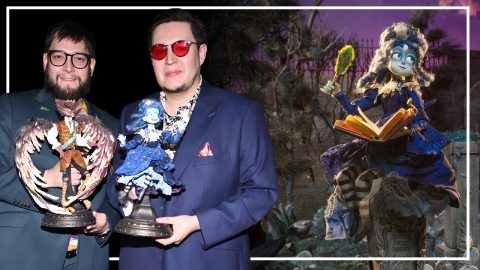
Picture Credits: Netflix / Kevin Smithers
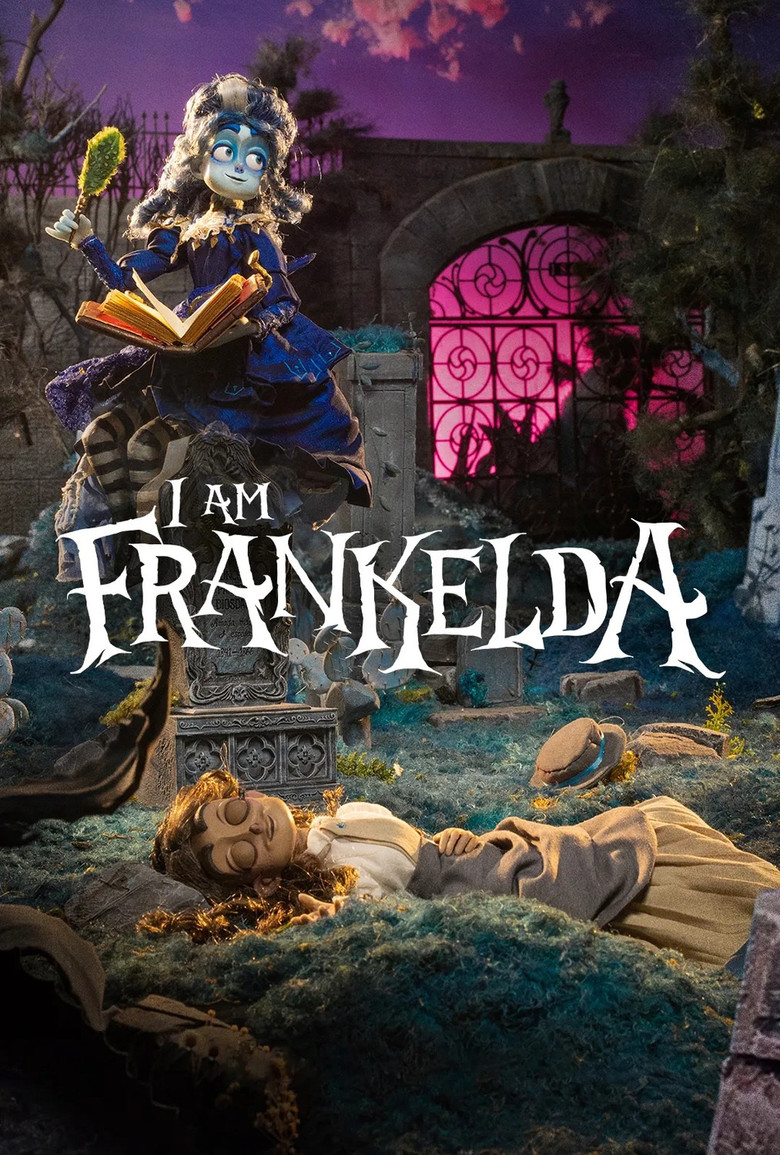
I Am Frankelda is an inviting nightmare from filmmakers Arturo and Roy Ambriz. Based on the TV series Frankelda’s Book of Spooks, it’s the first stop-motion film from Mexico. It is pure magic in all its hand-crafted glory. Composer Kevin Smithers, who scored the television series as well, returned to bring new themes as well as musical numbers to the film about an aspiring writer visiting the realm of terrors.
The score lives up to the film’s visual splendor. “I hope audiences find wonder and terror, see that the movie and the music are inherently Mexican, but never rely on clichés or stereotypes,” Smithers told What’s on Netflix. “The wonder, political revolution, tragedy and joy, and everything in between—I hope they see that in the work and the music and have a great time.”
What was your reaction to the stop-motion animation? How did its beauty inspire your music?
I did the musical numbers, the songs, and the score for the film. What that meant is that I came in when they didn’t have any visuals at all. They had a couple of tests, concept art, and a couple of character models, but they didn’t have any animation to look at. I had to write all the songs at the beginning based on my collaboration with the directors so that they could animate the music.
The scoring process of the background music happened once they had animation and I had picture to work with. I worked on this for years on and off because I had to write stuff at the beginning, then come back and score the movie. By the time I got to come back and do the score, I had already done a lot of work regarding style, instrumentation, and some themes. It’s a little different than when you’re a composer who comes in at the end.
Since you wrote the musical numbers before seeing any footage, how did you react to the finished numbers?
Oh, it’s beautiful. It comes alive. You write the music and hope that it’ll work, but until you see the finished product, you don’t know. I’m sure that if something doesn’t work, the directors will reach out and address it. One of the songs that ended up in the movie, we actually wrote for the TV show. I wrote it maybe six years ago.
What song was that?
That is “Invisible Ink,” one of the love songs. It’s in the TV show airing on HBO Max. It was weird going back to this song that I wrote years ago, reorchestrating it a bit, and doing a different mix.
I couldn’t get enough of the musical number in which everyone is going against the Prince of Terrors, Hernval. It’s fantastic.
Thank you. The idea of that song came directly from the directors. They wanted to essentially bring back every song we’ve ever written for the IP from the TV show and the movie and have this big climax that propels us into act three. Each of those sections is a song from the movie and TV show. We bring back every single song that’s been showcased with the Frankelda IP and introduce some new music as well.
For the opening cue of the movie, how did you want to invite audiences into the world of terrors? Especially if they haven’t seen the show.
For your audience, you don’t need to watch the TV show to understand the movie. It’s cool, but it’s almost a different thing. The TV show was horror for kids. I grew up with Goosebumps, so I love that stuff you don’t really get to see anymore. Nowadays they don’t want to scare kids too much, but that wasn’t the case in the ’90s. So, that’s the TV show.

Picture courtesy of Cinema Fantasma
How does the movie compare?
The movie takes a turn more toward adventure, some mythology, and is almost closer to fantasy. It’s more of a Lord of the Rings vibe than horror for kids. With the first cue, we wanted to set the tone that this movie was going to be a different thing while still maintaining some of the infrastructure that made the TV show. We introduced everything that you were going to see or hear in the music throughout the movie.
There’s a bit of a looping quality to the music—and that circles back to the looping quality of the movie, without giving anything away. There’s this existential looping, the chicken-and-egg thing going on in the movie that we wanted in the music.
So, it’s a little bit influenced by musical minimalism. Then we hear the orchestra. Then we have the theremin, which is performed by Ernesto Mendoza Polanco. He’s a gifted theremin player based in Mexico City. The instrument is used as the “veil” between the worlds in the score. We bring it back for the movie because of the plot. I can talk more about that in a second if you like.
Yeah, please.
And then the choir, which is one of my favorite things about the score. The choir that we recorded is called Cuarteto Somos (formerly Shemesh Quartet), also in Mexico City. They don’t sing in English or Spanish. They sing in this language called Enkarik that was created just for the movie.
We worked with a linguist, Gina H. Amelio, who created this language, written and oral, so that we could write for it. I can’t recall exactly what languages she fused. It’s its own little thing, and nobody will understand what it means because it’s a new language, but there are actually little nuggets of plot for the audience in that choir spread throughout the movie in my music.
When you introduce the nightmare realm, also known as Topus Terrenus, you emphasize the beauty rather than the horror of the world. Was that important to you?
The Terrors in the Topus Terrentus are not bad guys. They feed on the nightmares that they create, but are you going to hate a tiger because he has to hunt? It’s the nature of the tiger. It ties into Mexican culture and how we perceive monsters and horror—and how sometimes it’s second nature to us. It feels like part of daily life, with all of our legends and what we have to see and experience.
On top of that, we see the world a lot of the time through the POV of Frankelda, who is fascinated by it more than anything. This is her chance to write these amazing stories and be part of this wonderful world. It’s not really terrifying for the characters. It’s more the wonder aspect of it that we wanted to explore.

Picture Courtesy of Cinema Fantasma
How much did Frankelda’s desire to create speak to you and inspire you when writing her theme?
I feel there’s a little bit of Frankelda in every creative, in every artist. We’ve all experienced that rejection, that self-doubt, and that impostor syndrome. It’s impossible not to see ourselves in her. I think that’s why so many people empathize with her situation and who she is.
She doesn’t necessarily have a Frankelda theme, per se. She has a couple of themes that actually spawn from the songs, and that’s how I approach the thematic writing for the movie. Most of the themes come from the songs that I wrote at the beginning. Frankelda and Herneval have a love theme, which is “Invisible Ink.” And then she has her wonder-filled, creative theme, which is “I’ve Been in this Place Before.” Depending on the setting she’s in, you might hear one or the other and maybe a variation or a twisted version of it.
We don’t really introduce her theme until she properly becomes Frankelda. Francisca doesn’t necessarily have a character theme. It’s when she embraces her new destiny and becomes Frankelda that we introduce her theme and her musical identity.
What is it like scoring the antagonist, the royal advisor Procustes, a total creative hack?
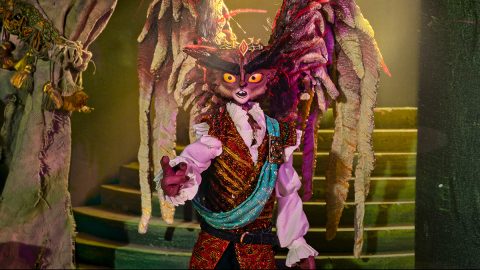
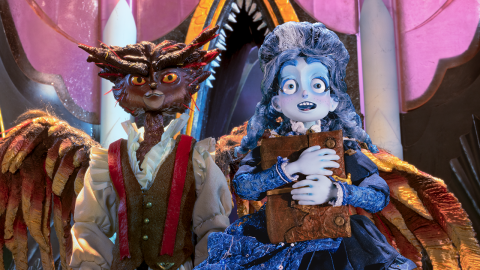
It’s great, man. I love the character model, the puppet. One of his characteristic sounds is the choir. I’ll speak a little bit about the language because it’s super interesting. You have this language called Enkarik, which is the mother tongue, basically. And then out of this mother tongue, there are two languages that spawn from it. One is called Aradithio, and the other one’s called Tecothia. Tecothia is the language that the owl people use and speak. Aradithio is the language that the spider people speak. Every time you see our bad guy, Procustes, you usually hear the male choir. It’s only men singing.
There are whispers. If you’re really listening to the soundtrack, there is whispering under the normal choir. It’s almost like the choir is trying to get into Procustes’ head and trying to push him to grab the realm and defeat the good guys. The choir is his consciousness.
And then on the other side, when you have Hernaval and Frankelda, you hear the female choir singing in Tecothia. They’re usually trying to warn them and keep them safe. You would never be able to tell because most people don’t know how to speak this language, but that’s what they’re saying.
As a storyteller, when you get to the sequence introducing Fear Itself, an actual figure in this world, how do you decide on the right sound for that story?
The main moment when we see her is when they’re telling her legend. We get to hear both choirs, the male and the female, using both languages because they spawn from her. Everything I do, I try to tie it to the plot and story. Why do we have a choir here? What is that choir going to say? How can we try to create a musical concept that is innately tied to the story? If there’s more Frankelda in the future, I kind of hope that we get to see more of her because that would be super fun to explore musically.

Picture Courtesy of Cinema Fantasma
As you said earlier, it’s hard not to connect with Frankelda, but there’s also the romanticism of storytelling in the movie. Did you find the themes of the film let you be musically more romantic than usual?
For sure. One of the great things about the directors and the way they work with me, at least, is that they love music. They set the boundaries as to what the story is and stylistically what we can and can’t do. Beyond that, they give me free rein to do whatever I want, which is rare.
Even just in the visual aspect of the movie, there’s this romantic, almost Gothic element to the visuals that lends itself to being very expressive, very thematic. There’s almost an operatic quality to the storyline and the music. The directors are huge fans of The Lord of the Rings. I’m a huge fan of the music of the movies, too.
[Composer] Howard Shore is one of the best.
Howard Shore is a genius. His use of motifs and themes—it’s like [Richard] Wagner. It’s incredible. I definitely leaned into that as well with the score. From the TV show, we already had all these themes and all these characters, so the movie was a great opportunity to unleash this plethora of themes that we already had. It’s the TV show on steroids.

Picture Courtesy of Cinema Fantasma
What are the release plans for the soundtrack? Will we get a vinyl release of I Am Frankelda?
The soundtrack is already out in Latin America. It hasn’t been released in the rest of the world. We don’t have plans right now. I would love to release the soundtrack everywhere; perhaps a limited vinyl release as well. It’s up to Netflix. If the fans want it, I’m sure Netflix will do it.
I know we all want to see the soundtrack released widely. It’s sometimes tricky though, there’s a lot of variables. If the fans want it though, Netlfix will do it. We all want to see what the best route is to get the music out to everyone.
The release did incredibly well in Latin America, though. The label that released it, Air-Edel Records, saw the numbers and was like, “This is crazy.” We’re very happy that the fans have reacted to it and seek out the music actively.