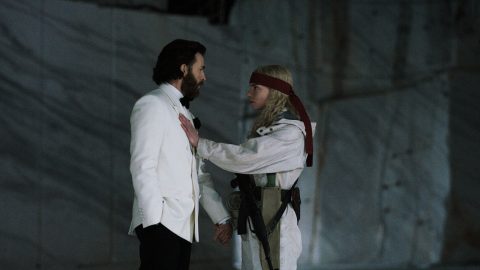
Picture Credit: Netflix / Arno
Sacrifice goes from a posh gala in a quarry to a river to a bunker to a volcano. It is, needless to say, quite a journey from director Romain Gavras. It’s part satire, part apocalyptic comedy about a rebel group led by Anya Taylor-Joy holding the richest of the rich hostage. Once Gavras had written the script, two of his immediate calls were to cinematographer Matias Boucard and production designer Arno Roth.
The filmmaker behind Athena told them to pack their bags. They had a movie to make. It was a fitting beginning to a gig for Roth, who found himself standing on volcanoes more than once. Not every production designer in the world has faced that task, and it’s an experience Roth told What’s On Netflix all about.
How was pre-production and scouting for Sacrifice? What interesting places did the film take you?
We started in Iceland, and we scouted volcanoes there. We had some storms, snowstorms. It was incredible. We spent a week there scouting all the volcanoes and everything.
The landscapes are amazing there, but what we felt is we’d already seen them. Many movies have been shot in Iceland, like Star Wars, for example, and many others, which show the incredible scale and landscapes.
We searched for where volcanoes are on planet Earth. And then Romain said, “But there are volcanoes in Greece.” And then we said, “Okay, let’s go to Greece.” So we went to Greece, and then we went to Santorini, the island where we finally found the volcano.
So we scouted the volcano and we said, “Okay, we are going to do it here if we are allowed,” because, as always, all these areas are really protected. It’s a kind of paradox because it’s really protected and also very touristy. I mean, there are tourists everywhere.
Cr: Courtesy NETFLIX
So you get the volcano. Where do you go from there?
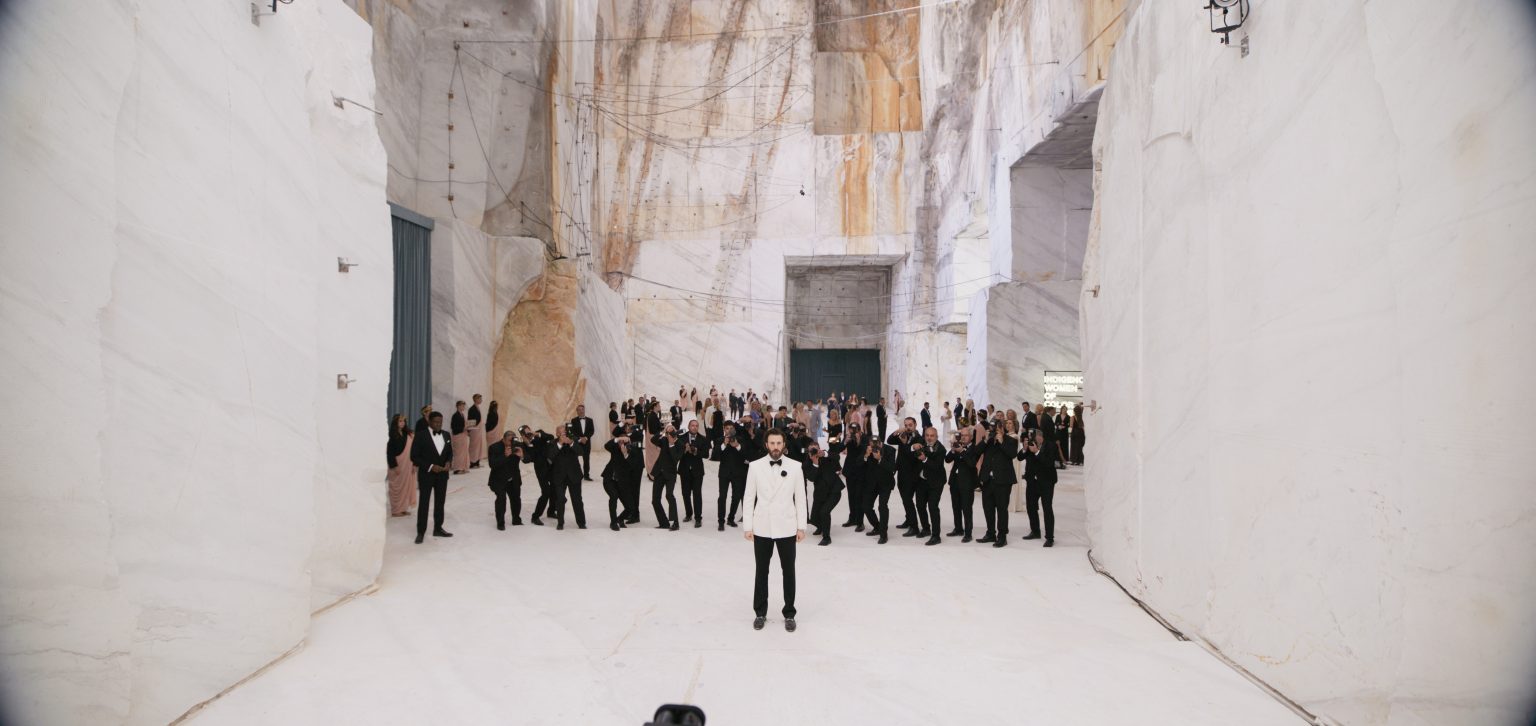
Then we had to find the quarry. We visited many quarries in Greece, around Athens at the beginning. And then we extended the perimeter. It was not that easy because all those quarries are, I mean, active. There are people working there, and they don’t want to have us for days, weeks, preparing everything, shooting, stopping work.
So finally, we found an incredible one in Volakas, which is in the north of Greece, probably two or three hours’ drive from the closest airport. It’s very close to the Bulgarian border.
And then we found Volakas, and we really fell in love with it. And then the director was really friendly and said, “Okay, I will try to make it happen, but I need to talk with my owner, the guy who owns the quarry.” Finally, after days and days of discussion, they accepted us there.
So we decided to shoot in the south of Greece on the island of Santorini, and in the north with the quarry. And then we had to find the cave, the grotto, and also the river.
How’d you land the proper river?
We had many guys in many countries, local productions that sent us several options. Bulgaria is a very movie-friendly country. They have a very good industry there. They’ve worked on commercials for decades now, so they have very good teams. I worked there many times as a production designer on commercials.
They had this incredible river with this incredible grotto. So we went there, we scouted, and said, “Okay, let’s do it here.” Everything happened probably in a month.
When you scout for a volcano — that’s a fun task, by the way — what qualities are you looking for?
Oh, that’s a good question because it’s not so easy. Obviously, we can’t shoot on a real volcano that’s alive. It’s way too dangerous, and it’s not allowed. I mean, it’s way too hot. Most of them are very old, so they’re almost green everywhere because vegetation climbs around, and with time, the shapes become softer and softer. You lose the shape, you lose the edges, you lose everything.
So we had some technical boxes to check. And then it has to be epic because it can’t be surrounded by other volcanoes. When we are on top of it, it has to be epic. We need to have an incredible background all around.
And then when we have that, we need to find a very interesting path because it’s a journey from the sea to the volcano, from anywhere to the volcano.
This path takes time, and we had many sequences there. So we had a lot of parameters, a lot of boxes to check. And at Santorini, it was absolutely amazing because it’s in the middle of the sea and it’s surrounded by an island, but 360 degrees around, it’s sea plus island far away.
So when we arrived there, we said, “Okay, this is the one.”
It must’ve been a fun trek every time, too.
The actors climbed every day. We had to climb the volcano. It takes probably one hour, and they had to do it. So there were no electric cars. So they had to do it, and they had to do it everywhere. When on the boat, this boat is amazing on the river. There are just two boats like that in the world.
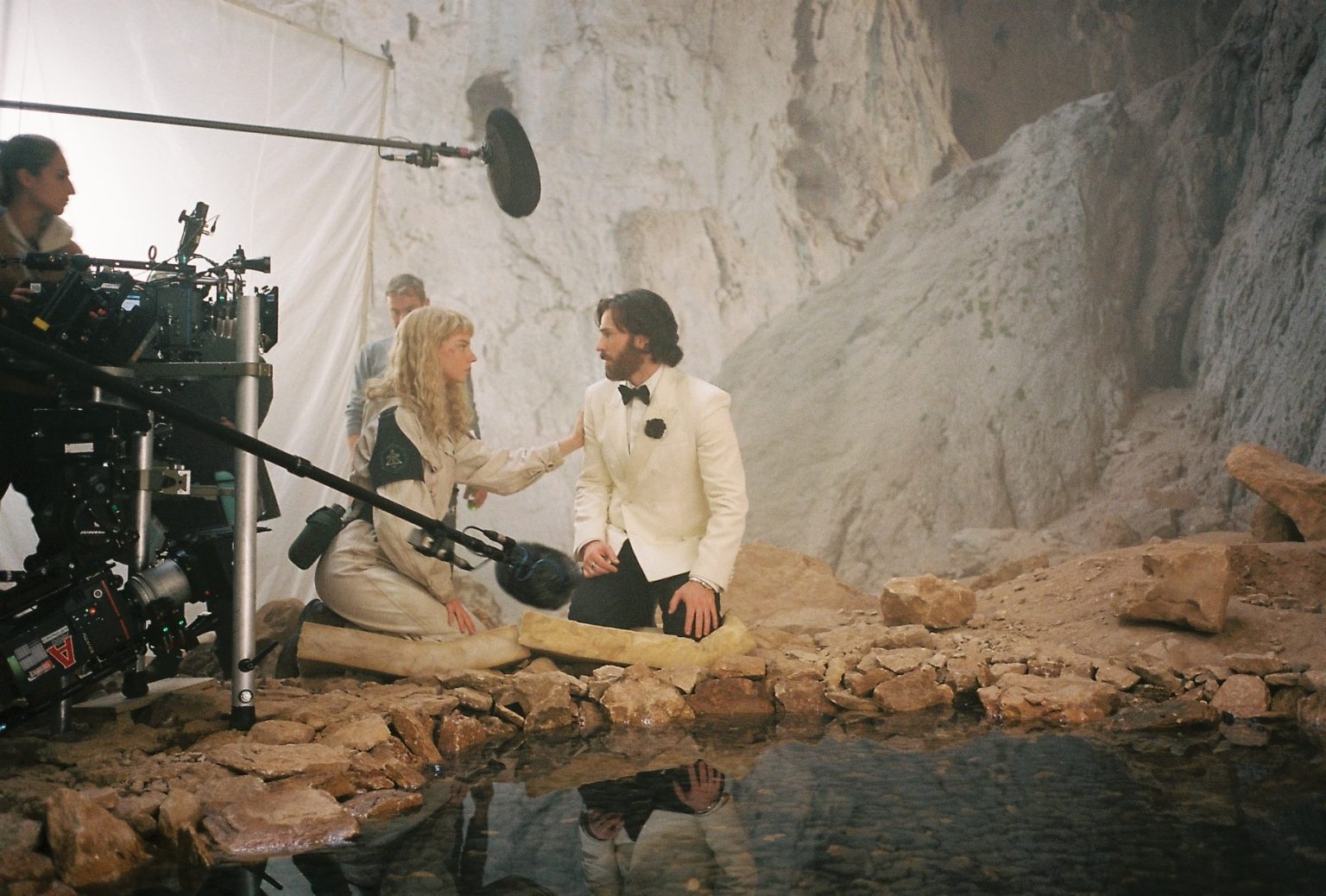
SACRIFICE (2026) Anya Taylor-Joy and Chris Evans on the set of Sacrifice. CR: Kim Chapiron/Courtesy Netflix
You and your props team did a great job with your main interior location, where the gala and fundraiser are held. What were you referencing for that space?
Romain thought about the many galas and charity events, especially when he went to the Cannes Film Festival or stuff like this. Romain, Matias, and I – we worked a lot for luxury brands. We know how it works in this world where everything is very specific and unique. It couldn’t be just a dinner; it has to be a dinner in an incredible place.
As Louis Vuitton or Dior or those brands are doing, they organize that for their best clients. So they send you a plane, you come to an island, and then you have dinner because you are probably one of the 100 best clients in the world. It has to be everything.
We had many discussions, the three of us – Romain, Matias, and I – because we really worked together since day one. We worked together on Athena before, so we knew each other, and it was really helpful to be as confident as we were because we knew each other very well.
So the scale for the three of us, the scale of everything, was really important. We spent many hours scouting with our camera, searching for the good scale, the good lenses for Matias, because it’s about scale, humans surrounded by nature, and nature can’t be random and small.
The quarry has to be amazing. Then we had to create this dinner. What color? What napkin? What tablecloths? What details? What is the good color that matches this incredible marble?
So we did many tests of probably 12 different colors in the quarry, shooting them with the camera and lenses to find the exact color we wanted for the curtains. Because we knew that we wanted curtains at some point to bring some warmth and some interesting material to contrast with the marble.
And when we decided, when we chose that color, that velvet, bluish-greenish velvet, then I could work on the tablecloths, napkins, cutlery, and everything.
Because the thing we knew, the three of us knew, is we would have Salma Hayek Pinault, who is probably one of the most professional ladies in the world.
Was her perspective very helpful there?
I mean, she is used to that kind of very, very, how do we say that, exclusive dinner in incredible places because of her husband, because of Gucci, because of everything. We knew she knows exactly, she knows that world, and we knew that she would be our judge and approve or not.
When she arrived, that was the first day she came, we delivered everything. Everything was ready. She arrived probably a day before shooting, and everything was dressed, almost all the details. The napkins folded as they’re supposed to be, all the glasses very clean. And then she arrived and she said, “Oh, it’s amazing.”
I was totally happy. I was waiting for her approval because nobody but her was able to tell us if it was credible for this world, which is also important for us. I mean, we are talking about something that honestly nobody knows but her.
So it has to be credible, it has to be impressive, it has to be as beautiful as possible regarding our taste.
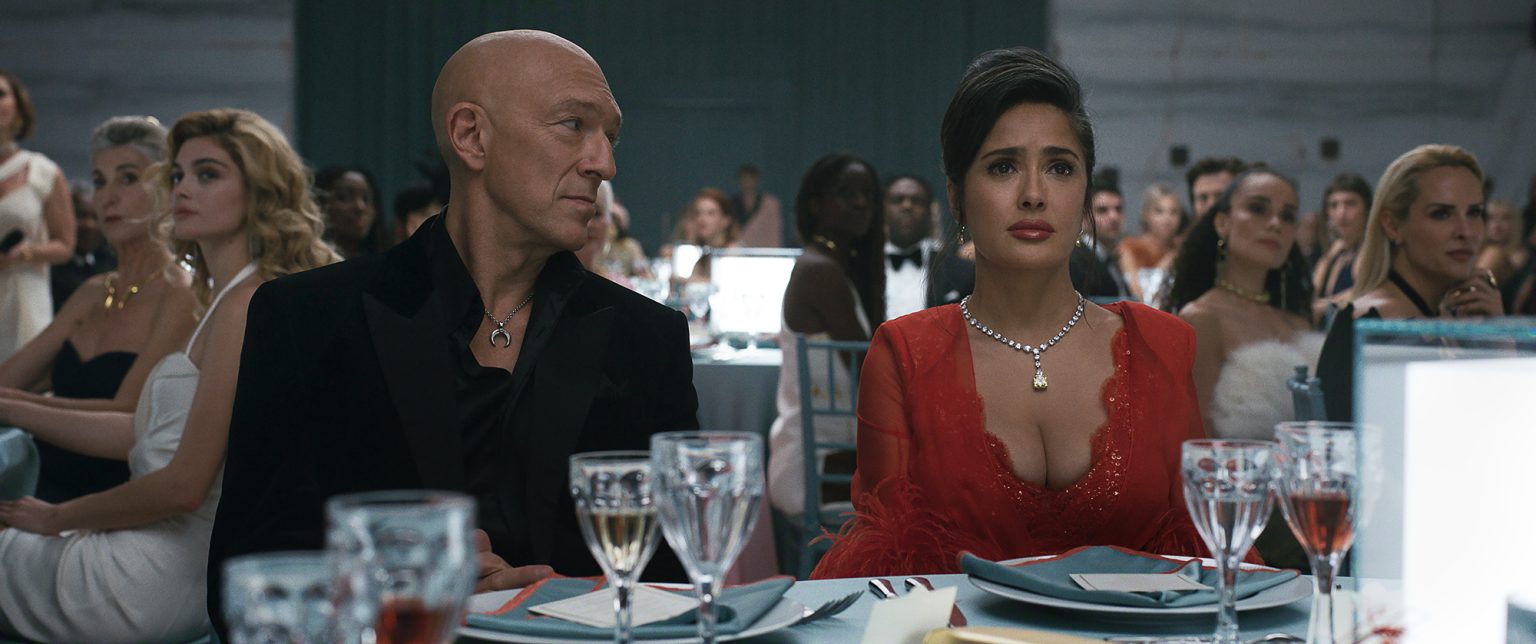
Sacrifice. (L-R) Vincent Cassel as Ben Bracken and Salma Hayek Pinault as Gloria Bracken in Sacrifice. Cr. Courtesy of Netflix © 2026
How else do you create scale besides just a large location?
Scale is something. Scale is not just big. Scale is also color. It has to be, at some point, iconic or singular.
You also get to create a doomsday prepper’s (John Malkovich) bunker. Did you research many bunkers?
For a long time, we thought we were going to build the bunker, the skeleton, the walls on stage, and then build the cabin inside it. Probably just before we started shooting, at the end of prep, our location manager, this guy was amazing, and he said, “Guys, maybe I have something interesting.”
So we drove for an hour and a half, and we arrived in the middle of nowhere, and then they opened a kind of gate, and then you have a tunnel for 10 minutes, and you arrive in an underground cave, which is supposed to be storage for toxic products.
Really?
They built it two years ago. It was not yet used, so it was empty, almost new, with these rooms. We said, “It’s amazing.” So we designed the cabin. Nothing was built there. So we designed the cabin, we built it in the workshop, and then we assembled it there, we dressed it there.
The idea was, until Mike opened the doors, we have to believe we are in a real cabin in the woods. And so that was the challenge.
I had a very good team there. We had a specific construction team for that set, and they were really great. We built that. We printed the background in front of the kitchen.
The reference was, I think, there is a guy probably in Las Vegas who built a bunker. This bunker is absolutely amazing. The guy asked his company, I don’t know who, to paint a fake background all around. He had a swimming pool — and it’s so tacky.
So it was our reference in the way that there are guys so crazy that they recreate their own world in a very small space, and they imagine they would live there for hundreds of years. I don’t know. It makes no sense. This is why we have this fake forest we saw, where there is the goat run made of polystyrene trunks with fake leaves.
It was this idea of this crazy Nobel Prize physicist who retires from the world and has his own lab and his own goat and is trying to find the secret of the future of life surrounded by a crazy environment.
Fitting, for this story about the decline of the world, that you shot in a storage space for toxic materials.
Yeah, that was crazy. I don’t know if they even did it, but this is why they built it at some point. Maybe they will never store anything there. I don’t know what happened now.