Note: This review is for episodes 1-3, which were previewed at the Busan International Film Festival.
A lot about The Blue Road seems to signal ‘prestige crime thriller’: the company-issue opening title sequence, the grisly cold open of a woman being tortured to death in an abandoned building in Shinjuku. The reality of the show is that it’s multiple things at once, and manages those disparate identities well even if the swings in tone are incredibly broad. It’s an unexpectedly kooky show, more chaotic than those first moments suggest.
Case in point, during the first of the three episodes aired at the Busan International Film Festival, one of the deuteragonists, the Japanese Detective Inose (an incredibly charming Nagayama Eita) wakes up surrounded by beer and cigarettes, sleepily stumbles to the aforementioned crime scene, and immediately starts slapping around the on-duty police officers as comic relief. It’s a testament to the show’s performances and how well these opposing elements work that this holds together, especially once the buddy cop dynamic is introduced. The visual direction from Han Jun-hee also keeps things level, with its striking color and dynamic camerawork threading rather disparate scenes together – from its brutal murder scenes and rather haunting kidnappings to pulpy backroom meetings with the yakuza to comedy in the confines of an underfunded Korean police unit.
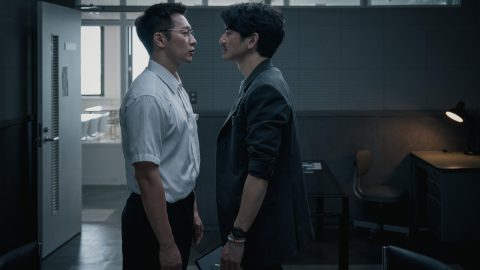
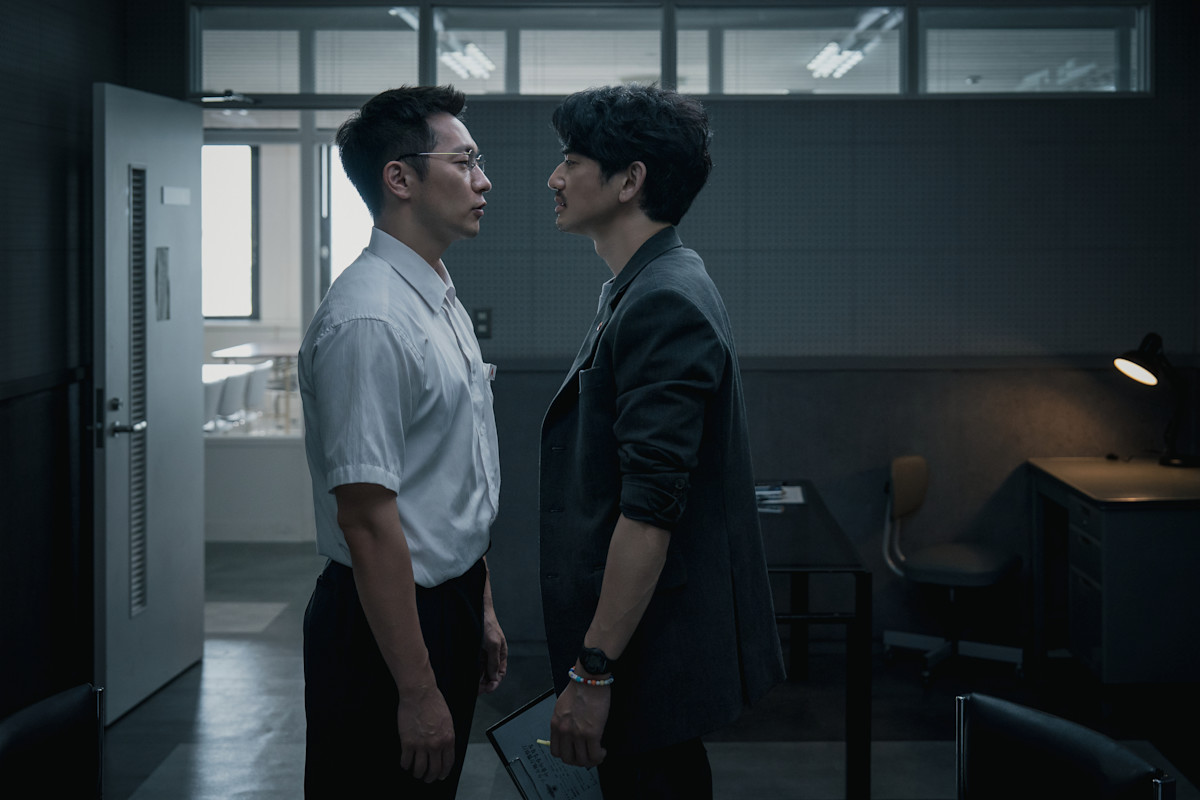
The series is set in 2002, appropriately, against the backdrop of the World Cup co-hosted by South Korea and Japan. It’s a time which brings out the historic animosity between the two nations on a casual level, and in the case of The Blue Road, between its two co-leads. Opposite Eita as Detective Inose is the stoic Detective Kim Seok (Son Sukku), who joins the case due to similar serial murders happening in South Korea as in Japan. The ensuing barbs are delightful, as each detective continually code-switches (or language-switches) in the same conversation (with a lot of early gags around their asymmetrical understanding of Korean and Japanese). This continues through scenes where they beat up gangsters with flair (Kim gets applause from bystanders for his surprising high kicks, to Inose’s annoyance), or where Inose wears a Japanese football shirt to the Korean police station in a playful act of provocation. Detective Kim gets the slightly less glamorous role of the two, as a literally buttoned-up (he always wears polos or shirts up to the neck) foil to Inose’s easygoing charm. This doesn’t mean he isn’t ready with some incisive one-liners of his own, and it’s clear that the two actors complement each other well as they bicker and come to understand each other.
Picture Credit: Netflix
Such playfulness may seem out of sorts with the dark crime procedural around which this banter is structured, but the whimsy combined with the gruesome and ornate murder scenes recalled NBC’s Hannibal in places, even if the psychological depth to the investigation is so far a bit more shallow in The Blue Road. (The Hannibal connections seem to deepen as the show goes on, with concerns of the killer connecting their victims to works of art and also hiding in plain sight).
As the buddy cop antics continue, The Blue Road gives something of a provocative and thoughtful edge to the developing relationship between Inose and Kim, playing off of historical tension and persecution. Beyond the police department in Japan, Kim is often referred to by randomers with anti-Korean slurs, while the case itself also ends up exploring the more blurry line of nationality with some interviewees in the case being “Zainichi”, ethnic Koreans who became Japanese citizens during the Japanese occupation of Korea. The case itself also follows a sadistic murderer obsessed with the iconography of the Imjin War, which refers to two Japanese invasions of Korea. The interest in these sociopolitical tensions is part of what helps to hold the different sides of The Blue Road together, and it will be interesting to see how this develops further throughout the rest of the show – especially with its surprisingly quick closing in on the identity of the killer. On paper it’s a show that shouldn’t work, and maybe it ultimately won’t, but it doesn’t feel mindless in any of its disparate endeavours.
MVP of The Blue Road
The cast of The Blue Road is a delight all around – a gaggle of bureaucrats and cops of varying tempers and competence – but it’s Nagayama Eita who stands out as Detective Inose, who plays off the rather classical role of “unconventional, rule-breaking detective” with a casual charm. The usual hallmarks are there: slovenly habits hiding a sharp wit and sense of righteousness, a personal life falling apart despite a dedication to the job, but these are all downplayed perfectly. He’s also a fantastic counterpart to Son Sukku, especially as the two characters soften to one another.
Verdict
The Blue Road feels like a rather distinct clash of highbrow crime thriller with slightly lower-brow buddy cop antics, but the disparate tones from scene to scene somehow hold together through the strength of its visual construction and the performances of all involved. It’s too early to tell if the actual murder mystery across South Korea and Japan will turn out as well as the rest has so far, but it’s compelling nonetheless.
The Blue Road, a Netflix limited series, premieres globally on November 20th, 2026.