Picture Credit: Netflix
Stephen Surjik is a director Netflix has counted on for years. Surjik has directed episodes of Daredevil, The Witcher, The Punisher, Luke Cage, and a show he clearly has great fondness for, The Umbrella Academy. He delivers consistency and quality for the streamer, making fantastical worlds more relatable and tangible.
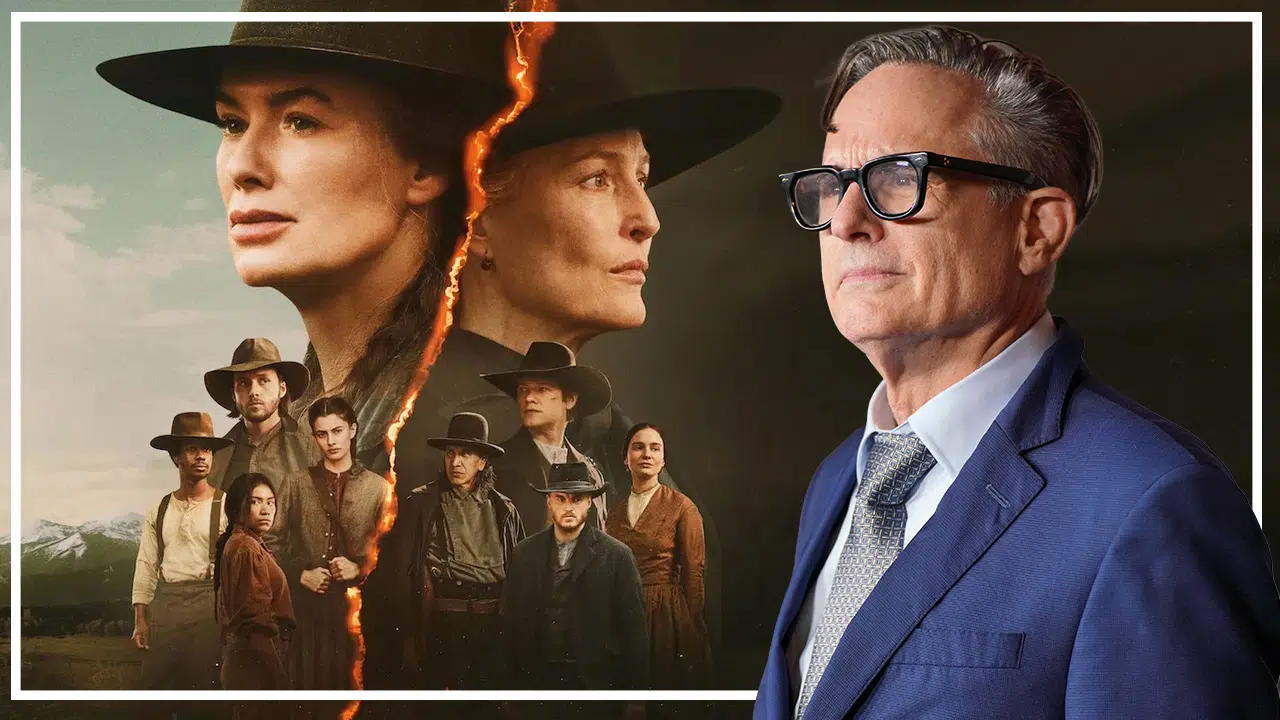
Surjik’s latest work for Netflix is a little more grounded — The Abandons. The Kurt Sutter–created Western stars Gillian Anderson and Lena Headey as two family heads battling over land. Surjik directed episode six of their journey, titled “Piety and Rage.”
Recently, the director — who also directed classic segments of The Kids in the Hall — spoke with What’s On Netflix about directing a Western and capturing the cruelty and reality of nature and the Old West.
How is shooting a Western in Alberta, Canada? What does that scenery give you?
First of all, the brutality of nature can’t be underestimated. It’s vicious. It’s deadly. You can freeze to death in the prairies and the mountains. When we were shooting in the Rockies, we were at altitude, and the temperature would change 70 or 80 degrees in a matter of two minutes because these winds would come over the top of the mountains, and they expand, which creates this weather pattern, which happens instantly. All of a sudden, it’s snowing out.
How does it affect the filming?
I believe that obstacles help define the characters in your drama. Those obstacles can come in the form of conflict between — they say — man versus man, man versus himself, man versus nature. Our showrunner, Kurt, kept talking about was how much he wanted us to establish these environments so that the audience would feel that nature was bearing down, that you could die from a toothache, that if you tripped off your horse, you would break your neck, you’d fall into the river and be swept away.
He didn’t have to really push too hard because it actually was that when we were there. We were using The Revenant’s location team to take us to the same places, so we shot in the same places where they shot The Revenant. The difference was that they were shooting one shot in a day, and we would have to shoot a couple of pages at least. It was really a challenge.
Does your eye also see the beauty in the cruelty, coldness, and danger of nature?
I embraced nature. The beauty, the splendor, the resplendent nature of it all is spectacular. And yet, you know any second that if you take the wrong step and you make the wrong move, it could be a fatal move. I think that has a bearing on the actors who are in the scenes there.
We had a boot camp where all the actors came and learned how to ride a horse, shoot a gun, roll in the dirt — all of that. It was well maintained, safe, but it’s dangerous to ride a horse. There are all these insurance restrictions, but just the simple fact of riding a horse was a huge deal.
At any rate, Kurt used to come out and he’d look at the town we were building, and he would say, “Well, there have to be more obstacles. There should be a hole in the ground. There should be a tree that’s fallen over that they can’t get the wagon by.”
My father actually lived in Alberta, and I used to visit him. I still have an Alberta driver’s license. I used to say to my co-producers, “You guys have no idea what we’re going into. This is going to be really challenging physically.” “What do you mean?”
Well, when we landed, it was 42 below zero. It was a total whiteout. We couldn’t even find our hotel in Calgary. We went out to do a scout — it was just white. All the windows just showed white. We had to go back again, wait around for a couple of days, come back again, and do it again.
Did you shoot in the Badlands at all for The Abandons?
The Badlands are just breathtaking. Even in my time off, I would jump in my car, drive an hour and a half, get to the Badlands, and go hiking and wandering around. There’s so much history in the Badlands. There’s like 300 million years of dinosaurs buried there.
I used to scout the Badlands until there was nothing left to scout. And then I would go — and I didn’t even shoot anything there of my own on my episode — but I would go out with the other directors who were shooting there. I would help them shoot things there. I’d shoot little pieces. I would wander around, but I couldn’t get away from it. The Badlands were the best.

Picture Credit: Netflix
Where does some of your prep begin for visualizing a show like The Abandons?
As an EP, what I had to do was understudy all of the episodes. I joined prep and studied and storyboarded every single shot of the pilot. And then I would do the same thing for episode one, episode two, and episode three. At episode three, I stopped because we were shooting and there were too many other fires going on, but I understood the show by then.
Then I have to sit on set and watch those directors shoot something. It’s unusual, but it’s a very educational thing for me. I really learned a lot from it because everybody has their own way of doing things, but I have a strict protocol for the way I work.
I don’t know if this falls under that strict protocol, but you’ve said before that when reading scripts, it’s all about character and situations that inform you as a director.
Exactly.
How did the characters and situations in The Abandons influence some of your choices?
When I read a script, I look for the scenes that I connect to. I wonder, why am I connected to that scene? Why is it that I feel that scene? There are a lot of scenes where you’re going to do a good job and try your very best and give 110 percent, but the scenes you connect to are usually because you’ve experienced something similar.
In this case, I always see that when I do my best work, it’s because I’m able to relate to a character’s behavior in a way that helps inform that character or the vibe of that scene.
So, in this particular episode six, I’m fortunate because — even when I was doing The Umbrella Academy, I started by doing episodes six and seven. And that’s usually the point when things start to really work on a show. It can be a little earlier, it can be a little later, but it’s usually around there. It’s often where the plot comes into conflict with the characters, and you get a lot of narrative movement.
What’s a moment that really brings it all together for you in episode six of The Abandons?
In this case, we had a young man, Garrett (Lucas Till), who was the son of Constance, and he was trying to help his family continue their legacy. He was struggling with that, and he was being rejected by his mother. His mother was a control freak. Constance kept putting him down.
As we were shooting that, I would track him and talk to him off camera. I wasn’t directing him at that point. I was talking to him about where we were going, because when we got to episode six, I knew he was going to start taking control.
I think a lot of young men and young women experience a time when they’re taken care of for most of their lives, and then they realize they have to step up and start taking care of their parents for the legacy of their family. It’s a difficult transition for everyone. The parents have to let go. The individual has to really toughen up.
I had just gone through that, and I thought I could at least recognize authenticity and help him with his path. So when Garrett got to that place where he would say, “Hey, Mom, I got an idea,” suddenly he was just doing it. It was violent and nasty, but it was the only way he could continue the legacy of his family and protect his parents.
I love that because I could relate to it — not that I’ve ever been violent in that way — but it was something I understood. Hopefully, it also becomes real for those who haven’t been in that situation.

The Abandons. Gillian Anderson as Constance Van Ness in Episode 106 of The Abandons. Cr. Michelle Faye/Netflix 2024 ©
When you see Lena Headey and Gillian Anderson acting, or speak with them about what’s motivating them, how does that influence your work?
Actors often understand the character better than the writers. I mean, that’s always an argument. Writers and actors are always having an uneasy debate about who the character is and how they should behave.
As a director, I don’t have as much authority as the writer. What I’m good at is working with an actor’s strengths to get the best of them on screen. It’s closer to being a coach in baseball than a medicine man, if you know what I mean. They’re the keepers of the character in series television. The bottom line is, they’re usually right. Their instincts are usually right.
You’ve directed several projects for Netflix, including Luke Cage and The Umbrella Academy. You get to work in very distinct worlds and styles. What’s most fulfilling about making those transitions?
It’s a question I ask myself a lot. I’m not just telling you this — it’s something I struggle with because “branding” is a big word in our culture. If I only did action comedy, I’d probably be doing action comedies, big features, all the time. It would be clearly defined, and people would know exactly what to do with me.
The fact that I’ve worked in horror, geometric comedy, broad comedy, action thrillers, and Marvel shows can be like a dog’s breakfast and confuse producers. But I actually like it. You get to start from scratch and ask: What does this world mean? What is this universe made of? What do we need to put into it? And here’s the real secret — and I’m probably going to Hell for saying this — but I think they’re largely the same.
How so?
Most of the metrics you have to watch in whatever universe you’re building have to support the characters in a way that makes them real and relatable to the audience. Now, in comedy, maybe you can’t use longer lenses because foreground compression can mess up a joke.
But other than that, every genre has its own small set of rules. Fundamentally, the actors have to be believable. They have to believe what they’re doing. They have to be committed and exist in a world that feels native to who they are. If you can follow those metrics, I think you can jump genres successfully.
 Rating: TV-MA