Pictures via Empire Online
Our first look at Greta Gerwig’s self-proclaimed ‘rock ‘n’ roll’ Narnia adaptation is here, and plenty of thoughts are being thrown around the internet. In this article, we uncover the good about it, the bad, and everything in-between
The Chronicles of Narnia by C.S. Lewis is one of the best-loved fantasy series of all time. For millions, Narnia has proven to be a warm and welcoming fantasy world, one that gives comfort and a cozy feeling — and embodies Lewis’ belief that imagination has zero boundaries. We’ve seen that vibe infused into adaptations over the years, from the BBC’s live-action TV adaptation that ran from the late ’80s into the ’90s, to the seminal movies that began with The Lion, the Witch, and the Wardrobe in 2005. The next adaptation comes from Greta Gerwig, the filmmaker behind such fan-favourites as Barbie (2023) and Little Women (2019). For so long, it remained to be seen how Gerwig would incorporate her distinct signature style into Narnia, but in a recent preview from Empire Magazine, it’s clear that her unique creative lens has encapsulated the project from the ground up, resulting in a glam-rock-inspired Narnia unlike anything we’ve ever seen.
Greta Gerwig’s Narnia is distinct from the outset. Unlike previous adaptations, which begin with adapting the first published novel The Lion, The Witch, and the Wardrobe (1950), her vision begins with The Magician’s Nephew (1955), the penultimate novel published but the first chronologically. This creative move allows her to not only establish the creation of Narnia in the first movie, but also introduce an origin story for Jadis, aka the White Witch, who begins the sequel as the villain.
Narnia: The Magician’s Nephew is not an ardently faithful adaptation of the original novel, however. Perhaps most of all, it shifts the timeline by over half a century, which completely alters how the rest of the franchise will develop. For instance, when the movies reach The Lion, The Witch, and The Wardrobe, the Pevensie children will not be World War Two evacuees; rather, their story will likely begin in the late 1990s to early 2000s, inherently changing how their story unfolds.
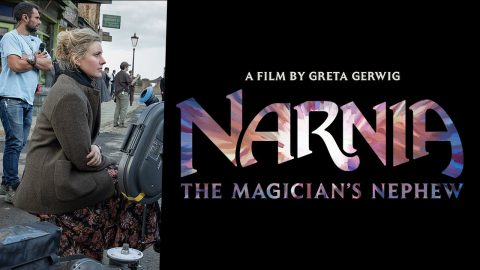
Of course, story alterations are one thing, but Gerwig is giving Narnia a visual makeover through her creative lens, which is a world away from the visual palette we’ve seen in other adaptations. “I wanted a rock opera,” she told Empire Magazine. “I wanted it to be big and transporting.”
While this might sound like the movie is a musical, it is not. However, it is a movie that takes heavy inspiration from music of the period the timeline has shifted to. “David Bowie saved my life. Paul McCartney saved my life. David Gilmour saved my life. Pete Townshend saved my life. Jimmy Page, Robert Plant,” she explained. “When I heard their music, I had this deep sense of [thinking], ‘You’re gonna be okay.’” And so that influence has been heavily baked into the creation of Narnia. “Narnia is literally a world made out of music. It is a world sung to life by Aslan, and rock ’n’ roll to me felt like a world made out of music.”
How does the new Narnia look through Greta Gerwig’s rock ‘n’ roll vision?
Our first look at Narnia: The Magician’s Nephew gives us a glimpse of Narnia as we’ve never seen it before — and incidentally, it appears to not be a preview of Narnia, or even Earth, but the world of Charn. The preview image shows Jadis (Emma Mackey) front and centre, and by her side are David McKenna as Digory Kirke and Beatrice Campbell as Polly Plummer.
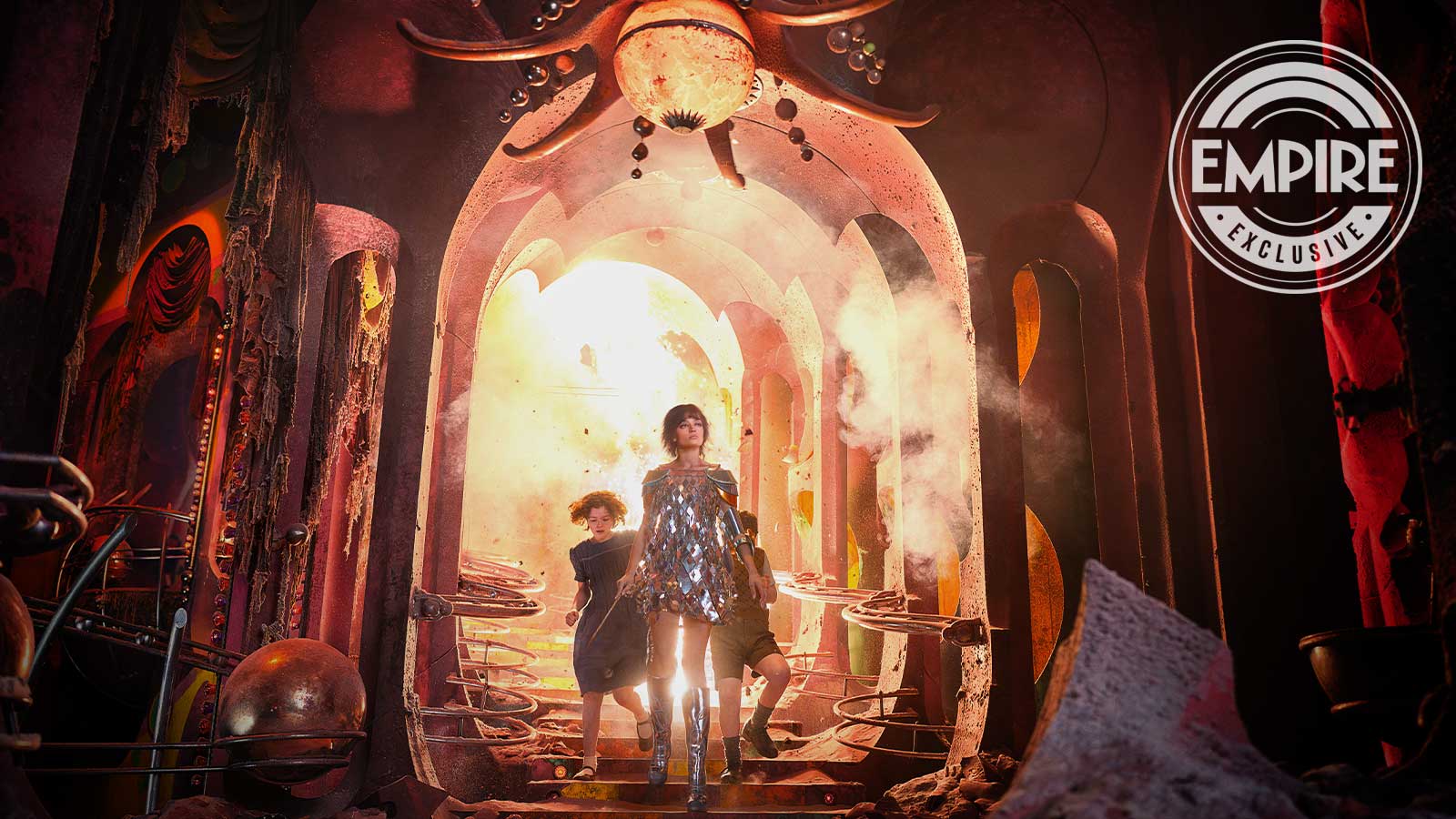
The world of Charn has never been shown in any live-action Narnia adaptation before. The world is the home of Jadis, who goes on to become the White Witch in Narnia. When Digory and Polly arrive in Charn, it is a desolate and destroyed city, glowing reddish from a deep red sun. That’s presumably the world we’re seeing in the first-look image above. How does it compare to the original novel? Below is an original illustration of Charn from Pauline Baynes.
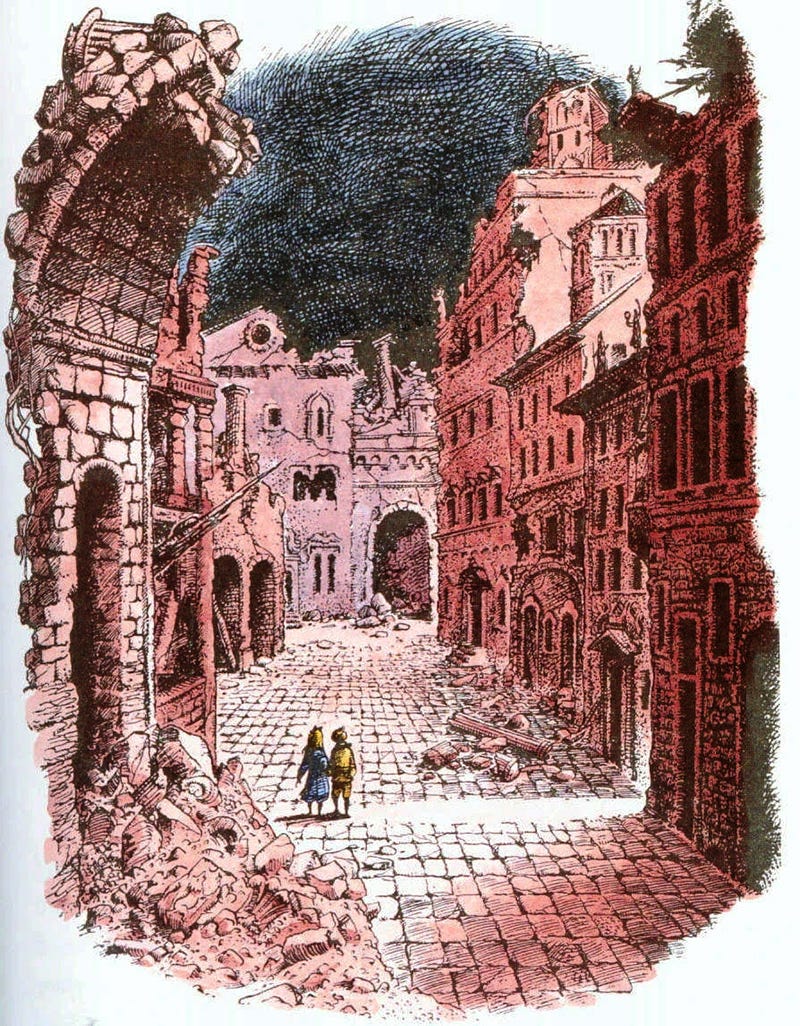
Charn from ‘The Magician’s Nephew’ | Illustrated by Pauline Baynes
Jadis has an all-new style in The Magician’s Nephew
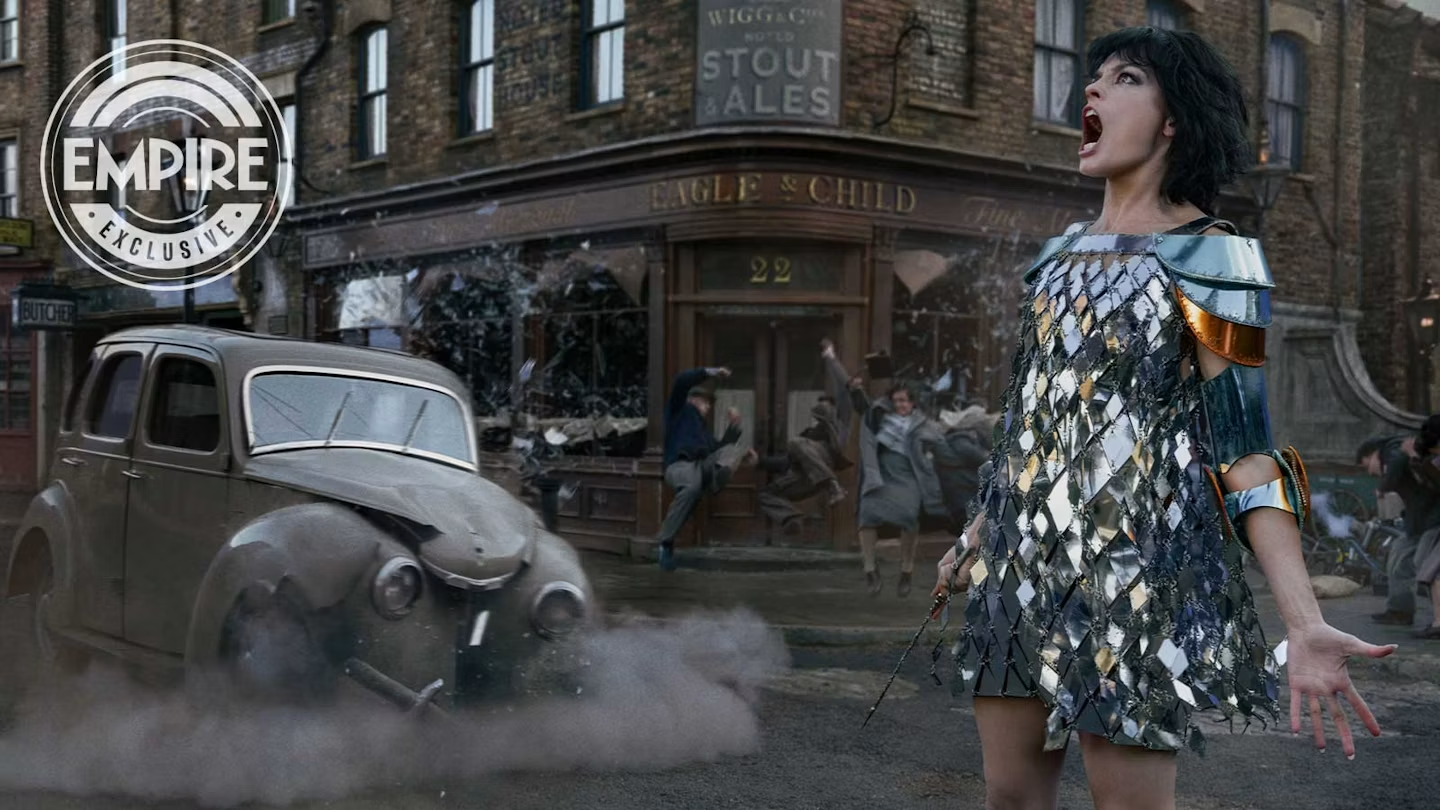
As we see in the first preview above, it’s impossible not to notice the disco-inspired, glam-rock dress that Jadis is wearing, which serves as a striking visual difference to the Jadis as illustrated by Pauline Baynes, who at that point is clad in regal attire with a golden crown. So far, this costume is the biggest and most striking example of the glam-rock influence that Greta Gerwig has infused into the movie.
Of course, we’ve already gotten a first look at her costume throughout production, with numerous set snaps released, albeit mainly featuring a stunt double in the outfit.
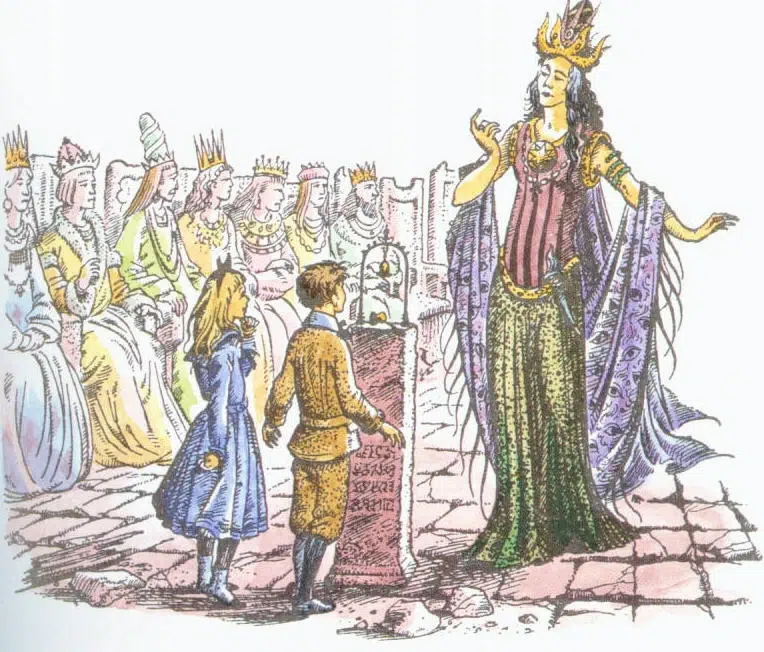
Jadis in ‘The Magician’s Nephew’ | Illustrated by Pauline Baynes
First look at Daniel Craig as Uncle Andrew Ketterley
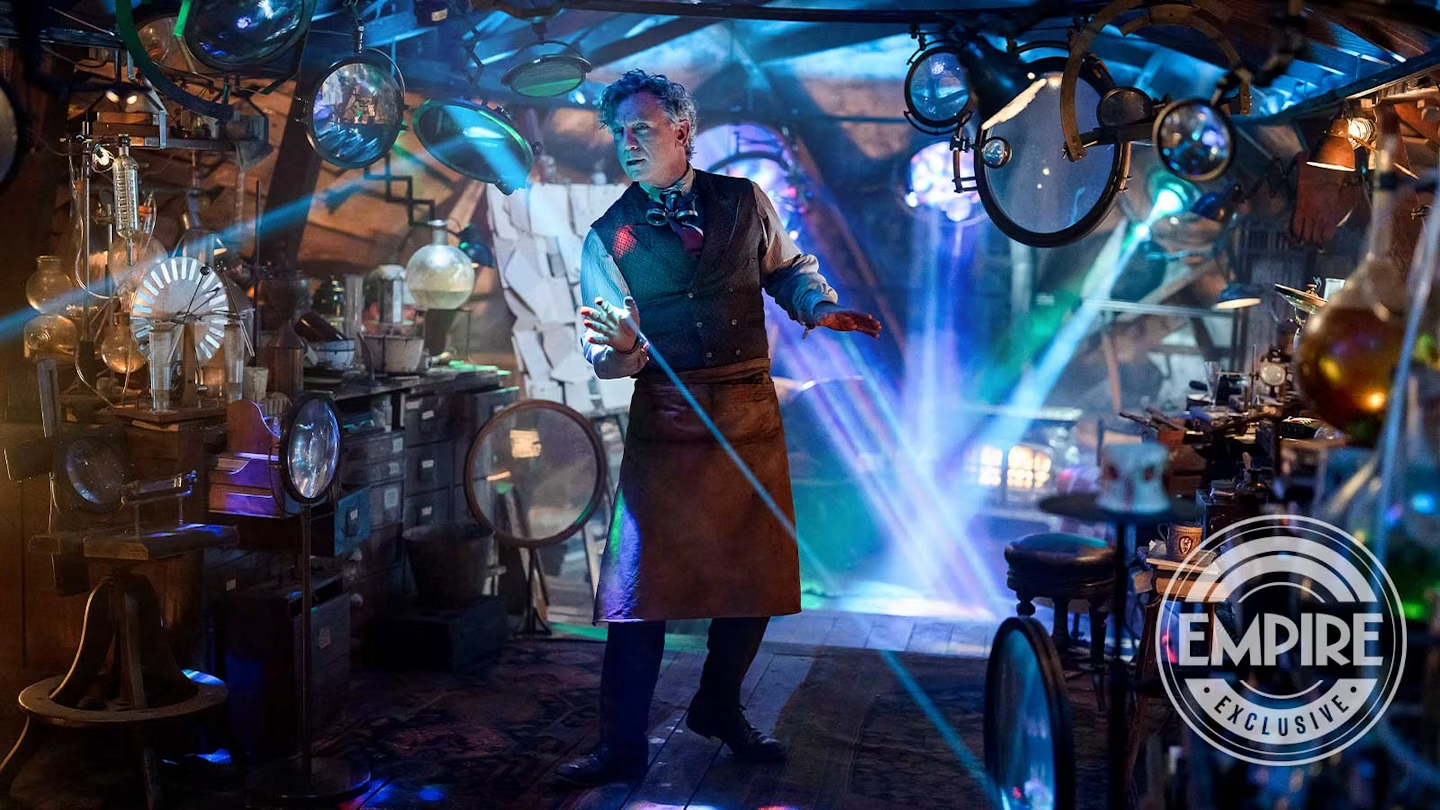
Legendary James Bond star Daniel Craig plays sorcerer Uncle Andrew Ketterley in the movie, a role Craig tells Empire is the “stupidest magician in the world who actually made magic.” In the movie, his office has a steampunk aesthetic. Compared to the way he’s described in the novel — tall, thin, with a mop of grey hair — Craig appears to look almost perfect.
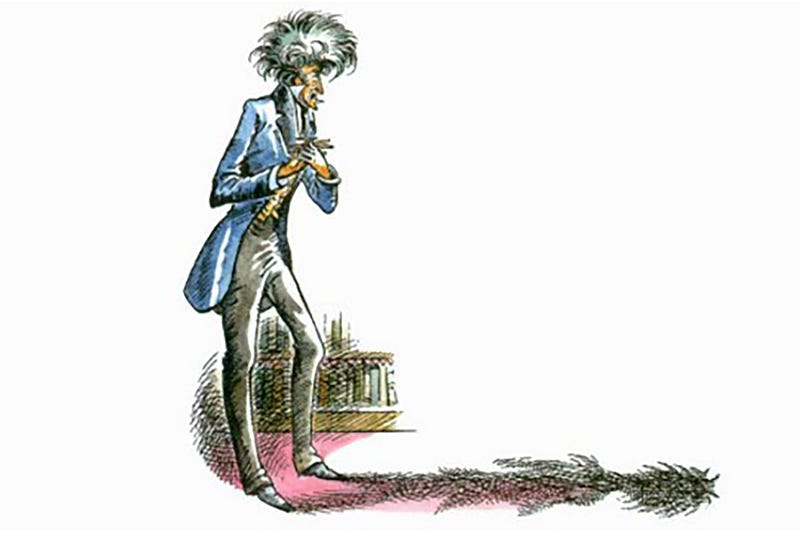
Uncle Andrew from ‘The Magician’s Nephew’ | Illustrated by Pauline Baynes
How does C.S. Lewis describe the creation of Narnia — And does it fit Greta Gerwig’s vision?
When fans of Narnia first beheld the preview image of Narnia, there was some backlash and hostility towards it. The overwhelming initial response was — and we’re paraphrasing — that’s not the vibe we expected! So in The Magician’s Nephew, how does C.S. Lewis himself describe the creation of Narnia? Well, we can split its creation into two distinct phases: a slow, quiet build, and a loud creation.
Lewis’s description of Narnia’s creation begins with descriptions of “no words” and “hardly even a tune,” which feels more like a siren song, contrasting Gerwig’s rock ‘n’ roll vision. This is mentioned in an excerpt taken from the novel, which you can read below:
“A voice had begun to sing. It was very far away and Digory found it hard to decide from what direction it was coming. Sometimes it seemed to come from all directions at once. Sometimes he almost thought it was coming out of the earth beneath them. Its lower notes were deep enough to be the voice of the earth herself. There were no words. There was hardly even a tune. But it was, beyond comparison, the most beautiful noise he had ever heard. It was so beautiful he could hardly bear it.”
But then, as Narnia bursts into life, Gerwig’s vision comes into its own. It could easily feel rock-inspired. Narnia entered its next phase of creation, and as Lewis wrote, “Now the song had once more changed. It was more like what we should call a tune, but it was also far wilder. It made you want to run and jump and climb.”
Reading that last excerpt, it’s easy to visualise how the idea of creation through rock ‘n’ roll of the ‘60s and ‘70s, particularly the glam scene, could fit into Narnia. It becomes a product of the era it is set. There’s an overwhelming sense that Gerwig takes the most inspiration from David Bowie and Jim Henson’s fantasy Labyrinth (1986). It’s a vibrant fantasy world built on glam rock. However, many fans have argued that Narnia didn’t need to be shifted or altered to fit that style and aesthetic, and that the IP didn’t need this treatment. That said, this vision has almost become a standard for fantasy nowadays — look no further than Wicked. This isn’t a criticism of the modern-day fantasy landscape, but an observation of the style that draws big audiences, and the demographic that Narnia will be targeting.
How have fans reacted to the first look at Narnia: The Magician’s Nephew?
Naturally, myriad people on social media have shared their reactions to the first look at Narnia: some love it, some are skeptical, and others aren’t enthused about the changes and tone. Below are a few reactions from across the board.
As a Narnia fan of 21 years, this is such a downgrade from the book and CS Lewis is rolling in his grave. Imagine if we’d had a book accurate Jadis instead of…whatever Greta Gerwig did. Her design in the Magician’s Nephew book is so beautiful and didn’t need to be changed. https://t.co/0O3a9hVLp8 pic.twitter.com/BPhPKGejio
— megs MET JOSEPH QUINN X2 (@fredhechinger) September 17, 2026
Honestly, digging what she’s saying about making Narnia a rock opera. It’s unique. https://t.co/xB7WIPZHob
— Richard Newby (@RichardLNewby3) September 17, 2026
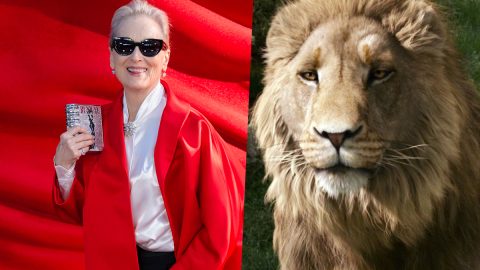
I’m not the biggest Narnia fan anyway (other than the original movie) but I had a bit of a visceral ‘ew’ reaction to this image. I don’t care about Aslan being voiced by Meryl Streep in the slightest but the vibe here is so far from Narnia. https://t.co/gKrle2jJhx
— Jack | (@TallShepherd) September 17, 2026
Honestly a fantasy rock opera where the world is “made out of music” and “sung to life” with rock ’n’ roll sounds like such an intriguing idea and would probably slap so hard… but it’s not Narnia. That’s never been Narnia, even if you choose to ignore the Christian allegory. https://t.co/65QuLcFtGe
— megs MET JOSEPH QUINN X2 (@fredhechinger) September 17, 2026
If nothing else, we commend Greta Gerwig’s ambition for a next-generation vision of Narnia. Whether it lands with viewers remains to be seen. Narnia: The Magician’s Nephew lands in theatres on February 12, 2027 before streaming on Netflix on April 2, 2027.