


Picture Credits: Netflix
You might have seen some articles floating around over the past few weeks claiming that we finally have proof: “Long waits between seasons are killing TV viewership!” but does the data line up with that?
These articles are based on a US study by the data firm Luminate (which you can read here if you really want to). As usual with Luminate, they tend to mix apples and oranges to draw connections between things that have very little to do with each other. But I digress—it does give us a great starting point to dive into the data and see if this claim is actually true.
This is an English version of this entry from the email newsletter Netflix and Chiffres – see the original French version here.
Preamble: No show actually “gains” viewers.
Let’s start by stating the obvious: no TV show actually gains viewers as it goes on. I’ve already beaten this topic to death in a previous article about Netflix Season 2 viewership, which makes a great companion piece to this one.
Why do I say this? Because in the streaming era, nobody discovers a show by starting at Season 2, Episode 3. When you click on a show on Netflix, you inevitably start at Season 1, Episode 1. Thirty or forty years ago on traditional broadcast TV, you could stumble into the middle of a show, but not anymore. We all start at Season 1, Episode 1, which means it will always be the most-watched episode of any streaming series.
The illusion of an audience increasing simply comes down to the viewing window. If I show you a graph of the first 4 days of viewership for the three seasons of Squid Game, you might say: “Season 3 did better than Season 2, which did better than Season 1! Squid Game gained viewers every season!”
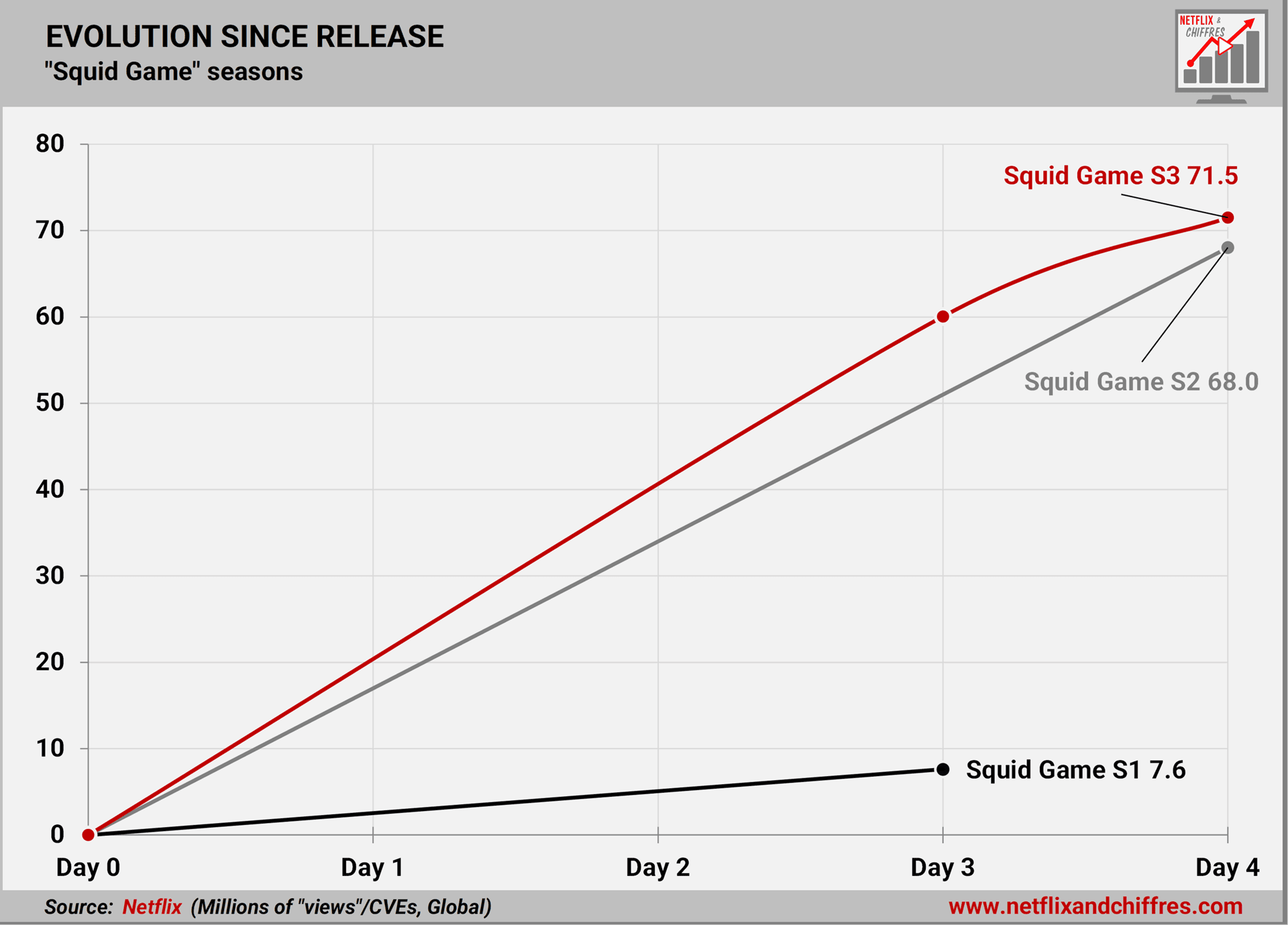
But if we zoom out to the first 91 days, the reality sets in: Squid Game Season 1 has vastly more views than Season 2, which has more than Season 3. There was a steep drop-off between S1 and S2, and a slightly softer drop between S2 and S3.

The only thing that actually “increased” was the hype. Fan appetite during those first few premiere days grew stronger with every season, but over the long haul, the most-watched episode of Squid Game is—and always will be—the pilot.
People make this same analytical mistake with weekly releases, too. Look at the recent HBO Max series Lanterns. Articles bragged that it “peaked” at Episode 3 with 10 million viewers. How did they pull off that miracle? The answer is buried in the fine print: Episode 1 had actually hit 20 million viewers since its premiere. Episode 3 just happened to gather its 10 million viewers in a tighter, newly measured timeframe. But going from 20 million on Ep 1 to 10 million on Ep 3 still equals a 50% audience erosion.
Whether you wait a week or two years, there will always be audience decay—both inside a single season and between multiple seasons.
Need more proof? Just look at Netflix’s Engagement Reports for finished shows where every season is already available. A wait time of zero weeks between seasons should mean zero viewer loss, right? Wrong. Heavy hitters like House of Cards, Orange is the New Black, 13 Reasons Why, and Unbreakable Kimmy Schmidt all shed millions of viewers season after season, despite the “Next Episode” button being just one click away.

It makes total sense: Season 1, Episode 1 is the entry door. Every single minute that passes after that is a potential exit door. We all have shows sitting half-finished in our watchlists. It happens.
So, setting Luminate’s theory aside for a moment, let’s look at the real underlying question:
Why do viewers stick around or bail on a show?
The main thing that bugs me about the Luminate study is that it points the finger at the wait time between seasons as the main culprit for audience decline. But if people are abandoning a show, the real culprit is usually staring us right in the face: The actual quality of the show.
If a show like The Pitt manages to retain its audience brilliantly, it isn’t just because it airs weekly. It’s mostly because it’s a genuinely great show that keeps its viewers hooked so they eagerly return for the next season. A shorter wait time definitely helps soften the drop-off, but the quality of the show is the real driving factor. Strangely, “quality” is rarely discussed by data analysts when talking about viewership decay. Why? Because quality is incredibly hard to measure on a spreadsheet.
How to measure quality and drop-off
Difficult doesn’t mean impossible, and that’s precisely what I decided to examine in my study on the subject: does the quality (or lack thereof) of a series have a greater impact on audience decline than the time between seasons? To answer this, we would need access to several data points that we don’t currently have, such as viewer satisfaction rates and episode-by-episode decline rates. Therefore, I had to find a suitable methodology, which remains imperfect, and which I will now explain:
- I used IMDb.com because it’s the largest public movie and TV rating site, especially since TV Time shut down. It’s global, although it also has biases that are hard to ignore, such as ratings that fluctuate significantly when a certain segment of users detect ” wokism .” The site also seems to over-index Indian users, so it’s not necessarily representative of the entire world, but you have to start somewhere.
- To determine the rate of erosion, I compared, for each season of the series studied, the difference in the number of ratings on the site between episode 1 of a season and episode 3. I estimate that if people drop a series, it is mainly between episode 1 and 3, but here too, it is necessarily imperfect.
- I also tried to determine which seasons provide a satisfying conclusion for viewers by comparing the average ratings of the first three episodes and the last three episodes of the season. If the season ends with a declining average rating, as casual viewers have lost interest and only the most dedicated fans remain, it’s reasonable to assume that not all of them will return for the following season. Conversely, if the average rating of the last three episodes is higher than the average of the first three episodes, it’s reasonable to assume that the fans who stayed are satisfied and will return for the next season’s premiere.
- I also took into account the overall average of these two sets of episodes (a series that goes from 6.5 to 7.5 is not quite the same as a series that goes from 8.5 to 9.5, even if the difference between the two averages is the same). This allowed me to obtain, using various formulas, a viewer satisfaction index based on the viewers who took the time to rate the episodes on IMDb.
- Next, I obviously took into account the weeks between the releases of the different seasons, and for the impact on viewership, I only looked at the viewership in millions of EVCs for the first few days (between 3 and 5) of each season. In the long term, everything evens out, as in the Squid Game example , but the viewership for the first few days is really what shows whether the fans have returned or not.
Season quality, erosion rate, audiences, and waiting time- these are the 4 measures that I will try to put into interaction in the following section.
From Season 1 to Season 2


Using my IMDb quality/retention metrics, I sorted about 30 recent Netflix series into four buckets:
- The Elite: High quality, high audience retention.
- The Comfort Traps: Lower quality, but high retention (easy binge-watching).
- The Polarizing Shows: High quality, but poor retention (niche appeal).
- The Danger Zone: Poor quality, poor retention.
When we map these shows against how long fans had to wait for Season 2 and how viewership changed, a clear picture emerges.
The biggest audience crashes happened to shows that started out in the Danger Zone or were Polarizing. Almost all the Elite shows saw great numbers for Season 2.
The one outlier? Beef Season 2. But the explanation is simple: it’s an anthology. Season 2 asked fans to return for a completely new concept without the characters they fell in love with in Season 1, which naturally led to a drop.
Avatar: The Last Airbender and One Piece are fascinating case studies in fandoms. Big, established IPs are a double-edged sword. If fans feel the adaptation missed the mark (Avatar), the S2 drop-off is severe. If it’s a hit (One Piece), the core fans show up in full force for S2, even if the mainstream “curiosity” viewers from Season 1 have moved on.
The absolute GOAT here is Squid Game. It had the longest wait time between its first two seasons, yet had the biggest surge in opening-weekend viewership. For a massive hit, a long wait actually built the hype.
Also, look at three recent comedies: Nobody Wants This, Running Point, and The 4 Seasons. All three dropped their second seasons about a year after their first. Their S2 viewership directly perfectly mirrors their S1 IMDb quality scores. The best-reviewed show held its audience; the worst-reviewed show lost them.
From Season 2 to Season 3


By the time you hit Season 3, the casual viewers are gone. You are left with the core fans.
Fans aren’t necessarily more forgiving about bad writing, but they are more loyal, which naturally bumps up the average retention rate.
- Bridgerton showed exceptional audience retention going into Season 3.
- However, shows like My Life With the Walter Boys, The Lincoln Lawyer, and XO, Kitty saw audience drops.
- The Lincoln Lawyer is a great example here: it suffered heavily from a mediocre reception to its second season. The wait time between S1->S2 and S2->S3 was the same, but the audience didn’t show up for S3 because S2 burned them.
Beauty in Black is a rare exception where a super-fast release strategy (splitting seasons into parts just months apart) worked wonders. But even then, its massive S3 viewership bump was likely because fans genuinely felt the quality of S2 was a huge step up from S1.
From Season 3 to Season 4


Let’s stick with The Lincoln Lawyer. After a rough Season 2, the fans who stuck around actually loved Season 3. The show bounced right back out of the “Danger Zone” and into the “Elite” tier for quality.
The result? A massive viewership spike for the Season 4 premiere, even though the wait time was essentially exactly the same as previous seasons. This proves that perceived quality matters way more than the release schedule.
Elsewhere:
- The Witcher S4 took a massive hit at launch, largely due to recasting Henry Cavill.
- Outer Banks S4 dropped because the first three seasons formed a complete, satisfying story arc. When S4 tried to start a new storyline, a lot of fans (myself included) just chose not to board the ship again.
- Meanwhile, Virgin River, Emily in Paris, and Bridgerton seem completely immune to audience decay.
From Season 4 to Season 5


Once you get this deep into a show’s lifespan, there are fewer examples to pull from.
- Stranger Things naturally sits in the Elite zone. Its massive waits between seasons only build the hype.
- Outer Banks saw a sharp quality drop in S4 (thanks to a highly divisive character death), which resulted in viewership bleeding.
- Shows with poorly received seasons—like the final season of You, Outer Banks, and Sweet Magnolias (which was subsequently canceled)—saw sharp declines.
- Emily in Paris remains an anomaly, fluctuating wildly regardless of its review scores or the wait times between seasons.
Conclusion
So, does a long wait between seasons kill a streaming show? Looking at the data, the answer is: Yes, but not in the way you think.
There is no simple rule that says “Longer Wait = Fewer Viewers.” We have shows that took 3 years off and returned to record-breaking numbers, and shows that returned in 12 months and completely faceplanted.
However, wait time absolutely acts as a trend multiplier:
- For “Event” Shows: A long wait is a weapon. It creates scarcity. People don’t forget Stranger Things, Squid Game, or Wednesday. The delay turns the new season into a massive cultural event.
- For “Everyday” Shows: For middle-of-the-road shows with average reviews, a wait longer than 18 months is usually fatal. The delay acts as a slow poison. People don’t hate these shows; they just literally forget they exist. If they return in under 18 months while maintaining their quality, they usually survive. (This is likely why Netflix often greenlights back-to-back seasons of certain shows, just to get them out faster).
- For Shows in Crisis: If a show had a poorly received season, lost a main actor, or is an anthology, a long wait time is the final nail in the coffin. It might not be the only reason the show dies, but it severely accelerates the crash.
Ultimately, comparing a massive IP like One Piece to a brand-new medical drama like The Pitt is too simplistic.
Time doesn’t kill TV shows. Time only kills the shows that failed to create a strong enough emotional connection to survive being forgotten. For the truly great shows, time is the best tool available to turn a simple season premiere into a global phenomenon.